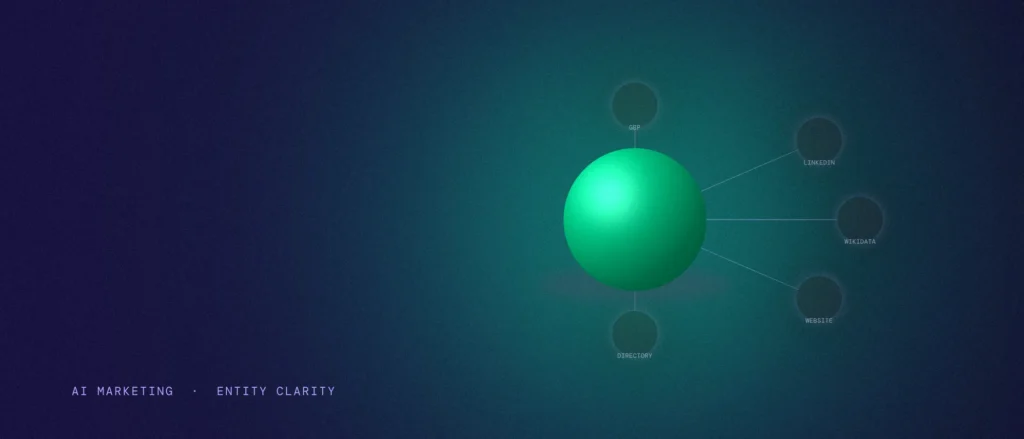
Ask ChatGPT or Google’s AI Overviews a question about a business, and the answer either names a specific company with confidence, or it hedges with vague, generic advice. What decides which one you get isn’t how well-written your website copy is. It’s whether the AI system can actually tell, with confidence, who you are, what you do, and that you’re a real, distinct thing, not just a page full of relevant-sounding words. That’s entity clarity, and it’s becoming one of the most important things a business’s online presence can get right.
Quick summary, if you’re short on time:
- An “entity” is a specific, identifiable thing, a business, a person, a place, that search engines and AI systems can recognise as distinct from every other similar thing.
- Entity clarity means there’s no ambiguity about who you are. AI systems can only cite what they can confidently attribute, and vague or inconsistent information gets ignored, not guessed at.
- Schema markup, especially the
sameAsproperty linking to Wikidata, your Google Business Profile, and other verified profiles, is how you build that clarity in a machine-readable way. - Consistency across every place your business appears online matters more than any single, perfectly-written page.
- This isn’t a replacement for good content. It’s the layer underneath that decides whether AI systems trust the content enough to actually use it.
Jump to a section:
- What “entity” actually means here
- Why AI answer engines care so much about this
- The schema property doing most of the work
- Why consistency matters more than any one page
- This isn’t a replacement for good content
- How to check your own entity clarity
- What this looks like in practice
- Using AI to audit your own entity clarity
- Questions worth answering directly
What “entity” actually means here
In this context, an entity is just a specific, real thing that can be told apart from every other similar thing. Your business is an entity. So is the founder. So is the physical location if you have one. The opposite of an entity is a vague reference, a page that talks about “a digital marketing agency in Bangalore” without ever clearly establishing which one, in a way a machine could confidently point to.
Google has organised search around entities like this for over a decade, through what it calls the Knowledge Graph, a structured map of specific people, places and things and how they relate to each other. AI answer engines lean on the same underlying idea: they can only confidently talk about things they can clearly identify, not things they’re guessing at from scattered, ambiguous text.
Why AI answer engines care so much about this
An AI system generating an answer has to decide, in effect, who it’s willing to name and cite. If your business is a clearly established entity, connected consistently across multiple trusted sources, an AI system has real signal to attribute a claim to you confidently. If you’re not, the safer move for that system is to describe things generically, or cite a competitor who is clearly established instead.
This is a genuine shift from how SEO used to work, sometimes called entity-based or entity-first SEO. Ranking well used to be mostly about relevant keywords and backlinks. Getting cited by an AI system is increasingly about whether the system can resolve you as a specific, verifiable entity in the first place, before it ever gets to judging whether your content is good.
The schema property doing most of the work
The specific piece of code that does the most for entity clarity is a schema property called sameAs. It sits in your Organization or LocalBusiness schema and points to other places on the internet where the same entity is already verified: your Google Business Profile, your LinkedIn company page, your Wikidata entry if you have one, and other authoritative profiles.
Wikidata is worth calling out specifically. It’s one of the most direct inputs into Google’s Knowledge Graph, and each entry gets a unique identifier, so linking to it gives search engines and AI systems an unambiguous, machine-readable bridge between your website and an already-established record of who you are. Not every business will have or need a Wikidata entry, worth considering once you have real press coverage, a Wikipedia mention, or another public footprint to point to, but for most small and mid-sized businesses, a consistent Google Business Profile, social profiles and schema already do most of the work.
Schema.org’s own definition of sameAs is plain: a URL of a reference page that unambiguously indicates the item’s identity. That framing matters: it’s not just another link on the page, it’s a machine-readable claim that says “this profile and this website describe the same real thing.”
A simple example, for a business with a claimed Google Business Profile and a LinkedIn page, might look like this in the site’s Organization schema:
{
  "@context": "https://schema.org",
  "@type": "Organization",
  "@id": "https://example.com/#organization",
  "name": "Example Business Name",
  "url": "https://example.com/",
  "logo": "https://example.com/logo.png",
  "sameAs": [
    "https://www.google.com/maps/place/example-gbp-listing",
    "https://www.linkedin.com/company/example-business"
  ]
}
Two smaller details worth getting right alongside sameAs: a stable @id, so every page on the site references the same underlying entity rather than accidentally creating duplicates, and mainEntityOfPage on key pages like your homepage or About page, which tells search and AI systems that page is the canonical representation of that entity.
Why consistency matters more than any one page
A single, beautifully written About page doesn’t establish entity clarity on its own. What actually builds it is the same core facts, your business name, what you do, where you’re based, appearing consistently across every place you’re mentioned online: your website, your Google Business Profile, your social profiles, directory listings, press mentions.
Inconsistency does real damage here. A business name spelled two different ways, an old address still showing on one directory, a different description on LinkedIn than on your homepage, all of it quietly makes it harder for a search engine or AI system to confirm that all these mentions are actually the same entity. Confidence and consistency have a direct relationship: the more consistently you appear, the more confidently a system can identify you.
This isn’t a replacement for good content
Entity clarity isn’t a shortcut around writing genuinely useful content. It’s the layer underneath that decides whether an AI system trusts the content enough to actually use it. A perfectly optimised, poorly written page still won’t get cited if nobody would want to read the answer it produced. A brilliant, deeply useful page attached to a business that’s ambiguous or inconsistent across the web is fighting an uphill battle it doesn’t need to fight.
Think of it as two separate jobs done well together, not one replacing the other: content earns the right to be cited, entity clarity gives the AI system the confidence to actually do it.
How to check your own entity clarity
Start by searching your own business name in Google. If a Knowledge Panel appears on the right side of the results, with your logo, description and key facts pulled together, that’s a strong sign Google has already resolved you as a clear entity. If nothing appears, or the panel shows outdated or wrong information, that’s your actual gap.
Next, check whether your site’s Organization schema actually includes a sameAs array, and whether it’s pointing to profiles that are genuinely still active and accurate. Then do a manual consistency pass: business name, description and key facts across your Google Business Profile, LinkedIn, and any major directories you’re listed on. Small mismatches you’d never notice as a human are exactly the kind of thing that quietly weakens machine confidence.
A practical way to run that pass: list out every place your business appears online, Google Business Profile, LinkedIn, Facebook, any directories or press mentions you know about, then check name, description, location and website URL match, or are at least clearly the same business, across every entry on that list.
What this looks like in practice
Picture two Bengaluru interior design firms with equally good websites and equally strong portfolios. One has a Google Business Profile with a slightly different business name than its website, no LinkedIn company page, and no schema markup connecting anything together. The other has matching name and details everywhere, a proper Organization schema with a sameAs array pointing to its verified profiles, and a Google Business Profile that’s clearly the same business as the one on its homepage.
Ask an AI system which firm to recommend for interior design in Bangalore, and the second one has a real structural advantage that has nothing to do with which portfolio looks better. It’s simply easier for the system to confidently confirm who it is.
Using AI to audit your own entity clarity
Working out which of your entity signals are actually missing or inconsistent, and which fix matters most, is exactly the kind of structured check a prompt handles well.
“Act as an entity SEO specialist helping me check my business’s entity clarity.
My current signals:
– Does a Google Knowledge Panel appear when you search my exact business name: [yes, accurate / yes, outdated / no panel]
– Do I have a claimed, active Google Business Profile: [yes / no / not sure]
– Do I have a LinkedIn company page, and does it match my website’s name and description: [yes, matches / yes, doesn’t match / no page]
– Does my site have Organization or LocalBusiness schema with a sameAs array: [yes / no / not sure]
– Any known inconsistencies in name, address or description across profiles I already know about: [describe them, or “none that I know of”]
– Do I have any press coverage, a Wikipedia mention, or public recognition beyond my own channels: [yes / no]Task:
1. Based on my answers, list the specific entity clarity gaps I actually have, not a generic checklist.
2. Tell me which single gap is most likely hurting me most, and why.
3. If I have real press coverage or public recognition, tell me whether pursuing a Wikidata entry is worth it now or premature.
4. Give me one concrete first step to fix this week.”
This is a reasoning aid, not a replacement for actually checking your own profiles and schema. It can’t see your real Knowledge Panel, GBP listing or schema markup, only what you describe. Answer honestly, including the gaps you’d rather not admit to, since those are usually the ones worth fixing first.
Questions worth answering directly
Do I need a Wikidata entry to have entity clarity?
No, it’s one strong signal among several, not a requirement. Consistent Organization schema, a claimed Google Business Profile, and matching details across your other profiles already do most of the work for most small and mid-sized businesses.
Is this the same thing as local SEO?
They overlap but aren’t identical. Local SEO focuses on ranking for location-based searches. Entity clarity is about being unambiguously identifiable at all, which supports local SEO but also matters for AI citations and general brand recognition beyond just local search.
How do I know if Google already recognises my business as an entity?
Search your business name directly. A Knowledge Panel appearing with accurate details is a strong sign. No panel, or one with outdated information, points to a real gap worth fixing.
Does entity clarity guarantee AI systems will cite me?
No. It removes one real barrier to being cited, but the content still has to be genuinely useful and relevant to the question being asked. Entity clarity earns you a fair chance to be considered, not an automatic mention.
What’s the single highest-impact fix if I’m starting from nothing?
Make sure your business name, description and key facts match exactly across your website, Google Business Profile and any social profiles, then add a proper Organization schema with a sameAs array linking them together. That consistency pass alone closes most of the gap for most businesses.
AI crawler access is a real prerequisite for any of this to matter. See our post on AI crawler access, and note that a consistent Google Business Profile is one of the entity signals covered above in practice.
Where this actually pays off
Entity clarity is quiet, unglamorous work, checking that the same facts appear the same way everywhere, adding schema markup nobody will ever see directly. But it’s exactly the kind of foundation that decides whether AI systems can confidently name you at all, before a single word of your actual content gets judged. This connects directly to the broader GEO picture, since being a clear, trusted entity is one of the base requirements for showing up in AI-generated answers at all.
Not sure whether AI systems can actually identify your business confidently, or whether inconsistent details across the web are quietly working against you? Share your site and we’ll check your entity signals properly, as part of every AI SEO and GEO engagement we run.