Ask around SEO circles and you will hear llms.txt described as the next robots.txt. Google has now answered the question directly. Its guide to generative AI features says Google Search does not use llms.txt, so adding one will neither help nor harm your rankings there.
That does not make the file useless. It is a real proposal, with real users in a few corners of the web. This post explains what an llms.txt file is, what Google says about it, who does use it, how to check whether your site already has one, and whether a small business should bother. We checked every Google and Chrome statement below against their own pages on 6 October 2026. Where something is our judgment, we say so. For the bigger picture of what does help in AI search, also called generative engine optimization, read our post on the three pillars of GEO.
Quick summary, if you’re short on time:
- llms.txt is a proposed markdown text file at the root of a website, meant to give AI agents a short, clean summary of the site with links to detail. Jeremy Howard published the proposal on 3 September 2024.
- Google’s guide to generative AI features (last updated 10 July 2026) says Google Search ignores llms.txt files. It says creating one for other systems that use them will neither harm nor help your visibility or rankings in Google Search.
- Chrome’s Lighthouse has an audit for the file. Providing it is described as optional at the moment, and a missing file is marked “not applicable”.
- If you use WordPress, check yourwebsite.com/llms.txt first. An SEO plugin may already have made one. Ours was generated by Rank Math.
- For a small business, it is a low-effort extra and not a priority. Clear pages, reviews and accurate listings matter far more.
Jump to a section:
- What llms.txt is
- What Google says about llms.txt
- Who uses it today
- How to check if your site has one
- Should a small business bother?
- How to create an llms.txt file
- A prompt to draft your own llms.txt
- Questions about llms.txt
What llms.txt is
The proposal lives at llmstxt.org. It describes the file as a way to provide information that helps AI agents use a website. The current version, called v2, was last modified on 10 August 2026.
The reasoning is simple. Web pages are built for people, and an HTML page wraps its content in navigation, ads and JavaScript, which makes it hard for a machine to turn back into clean text. Context windows, which is the amount of text a large language model can read at once, are still too small for most websites in their entirety. A short, curated text file points an AI agent straight to the useful parts, and helps large language models and other AI models find what matters.
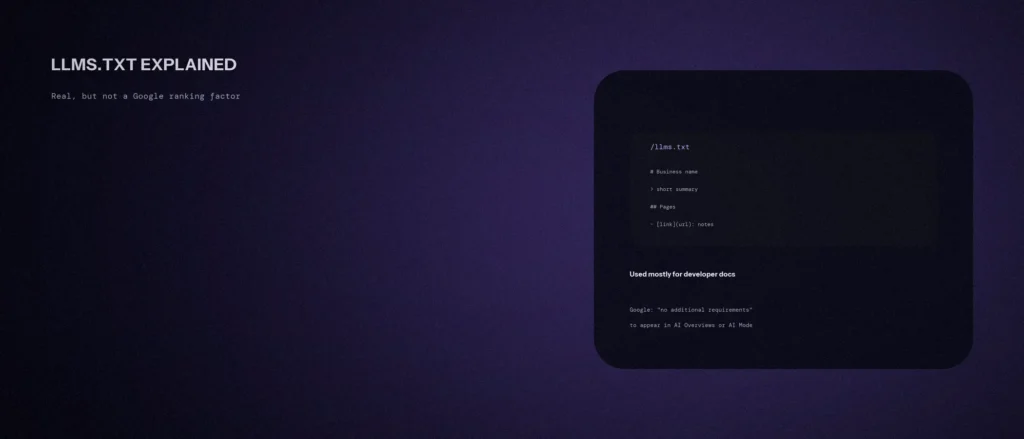
The format is plain markdown. According to the proposal, the file has these parts, in this order:
- An H1 with the name of the site or project. This is the only required part.
- A blockquote with a short summary.
- Optional paragraphs or lists with more detail.
- Sections under H2 headings, each holding a list of links, each link with a short note.
- An optional section called “Optional”, for links that can be skipped when a shorter context is needed.
Here is a small example of the shape, using a made-up business:
# Example Dental Clinic

> A family dental clinic in Indiranagar, Bangalore. Services include check-ups, braces and root canal treatment.

## Main pages
- [Services](https://example.com/services/): What we treat and how it works
- [Contact](https://example.com/contact/): Address, hours and phone number

## Optional
- [Blog](https://example.com/blog/): Patient guides
The proposal also says the file is meant to sit alongside existing standards. A sitemap lists all pages for search engines, while llms.txt offers a curated overview. It can complement robots.txt, which tells a crawler or bot what it may access, by giving context about the content that is allowed.
What Google says about llms.txt
Google’s guide to optimizing for generative AI features on Google Search names the file. In a list of things you can ignore for Google Search, it puts “LLMS.txt files and other special markup”. It says you do not need to create new machine-readable files, AI text files, markup or Markdown to appear in Google Search, including its generative AI features, because Google Search itself does not use them.
It then adds two points that answer most of the questions people ask:
- It is completely fine to create and keep llms.txt files for other services or systems that use them.
- Doing so will neither harm nor help your site’s visibility or rankings in Google Search, as Google Search ignores them.
The page was last updated on 10 July 2026. Google’s separate page on AI features in Search says the same thing in general terms (it was last updated on 10 December 2025): there are no additional requirements to appear in AI Overviews or AI Mode, and you do not need to create new machine-readable files or AI text files. Our post on FAQ schema for AI search covers that page. For Google Search, this is settled.
Who uses it today
Google Search is not the only reader. The proposal’s author says that after two years of adoption, thousands of sites publish an llms.txt file, documentation platforms generate one automatically, and Chrome’s Lighthouse audits sites for one as part of its agentic browsing checks. He also says AI companies publish llms.txt files for their own developer documentation, naming OpenAI, Anthropic and Gemini.
The Lighthouse audit is worth understanding. Chrome’s documentation calls llms.txt an emerging convention that gives a machine-readable summary of a site for AI agents, and says that without the file an agent may spend more time crawling the site to understand it. The audit works like this, according to the page (last updated 5 May 2026):
- If the server returns an error when Lighthouse tries to fetch the file, Lighthouse flags it.
- If there is simply no file (a 404), the audit is marked “not applicable”, because providing the file is optional at the moment.
Note that Lighthouse is a Chrome developer tool, not Google Search. A Lighthouse audit existing does not mean Google Search ranks pages with the file. Google’s own guide, above, says it does not.
The pattern is clear. The file is used mostly for software documentation, where coding agents follow it to find the right API reference. That is a very different use from a local business trying to be found in AI Overviews or ChatGPT. We did not check the crawler documentation of ChatGPT, Claude or Perplexity for this post, so we cannot tell you whether those AI systems read the file when they answer a question.
How to check if your site has one
It takes about a minute.
- Type your address plus /llms.txt into the browser, for example yourwebsite.com/llms.txt. If you see plain text, the file exists. If you see a “page not found” message, it does not.
- Read what is in it. Some files are made automatically and may list pages you would rather not highlight, such as old posts.
- Check your SEO plugin. On WordPress, an SEO plugin can create the file for you. Our own file at zunelo.in/llms.txt begins with a line saying it was generated by Rank Math SEO, and it lists our sitemap and our blog posts. We did not write it by hand. We have only checked this for Rank Math, so look at your own plugin’s settings rather than assuming.
- Make sure the file loads without an error. Per Chrome’s audit page, a server error is flagged while a plain 404 is not.
Should a small business bother?
Our view, and it is a judgment, not a Google rule: add one only if it takes you less than an hour, and never ahead of the basics.
- If your SEO plugin already made one, look at it, tidy it if needed, and move on.
- If you run a developer tool or documentation site, it is worth doing properly, because that is where the file is used today.
- If you are a local service business, do these first: a clear website, an accurate Google Business Profile, real reviews and content that answers real questions. Google says the best practices for SEO remain relevant for its AI features.
The honest answer to “will it get me into AI answers?” is that nobody has shown that for a small business, and for Google Search the answer from Google is no.
How to create an llms.txt file
- List your 5 to 10 most important pages. For a service business, that is the homepage, your main service pages, pricing, about and contact.
- Write one clear sentence about what you do and where. This becomes the blockquote summary.
- Write the file in markdown using the shape above. A plain text editor is enough.
- Upload it to the root directory of your site, so it opens at yourwebsite.com/llms.txt. Chrome’s guidance is the same: place it in the root directory.
- Test every link and check the file loads without an error.
- Keep it current. A file that lists pages you have deleted is worse than no file.
A prompt to draft your own llms.txt
An AI tool is good at turning your page list into a clean markdown file. It does not know your business, so give it your real details and check every line.
Act as a technical writer. Draft a simple llms.txt file for my website, following the llms.txt format from llmstxt.org.
My business:
– Business name: [name]
– What we do and where, in one sentence: [describe]
– My main pages, one per line as “page title: full address: what a visitor finds there”: [list 5 to 10]
– Pages that matter less but are still useful: [list, or say none]Please do the following:
1. Write the file in markdown: an H1 with my business name, a blockquote summary, and an H2 section of links with a short note each.
2. Put the less important pages under an H2 section called “Optional”.
3. After the file, list anything you were unsure about.Rules:
– Use only the facts I gave you. Do not invent services, prices, pages or claims.
– Use my exact addresses. Do not change or guess any link.
– Keep each note under 12 words.
– Write in plain, simple English.
Open every link before you upload the file. Then load yourwebsite.com/llms.txt in a browser and confirm it shows as plain text.
Questions about llms.txt
Does Google use llms.txt to rank pages?
No. Google’s guide to generative AI features says Google Search ignores llms.txt files, and that creating one will neither harm nor help your visibility or rankings in Google Search. The page was last updated on 10 July 2026.
Does llms.txt actually work?
It works as designed for the tools that read it, mostly documentation tools and coding agents. For Google Search it has no effect, according to Google. We have not checked whether other AI systems read it, so we cannot promise any effect on their answers.
What does LLM text mean?
LLM stands for large language model, the kind of AI behind tools like ChatGPT and Gemini. An llms.txt file is a plain text file written for these models and the agents built on them, so they can find the key parts of a site quickly.
Is llms.txt the same as robots.txt or a sitemap?
No. Robots.txt tells a crawler which parts of a site it may access. A sitemap lists all the pages for search engines. The llms.txt proposal says it offers a short, curated overview for language models and is meant to sit alongside both.
Who created llms.txt?
Jeremy Howard published the proposal on 3 September 2024. It is not a Google standard or an official specification from a search engine. Some AI companies publish their own developer documentation in this format.
Should I add llms.txt to my small business website?
It will not hurt, and for Google Search it will not help either. If a plugin made one for you, review it. If not, treat it as a small extra after your pages, Google Business Profile and reviews are in good shape.
Will llms.txt become a ranking factor?
Google says its Search ignores the file today and we cannot predict what any company will do next. Treat any claim that it is a ranking factor with caution until Google says so on its own pages.
Where this matters
llms.txt is a real proposal with real use in software documentation. For Google Search, Google has said plainly that it ignores the file. If you want to create one, check whether your SEO plugin already has, keep it short and accurate, and spend your real effort on the pages, profile and reviews that customers and Google do read.
Want to know what actually helps your business show up in AI search? Our AI SEO and GEO service is built around exactly that question.