Ask ChatGPT which CRM is best for a small business, and it doesn’t hand you ten blue links to click through. It just answers, in a paragraph, naming a couple of tools, sometimes with a source, sometimes not. That’s why a new term keeps showing up in marketing conversations: GEO, or Generative Engine Optimization. It sounds like SEO with a new coat of paint. It isn’t, quite, and the difference matters more than the name suggests.
Quick summary, if you’re short on time:
- GEO means getting your business mentioned or quoted inside an AI-generated answer, not just ranked on a results page.
- SEO and GEO are not the same job. A page can rank well on Google and still never get picked up by ChatGPT, Perplexity, or Google’s AI Overviews.
- GEO doesn’t replace SEO. It’s built on top of the same technical basics: a fast, crawlable, indexed website.
- You can check today, by hand, whether AI tools mention your business. There’s no proper tracker for this yet, so a manual check is the honest answer.
Jump to a section:
- What GEO actually means
- SEO vs GEO, side by side
- Why the same page doesn’t automatically work for both
- Four things worth doing differently
- A before and after example
- What this looks like for a local business
- Common GEO mistakes
- What GEO doesn’t replace
- How to check if it’s working
- Questions worth answering directly
What GEO actually means
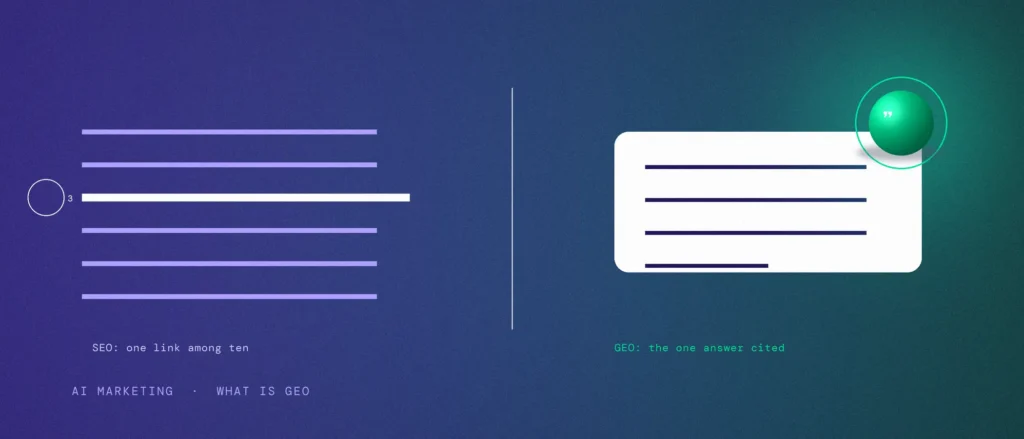
Generative Engine Optimization is the work of making it easier for an AI tool to understand your business, trust it, and mention it when someone asks a related question. SEO optimises for a ranking position: you want your page to be the one Google decides deserves the top spot, among ten or so competing links. GEO is aiming at something different. There’s no list of ten. There’s one answer, written by the AI, and your business is either part of it or it isn’t.
The tools this applies to include Google’s AI Overviews, ChatGPT search, Perplexity, and Gemini, though how each one works, and how much it changes month to month, differs. Search Engine Land covers this shift in more depth if you want to go further. This isn’t a rebrand of SEO. A page can rank third on Google and still never get pulled into an AI answer, because the two systems are doing different jobs. One is ranking a list of pages. The other is writing one answer and deciding what’s trustworthy enough to lean on.
SEO vs GEO, side by side
| SEO | GEO | |
|---|---|---|
| Goal | Rank high on a results page | Get named or quoted inside one AI answer |
| What gets judged | The whole page | One passage or sentence, often pulled out on its own |
| How you measure it | Rank trackers, Search Console | Mostly manual checks, for now |
| What a win looks like | A visitor clicks your link | A person reads your name inside someone else’s answer, and may never click through at all |
Why the same page doesn’t automatically work for both
Normal SEO rewards a page that’s thorough, covers a keyword well, and has good links pointing to it. AI tools want something narrower: a short, self-contained answer to one specific question, written by a source the AI has reason to trust. A 2,000-word guide can rank brilliantly on Google while its best, most quotable sentence sits buried in paragraph fourteen. A human reader would happily scroll to find it. An AI tool skimming for a quick answer usually won’t.
Google’s normal ranking looks at a whole page at once. AI tools increasingly look at one small piece, a paragraph or even a single sentence, pulled out on its own and judged on whether it stands up by itself as a clear, correct answer.
Four things worth doing differently
Answer the question first
Put the direct answer in the first sentence or two under a heading, then explain more after. This helps a human skimming the page, and it gives an AI tool one clean sentence to lift, instead of making it guess the answer from three paragraphs of background first.
Make it obvious who you are
AI tools build an internal picture of who you are and what you do, and how confident they can be quoting you. Using your business name consistently everywhere, having a clear “about” page, and adding basic structured data (a technical detail your developer or SEO team can set up) all help build that picture. If it’s unclear who’s actually behind a page, that’s a real reason to get left out.
Add FAQ and How-To markup where it’s true
FAQPage and HowTo schema (structured data that describes your page’s format to search engines) don’t just help with the little extra boxes you sometimes see in Google results. They give AI tools an easy-to-read version of your content’s shape, so there’s less guessing involved in pulling out a clean answer. Only add this where the actual visible content matches, not as a shortcut.
Show real, specific expertise
AI tools weigh trust heavily, the same way Google does. Real author information, specific first-hand detail, and evidence that someone has actually done this work matter. Generic content that could have been written by anyone about anyone is exactly what these systems are built to filter out, not repeat.
A before and after example
Here’s the difference in practice. A typical local service page might open like this:
“Welcome to our website. We are a leading provider of digital marketing services, dedicated to helping businesses grow. Our team has years of experience across a range of industries, and we pride ourselves on delivering results our clients can count on.”
That’s a page written for nobody in particular. An AI tool has nothing clean to quote, because it doesn’t actually answer anything. Rewritten to answer a real question first:
“A local SEO retainer for a Bangalore service business typically covers technical fixes, on-page work, and a locked set of target keywords, reviewed monthly against Search Console data. Zunelo’s Local Starter plan locks 5 keywords and starts at ₹15,000 a month.”
The second version answers a real question (what’s included, what it costs) in one breath. That’s the sentence an AI tool can actually lift and use.
What this looks like for a local business
GEO isn’t only for big SaaS companies or news publishers. A few examples of how it plays out for a smaller, local business:
- A dentist in Bengaluru. Instead of a generic “About Us” paragraph, a page that clearly states which procedures are offered, which areas are served, and who the dentist actually is, gives an AI tool something specific to repeat if someone asks “which dentist in Whitefield does root canals.”
- An interior designer. A portfolio page with real project photos, a clear description of the design process, and a named designer with real credentials is far more citable than a page that just says “we create beautiful spaces.”
- An immigration consultant. Clear, specific answers to the exact questions people actually type into ChatGPT, like visa timelines or document checklists, written in plain language, are much more likely to get quoted than a vague overview page.
The pattern is the same across all three: specific, checkable detail beats a polished but generic description every time. This is the same discipline behind good local SEO work, just aimed at a different kind of search result.
Common GEO mistakes
- Treating it as a checklist instead of an actual rewrite. Adding schema to a vague page doesn’t fix the fact that the page never actually answers anything.
- Promising results that aren’t provable. Nobody can guarantee a business will be cited by ChatGPT. The systems change constantly, and no agency controls them.
- Ignoring the SEO basics. A slow, uncrawlable, unindexed site won’t benefit from GEO work, because most AI tools still lean on the same underlying search infrastructure SEO already depends on.
- Writing for AI instead of for people. Content that reads like it was stuffed with keywords for a machine tends to fail with both humans and AI tools, since both are increasingly good at spotting it.
What GEO doesn’t replace
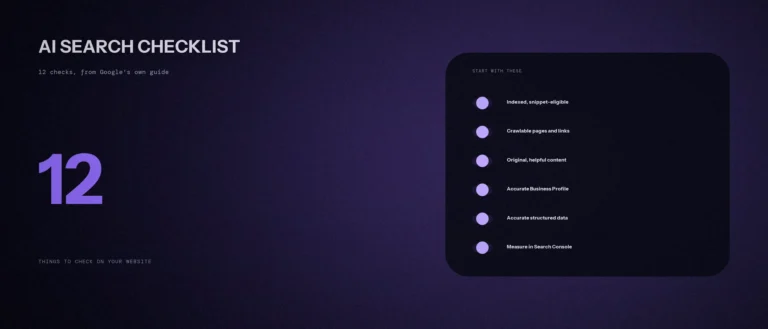
None of this works without the SEO basics already in place. If a page isn’t crawlable, isn’t indexed, or loads too slowly, no amount of clean answer-first writing saves it. GEO sits on top of solid technical SEO. It isn’t a replacement for it. Treat GEO as a rebrand of SEO and you’ll be disappointed. Treat it as SEO’s foundations plus one new, narrower target, and it actually makes sense.
How to check if it’s working
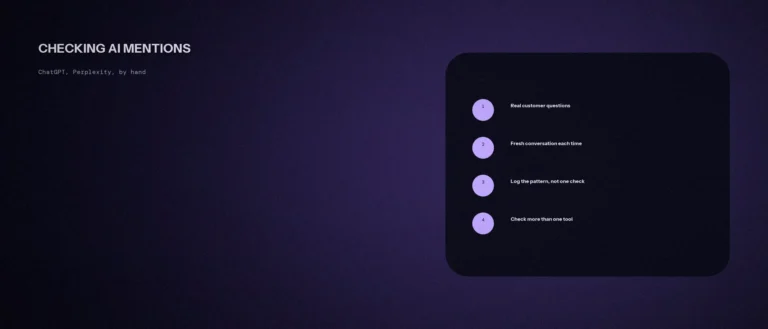
Here’s the honest, slightly awkward part: measuring this properly is still hard. There’s no tool yet with the maturity of a normal rank tracker for AI answers. What you can do right now is simple: ask the AI tools your customers are likely to use the exact question they’d ask, and check by hand whether your business shows up, and whether what it says about you is actually true. It’s not exciting, but it’s real information, and you don’t need to wait for better tools to start.
A prompt for the check above
A one-line question like “who’s the best plumber in Bangalore” gets a one-line answer, and it doesn’t tell you much. The prompt below does more work: it asks the AI tool to actually check for your business by name, explain why it picked the businesses it picked, and tell you what would change its mind. Run it in ChatGPT, Perplexity, or whichever tool your customers actually use, since the result only means something if it’s the tool your audience reaches for.
“Act as a researcher helping me check how visible my business is in AI search answers.
Here’s my business:
– What I do, in one sentence: [describe your business and main service]
– City or area I serve: [location]
– My business name, written exactly as it appears on my website: [name]
– The exact question a customer would type to find a business like mine: [example, such as ‘best dentist in Whitefield for a root canal’]
– Competitors I already know about, if any: [names, or say ‘not sure’]Please do the following:
1. Answer the customer question above as if you were actually helping someone find a provider. List the specific businesses you’d recommend.
2. Tell me clearly whether my business appears in your answer, and if it does, repeat back exactly what you said about it.
3. If my business does not appear, tell me honestly why the businesses you did list seem more visible or trustworthy to you for this question.
4. If anything you said about my business is wrong, outdated, or missing, point out specifically what’s wrong.
5. Suggest one or two specific things I could add to my website that would make you more confident recommending my business next time.”
Read the answer to part 3 carefully. That’s usually the most useful part of this whole exercise, because it’s the AI tool explaining, in its own words, what it actually values, rather than you guessing. Part 5 is where you’ll often get a genuinely specific, actionable idea instead of a generic “improve your SEO.”
Do this every few months, not just once. This space changes fast enough that a good result today doesn’t mean the same result in three months, and a bad result today is worth checking again once you’ve made changes, rather than just hoping they worked.
Questions worth answering directly
Is GEO just a new name for SEO?
No. SEO aims to rank a page on a results list. GEO aims to get your business named or quoted inside one AI-written answer. GEO also depends on solid SEO fundamentals, so the two work together rather than replacing each other.
Can I guarantee my business gets cited by ChatGPT?
No, and anyone who promises this isn’t being honest with you. AI tools change constantly and no agency controls how they pick sources. What you can do is make your content genuinely easy to understand, trust, and quote.
Do I need to redo my whole website for GEO?
No. Start with your five or six most important pages, make sure each answers its main question clearly in the first couple of sentences, and add FAQ schema only where the page genuinely has real questions and answers.
How do I know if GEO is working for my business?
There’s no mature tracking tool yet. The honest method right now is asking the AI tools your customers use the exact questions they’d ask, and checking by hand whether you show up and whether it’s accurate.
Does GEO apply to small, local businesses?
Yes. Specific, checkable detail, like real service areas, real credentials, and real answers to common questions, works for a local dentist or interior designer the same way it works for a larger company.
Where to actually start
If you’re starting from zero, the highest-value first move isn’t a full rewrite of your website. Pick your five or six most important pages, check whether each one answers its main question clearly in the first couple of sentences, and add FAQ schema only where a page genuinely has three or more real questions worth answering. That’s a few hours of work, not a few months, and it’s the same foundation everything else in this article is built on.
Being findable by AI answer engines also depends on a more basic technical question first: can AI crawlers even reach your site.
Want to know if your business already shows up in AI answers, or where the gaps are? This is exactly what we check first inside every AI SEO and GEO engagement, entity clarity, schema, and answer-shaped content, built on a site that was already fast and crawlable to begin with.