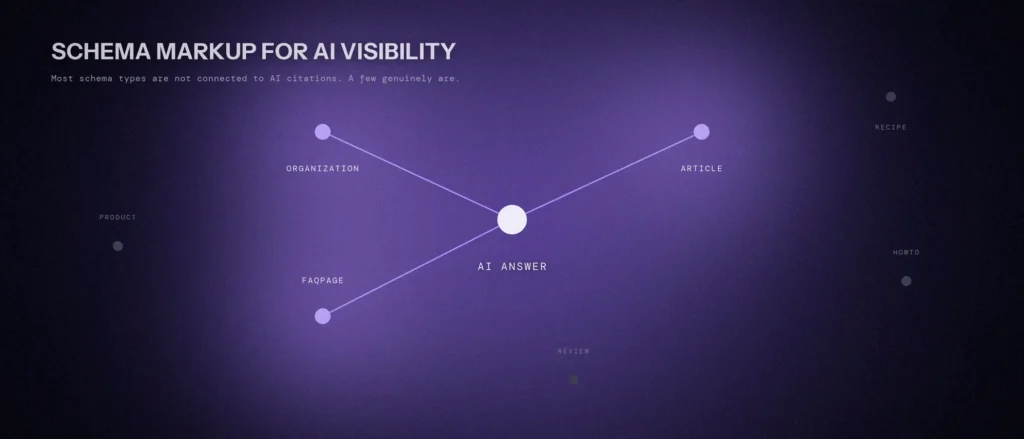
Schema markup for AI visibility gets sold as an easy win: add it, and AI search will start citing you. It is one of the most repeated pieces of advice in AI SEO content right now, and it is only partly true.
Schema markup does real work. It is just not the work most of that advice claims it does, and the evidence for a direct citation boost is a lot thinner than the hype suggests.
Quick summary, if you’re short on time:
- A large, rigorous study tracking 1,885 pages that added schema found no meaningful citation lift on Google AI Overviews, Google AI Mode, or ChatGPT.
- Schema still matters, just not as a direct citation lever. Its real job is machine-readable clarity: telling AI systems exactly who you are and what a piece of content is, not persuading them to quote you.
- A small number of types do most of the useful work: Organization, FAQPage, and Article. Most of the rest is niche or irrelevant unless it matches your actual content.
- Google restricted FAQ rich snippets to government and health sites in 2023, then removed them from Google Search entirely, for every site, as of 7 May 2026. FAQ schema still helps AI systems parse Q&A content, there is just no visual reward left in Google Search for anyone.
- Correlation is not causation here. Pages cited by AI systems often have schema, but that is more likely because well-structured, well-maintained sites tend to have both good schema and good content, not because the schema itself caused the citation.
Jump to a section:
- What a real study actually found
- What schema markup actually does
- Organization schema: the one that matters most
- FAQPage: still useful, just not for the reason you think
- Article schema: recency and authorship signals
- The types worth skipping unless they genuinely apply
- How to check what you actually have
- Using AI to audit your own schema
- Questions worth answering directly
What a real study actually found
Most of what gets written about schema and AI visibility is confident guessing. One piece of research actually tested it properly.
Ahrefs tracked 1,885 pages that added JSON-LD schema between August 2025 and March 2026, and matched each one against three control pages from different domains that never added schema but had similar citation levels beforehand.
The result: adding schema produced a 4.6% decline in Google AI Overview citations, small but statistically real, and changes on Google AI Mode and ChatGPT that were indistinguishable from random noise.
Across four separate analytical methods, the same conclusion held. Schema alone did not move the needle.
Read the full study directly if you want the methodology rather than just the headline, because the honest takeaway is not “schema is useless.” It is that schema is not the lever most content treats it as.
What schema markup actually does
Schema markup is a structured, machine-readable label on your content. It does not make your writing better and it does not persuade an AI system to trust you.
What it does is remove ambiguity: it tells a crawler or an AI system exactly what kind of thing it is looking at, whether that is a business, a question and answer, an article, or a product, instead of leaving the system to guess from the surrounding text.
That distinction matters. The correlation numbers floating around, roughly seven in ten pages cited by ChatGPT and about two in three pages cited by Google AI Mode carry structured data, are real but easy to misread.
Well-run websites tend to have good schema and good content at the same time. The schema is a marker of a well-built site, not the reason that site gets cited.
This is not a one-off finding either. A separate December 2025 analysis by Search Atlas, comparing schema coverage against LLM citation frequency across OpenAI, Gemini and Perplexity, reached the same conclusion through a different dataset.
Visibility stayed flat across every level of schema adoption, from none to full coverage. Two independent studies, two different methods, the same answer.
Organization schema: the one that matters most
If there is one schema type worth prioritising, it is Organization or LocalBusiness schema. Its job is establishing entity clarity, telling search engines and AI systems, unambiguously, who you are as a business, not persuading them to quote a specific paragraph.
That distinction between citation and identification is exactly why this type keeps showing up as foundational rather than optional, and it is covered in more depth in our post on entity clarity.
In practice, this means a stable @id, a sameAs array pointing to your verified Google Business Profile and social profiles, and consistent name, description and contact details matching what appears everywhere else you are listed.
None of this earns a citation directly. It removes the ambiguity that stops one from happening.
FAQPage: still useful, just not for the reason you think
FAQPage schema used to be worth adding for a simple reason: Google would sometimes show your questions and answers directly in search results as a rich snippet, extra visual space with almost no extra effort.
Google restricted that in August 2023 to a small set of well-known government and health websites, and then went further: as of 7 May 2026, Google removed FAQ rich results from search entirely, for every site, including the government and health sites that had kept them.
There is no FAQ rich snippet reward left in classic Google search for anyone, not a shrinking exception, a closed one.
What FAQ schema still does is give AI systems a clean, pre-structured question-and-answer format that matches exactly how many of them retrieve information to build an answer.
It is not a guaranteed citation trigger, the study above makes that clear, but it is a genuinely low-effort way to present content in the shape these systems already look for. Worth keeping if you are already writing real FAQ content, not worth building fake questions around just to add the schema.
Article schema: recency and authorship signals
Article schema carries two pieces of information that matter for AI visibility specifically: when something was published or updated, and who wrote it.
AI systems weighing which source to trust or cite often lean on recency, especially for anything time-sensitive, and a clear author or publisher signal is one more small piece of the same identity puzzle that Organization schema handles at the business level.
This one is worth adding on genuine content, blog posts, guides, long-form pages, and not worth forcing onto a service page or a pricing page where it does not actually describe what the page is.
The types worth skipping unless they genuinely apply
HowTo, Product, Review and several other schema types get recommended constantly in generic AI SEO checklists, regardless of whether the site actually has step-by-step instructions, physical products, or genuine reviews to mark up.
Forcing a schema type onto content it does not actually describe does not create AI visibility. At best it does nothing. At worst, mismatched or inaccurate schema is exactly the kind of thing that erodes the same trust signals Organization and Article schema are trying to build.
The honest rule here: use the schema type that accurately describes what is actually on the page. If you run a services business with no products, skip Product schema entirely rather than reaching for it because a checklist said to.
How to check what you actually have
Start with Google’s Rich Results Test, paste in a real URL from your site and see which schema types it actually detects, not which ones you think you added.
It is common to find schema that was added once, then broken by a later template change, and nobody noticed because nothing visibly failed.
From there, check the substance, not just the presence: does your Organization schema have a working sameAs array pointing to profiles that are still live and accurate.
Does your FAQ schema match real questions and answers that are also visible on the page as readable content, not schema-only text hidden from actual visitors. Mismatches between what is marked up and what a person actually sees on the page are treated as a real problem, not a technicality.
Using AI to audit your own schema
Once you know what is technically present, deciding what is actually worth fixing first is a good use of a structured prompt.
“Act as a technical SEO specialist helping me prioritise schema markup fixes for AI visibility.
What I currently have, based on checking Google’s Rich Results Test:
– Organization or LocalBusiness schema present: [yes, with sameAs / yes, without sameAs / no]
– FAQPage schema present, and does it match real, visible Q&A content on the page: [yes, matches / yes, but hidden or mismatched / no]
– Article schema on blog or guide content, with author and publish date: [yes / no / partial]
– Any schema types present that do not match my actual business, like Product or HowTo on a page with neither: [describe, or “none that I know of”]
– My business type and what my content actually consists of: [describe briefly]Task:
1. Tell me which gaps in my current setup are actually worth fixing, based on what I described, not a generic checklist.
2. Flag any schema I have that is mismatched with my real content and should be removed or corrected.
3. Give me one concrete first fix to prioritise this week, and explain why that one over the others.”
Treat the output as a starting point, not a verdict. It only knows what you tell it, not what is actually rendering on your live pages, so check its suggestions against the Rich Results Test before acting on them.
Last verified 31 August 2026. Google’s FAQ rich results policy has changed twice already, so if you are reading this well after that date, check Google’s own documentation before assuming the May 2026 removal is still the latest word.
Questions worth answering directly
Does adding schema markup guarantee more AI citations?
No. A large study tracking 1,885 pages that added schema found no meaningful citation increase on Google AI Overviews, Google AI Mode, or ChatGPT. Schema supports clarity and structure, it does not directly cause citations.
Is FAQ schema still worth adding if it does not show rich snippets anymore?
Yes, if you already have genuine FAQ content. Google fully removed FAQ rich results from search for every site as of 7 May 2026, so there is no visual reward left at all, but it still presents question-and-answer content in a structure AI systems can parse cleanly.
Which single schema type should a small business prioritise first?
Organization or LocalBusiness schema, with an accurate sameAs array. It establishes who you are as a business, which is the foundation everything else, including AI visibility, is built on.
Should I add HowTo or Product schema even if I am not sure it applies to me?
No. Only use a schema type that accurately describes what is genuinely on the page. Mismatched or forced schema does not help, and can quietly undermine the trust signals your accurate schema is trying to build.
How do I check what schema is actually live on my site right now?
Use Google’s Rich Results Test on real URLs from your site. It shows what is actually detected, which is often different from what was added at some point and may have broken since.
This connects directly to entity clarity, since Organization schema is one of the main ways that clarity gets built in a machine-readable form.
And schema is only useful at all if AI crawlers can reach your site in the first place, worth checking against our post on AI crawler access.
Where this actually pays off
Schema markup was never going to be a shortcut to AI citations, and the evidence now backs that up plainly.
Its real value is quieter: making sure AI systems and search engines have no ambiguity about who you are and what your content actually is, so that when your content is genuinely good enough to cite, nothing structural is standing in the way.
Not sure whether your schema is actually correct, or just present, or whether it is doing anything at all? Share your site and we will check what is genuinely implemented versus what is broken or missing, as part of every AI SEO and GEO engagement we run.