Open ten small business websites and count how many say some version of “we provide quality service.” Most of them. Now ask yourself what you learned about any of those businesses from that sentence. Nothing. It could sit on a plumber’s site, a law firm’s site or a bakery’s, and it would read exactly the same.
That’s the problem. A sentence that fits every business describes none of them. Here’s what the research says about why people skip it, and a simple way to replace it with something a stranger can actually use.
Quick summary, if you’re short on time:
- Nielsen Norman Group tested website copy with 51 experienced users and found that an objective writing style scored 27% higher on measured usability than promotional writing.
- The study defined promotional writing as “exaggeration, subjective claims, and boasting, rather than just simple facts.”
- Its explanation: users question the credibility of promotional statements, and that doubt distracts them from the meaning.
- Stanford’s web credibility guidelines say to make accuracy easy to verify and to use restraint with promotional content.
- The fix isn’t a cleverer adjective. It’s replacing the claim with a fact the reader can check.
Jump to a section:
- Why “quality service” tells people nothing
- What the research says about promotional copy
- How to turn a claim into proof
- A five-minute check for your own site
- A prompt to replace a claim with a proof
- Questions worth answering directly
Why “quality service” tells people nothing
Words like quality, best, trusted, professional and dedicated share one flaw. Every competitor can say them, and no reader can check them. A phrase that any business could write, and nobody could prove, doesn’t help someone choose between two options.
It also fails the test we described in our post on the one-sentence test. If a stranger can’t tell from your copy what you do, who it’s for or how you’re different, adding “quality” in front of it doesn’t help.
What the research says about promotional copy
A classic Nielsen Norman Group study tested five versions of a website with the same information written in different styles. In the measurement study, 51 experienced web users completed tasks and answered memory and satisfaction questions.
The objective version, plain facts without exaggeration, scored 27% higher on measured usability than the promotional one. Concise writing scored 58% higher and scannable text 47% higher. A version combining all three scored 124% higher.
The reason matters more than the number. NN/g’s explanation: “Web users wonder about credibility, and questioning the credibility of promotional statements may distract users from processing the meaning.” One participant put it more bluntly: “I want to hear fact, not platitudes.”
An honest caveat: the study is old and used a small sample on a specific kind of site, so treat the exact percentages as a direction. Its core idea, that boasting makes readers doubt you, is the useful part.
Stanford’s web credibility guidelines point the same way. Two of the ten are “Make it easy to verify the accuracy of the information on your site” and “Use restraint with any promotional content.”
How to turn a claim into proof
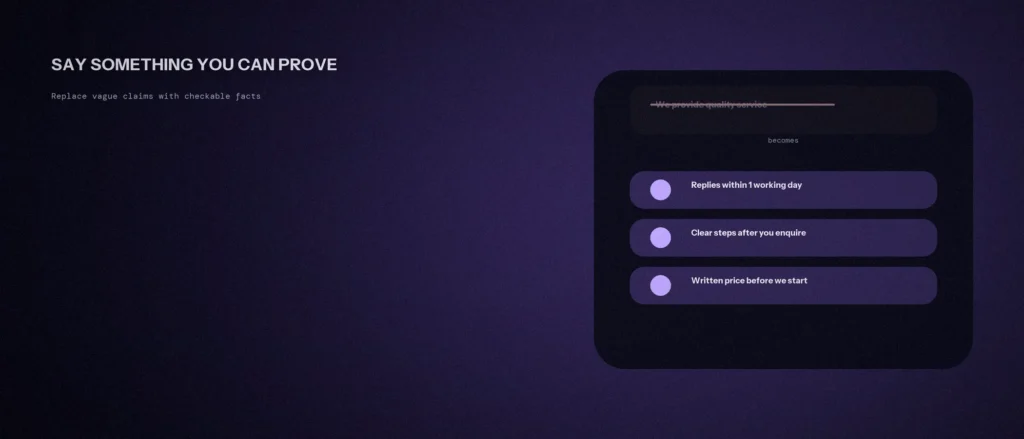
Take each vague claim on your site and ask one question: what would a customer see or experience if this were true? Then write that instead. Four kinds of proof work for almost any small business:
- A number. How fast you reply, how long a job takes, how many years you’ve done this. Only use figures you can back up.
- A process. What happens after someone contacts you, step by step. A clear process shows you’ve done this before.
- A named example. A real project, client or result, with permission. One specific story beats ten adjectives.
- A limit or promise. What you will and won’t do, or what happens if something goes wrong. Saying no builds more trust than saying yes to everything.
Here’s what the swap looks like. These are templates, so fill them in only if they’re true for you:
- Instead of “We provide quality service,” write “We reply to every enquiry within one working day.”
- Instead of “Fast, reliable turnaround,” write “Most projects are finished within [your real timeframe], and we tell you the date before we start.”
- Instead of “Trusted by many clients,” write “We’ve worked with [your real number] [type of client] in [your city].”
The same rule applies to your About page, which is covered in our post on why an About Us page sounds generic.
A five-minute check for your own site
Open your homepage and highlight every adjective. Then, for each one, try to complete this sentence: “You can tell because…” If you can finish it with something a customer could check, keep it and lead with the proof. If you can’t, the word isn’t doing any work. Cut it or replace it.
Be careful not to over-correct. You aren’t trying to sound cold or robotic. Warm and specific work together: “We’ll call you back the same day, even if it’s just to say we need more time” is friendly and checkable.
A prompt to replace a claim with a proof
Words like quality and trusted mean nothing without proof. The prompt below asks an AI tool to help you turn a vague claim into a specific one. Fill in the claim, then answer its questions with real details.
Act as a copywriter who turns vague claims into specific, honest statements.
The claim I want to replace: [for example we provide quality service]
What I really do that supports it:
[describe your process, guarantees, response times or examples]Please do the following:
1. Ask me up to 5 questions to find the real proof behind the claim.
2. After I answer, write 3 specific replacement sentences.
3. Tell me which one is the most believable and why.Rules:
– Use only what I tell you. Do not invent numbers, awards or customer names.
– Use plain words and short sentences.
Use only the sentence you can prove. If you cannot prove it yet, leave it out until you can.
Questions worth answering directly
Why doesn’t “we provide quality service” work?
Because every competitor can say it and no reader can verify it. Nielsen Norman Group’s research found that promotional language, made up of exaggeration and subjective claims, makes people question credibility, which distracts them from the actual message.
What should I write instead of vague claims?
A fact the reader can check: a number, a process, a named example, or a clear promise. For instance, “We reply to every enquiry within one working day” says more than “excellent customer service,” provided it’s true.
Does this mean I can’t use any positive words?
You can, but let proof come first. Stanford’s credibility guidelines ask for restraint with promotional content and for accuracy that’s easy to verify. A warm tone is fine when it sits next to something specific.
How do I prove a claim if I don’t have numbers yet?
Use a process or a promise instead. Describing what happens after someone contacts you, or what you will and won’t do, gives readers something to check. Only use figures you can back up.
What counts as promotional writing in the Nielsen Norman Group study?
The study defined it as exaggeration, subjective claims and boasting rather than just simple facts. Its objective version stuck to plain facts, and scored 27% higher on measured usability.
Is the Nielsen Norman Group study still relevant?
The study is old and used a small sample of 51 users on a specific kind of site, so treat the percentages as a direction. The core idea, that boasting makes readers question your credibility, is the useful part.
Where this actually matters
Choosing a business is a small act of trust. Vague claims ask the reader to trust you on your word, while specific ones let them check for themselves. The second is what actually gets a call.
Not sure which lines on your own website are doing no work? We look at this as part of every website engagement we run.