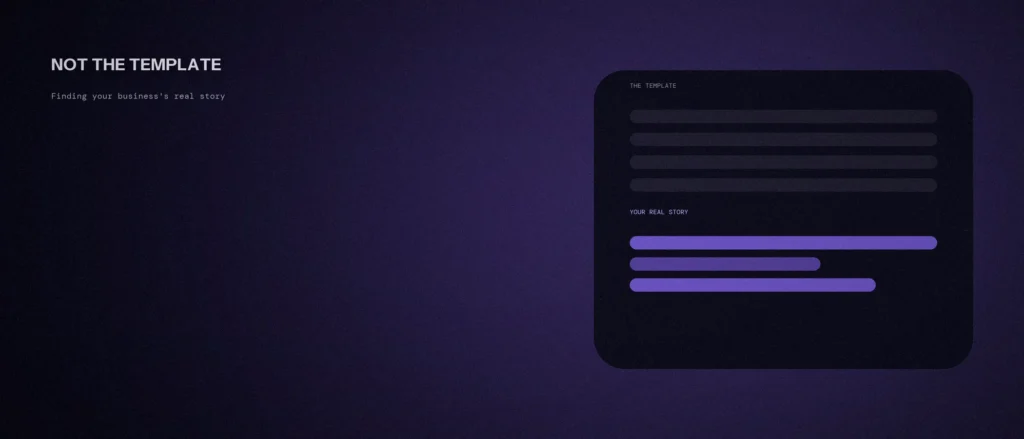
Open the About page of ten small businesses and count how many begin the same way. “It all started when our founder had a dream.” “After years in the corporate world, we decided to follow our passion.” The words change a little. The shape never does. That shape is the founder-story template, and it makes very different businesses sound like one business.
Your business story doesn’t need to be dramatic to be worth telling. It needs to be true and specific enough that nobody else could have written it. Here’s what the research says people want from it, and five questions that help you dig it out.
Quick summary, if you’re short on time:
- Nielsen Norman Group’s About Us research, covering 100 tested websites and more than 70 users, found people expect “a heightened level of authenticity and transparency.”
- The same research advises explaining “what you do, your company’s origins, how you view business, and how you relate to the community.”
- Google’s guidance on helpful content asks whether it’s “self-evident to your visitors” who created the content, which is a good test for who’s visible on your site too.
- A template story fails because it could describe anyone. A real one is built from specific decisions, mistakes and things you refuse to do.
- You already have the material. It just hasn’t been asked for in the right way.
Jump to a section:
- What people actually look for in a business story
- Why the founder-story template fails
- Five questions that find your real story
- Turning the answers into a story
- A prompt to find your business’s real story
- Questions worth answering directly
What people actually look for in a business story
Nielsen Norman Group’s About Us research ran across three rounds of expert reviews and usability testing, observing over 70 users across 100 tested websites and 65 more reviewed sites. Its finding is that “users now expect companies to demonstrate a heightened level of authenticity and transparency.”
What those users looked for included the organisation’s purpose, location, values, history and ways to make contact. The advice back to businesses is to “explain what you do, your company’s origins, how you view business, and how you relate to the community.” The research also names storytelling, realistic photography and unbiased reviews as things that help a company appear authentic.
Notice what that list doesn’t ask for: a dream, a passion or a journey. It asks for origins, views and relationships, all things that can be stated plainly.
Why the founder-story template fails
A template story fails a simple test: swap the logo and nothing changes. If the same paragraph could sit on a competitor’s site, it isn’t telling the reader anything about you. This is the same problem covered in our post on why an About Us page sounds generic, applied to the origin story specifically.
It also leaves out the people. Google’s guidance on creating helpful content asks, “Is it self-evident to your visitors who authored your content?” That question is about bylines, but it’s a fair test for a business story too. If a visitor can’t tell who is actually behind the business, the story is doing no work.
Five questions that find your real story
Answer these out loud or in rough notes, not in polished copy. The first honest answer is usually the useful one.
- What did you see that others were getting wrong? The real reason a business exists is usually something its founders found frustrating or missing.
- What surprised you with your first customers? Early surprises show what the work is really about, which is often not what you planned.
- What did you change after a mistake? A specific change you made because something went wrong is worth more than any claim about quality.
- What do you refuse to do? Lines you won’t cross say more about your values than a list of them.
- What do customers say you do differently? Their words are often sharper than yours, and they can’t be accused of boasting.
Turning the answers into a story
Pick the one answer with a concrete detail in it, a moment, a decision, a change, and build the story around that. Keep the rest as supporting lines. Here’s an illustration of the difference. This is a made-up example, so use your own facts:
- Template: “We started with a passion for helping small businesses succeed.”
- Specific: “We started after watching a friend’s shop pay for a website that never showed up when people searched for it. So we now show every client where they rank before we charge a rupee more.”
The second one names a situation, a reason and a resulting practice. Write it the way you’d tell it to someone across the table, in plain words, as we describe in our post on writing website copy that sounds like a person. And attach it to real people: names, faces where you can, and a way to reach them.
A prompt to find your business’s real story
The strongest story is usually a real problem you solved, not a founder legend. The prompt below asks you the questions that find it. Answer them honestly, then write the final version in your own words.
Act as an interviewer who helps small businesses find their real story.
My business: [describe in one sentence]
Please do the following:
1. Ask me one question at a time, up to 8, about a customer problem I solved, what I do differently, and what customers say.
2. After I answer, write a short story of under 150 words using only my answers.
3. Point out any part that sounds like a template and might not be true.Rules:
– Do not invent events, numbers or quotes.
– Use plain words.
– Keep the focus on the customer.
Cut anything you cannot back up. A short true story beats a long polished one.
Questions worth answering directly
What is the founder-story template?
It’s the familiar About page opening: a founder with a dream or a passion who left a job to start something. It fails because it’s true of almost every business, so it says nothing about yours. A real story uses details that only apply to you.
What if my business doesn’t have a dramatic story?
It doesn’t need one. Nielsen Norman Group’s advice is to explain what you do, your origins, how you view business and how you relate to the community. Plain, specific facts about those four things are more credible than a dramatic arc.
How long should a business story be?
Long enough to include one concrete detail and short enough to read in a minute or two. There’s no official length. If a sentence could sit on a competitor’s site unchanged, cut it or make it specific.
Should I use photos in my story?
Yes, real ones. Nielsen Norman Group’s research names realistic photography among the things that help a company appear authentic. Photos of the actual team and workplace do more than generic stock images.
Should the story be in first person or third person?
Either works if it sounds like a real person. First person (“I” or “we”) usually reads warmer and clearer. Whichever you pick, keep it consistent, and make sure the people behind the business are named.
Where should my business story go on the website?
On your About page, since that’s where visitors look for it. Nielsen Norman Group found people look there for purpose, history and contact details. Add a one-line version to your homepage that links through.
Where this actually matters
People decide whether to trust a business in a few moments, and a story that could belong to anyone gives them nothing to hold on to. A specific one, told plainly by real people, is one of the few parts of a website a competitor can’t copy.
Not sure whether your own About page tells a real story or a template? We work through this as part of every website engagement we run.