The one-sentence test is simple: ask a business owner to describe what they do, and they’ll answer instantly, clearly, without hesitation. Ask a stranger who just heard that same description to repeat it back, and it usually falls apart. That gap, between how clear something sounds to you and how clear it actually is to someone else, is the real test worth running.
It isn’t a writing problem. It’s a psychology problem, and there’s a name for exactly why it happens.
Quick summary, if you’re short on time:
- Business owners struggle to judge their own clarity because of what researchers call the curse of knowledge, the difficulty of imagining what it’s like not to already know what you know.
- Steven Pinker calls it “the single best explanation I know of why good people write bad prose,” and it applies just as much to how people describe their own business out loud.
- The one-sentence test isn’t asking yourself if your description is clear. It’s asking someone else to repeat it back and seeing what survives.
- Jargon and industry shorthand are usually invisible to the person saying them and completely opaque to the person hearing them for the first time.
- The test only works if you use a real stranger, not a colleague, a friend, or anyone who already half-understands your business.
Jump to a section:
- Why you can’t judge your own clarity
- What the test actually is
- What almost always breaks it
- How to actually run this test
- A prompt to run the one-sentence test
- Questions worth answering directly
Why you can’t judge your own clarity
There’s a specific, well-studied reason business owners are bad judges of their own descriptions. Researchers call it the curse of knowledge, the difficulty of “imagining what it is like for someone else not to know something that you know.”
Steven Pinker, who wrote about this at length, doesn’t treat it as a minor writing quirk. He calls it “the single best explanation I know of why good people write bad prose.” Once you’ve spent years inside your own business, the words that describe it stop sounding like jargon to you. They just sound normal, because everything around you already agrees on what they mean.
What the test actually is
The test isn’t reading your own description and deciding whether it sounds clear. That’s the exact judgment the curse of knowledge already makes unreliable, you’re the one person guaranteed to understand it.
The real test is simple and slightly uncomfortable: say your one-sentence description out loud to someone, then ask them to repeat back what you do in their own words. Not recite it, explain it, as if telling a third person. What survives that translation is what your description actually communicated. What gets dropped, garbled, or replaced with a vague guess is what was never actually clear, no matter how clear it sounded when you said it.
What almost always breaks it
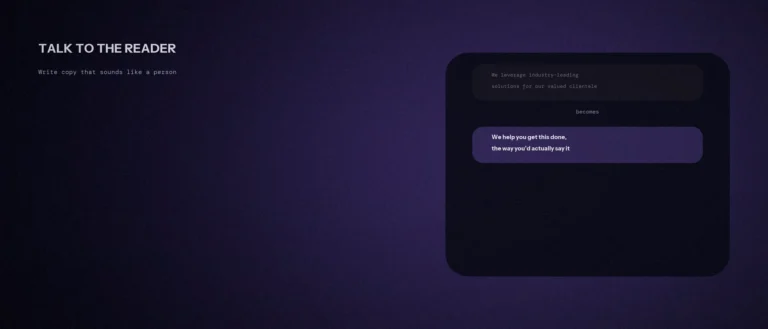
Industry shorthand is the most common failure. “We provide end-to-end solutions for SMB operational efficiency” means something specific inside your head, and almost nothing to someone hearing it cold. Every industry has its own version of this, words that function as a private shorthand for people already in the room and as noise for everyone else.
The second common failure is abstraction dressed up as precision. “We help businesses grow” sounds like an answer, but it describes almost every business that has ever existed. A stranger asked to repeat it back usually can’t, not because they weren’t listening, but because there was nothing concrete enough to hold onto.
How to actually run this test
Use someone who genuinely doesn’t know your business, not a colleague, not a friend who’s heard you talk about it before, not anyone who already has context filling in the gaps for them. The whole point is removing the context you take for granted.
Run it more than once. A single person’s confusion could be an off day or a bad listener. The same specific word or phrase tripping up three or four different people in a row is a real signal, not a coincidence, and it tells you exactly which part of the sentence to rebuild. This is the same underlying gap covered from the writing side in our guide to the homepage hero, and the same clarity problem showed up from a different angle in why About Us pages sound generic: the common thread across all three is that clarity has to be tested on someone else, not judged by the person who already understands it.
A prompt to run the one-sentence test
If a stranger cannot say what your business does after five seconds, your message needs work. The prompt below helps you test that. Paste in your homepage text and ask the tool to explain your business back to you as a stranger would.
Act as a stranger who has never heard of my business. I will paste the top of my homepage.
Here is the text:
[paste the headline and the first paragraph]Please do the following:
1. In one sentence, tell me what you think this business does and who it is for.
2. List anything that confused you or that you had to guess.
3. Suggest 3 clearer one-sentence versions, using only what the text says.Rules:
– Do not use knowledge about my business that is not in the text.
– Do not use buzzwords.
– Be honest, even if the answer is that the page is unclear.
If the tool guesses wrong, so will a visitor. Fix the wording until a friend outside your industry can repeat your business back to you correctly.
Questions worth answering directly
Why can’t business owners tell if their own description is clear?
Because of the curse of knowledge, a well-documented difficulty in imagining what it’s like not to already know something you know. Once you understand your business deeply, the language describing it stops sounding like jargon to you, even when it still is to someone hearing it for the first time.
How do you actually run the one-sentence test?
Say your description out loud to someone unfamiliar with your business, then ask them to explain back what you do in their own words. What they can repeat accurately is what actually communicated. What they drop or get wrong reveals exactly which part of the sentence failed.
Why does the test need to use a stranger, not a colleague?
Anyone who already has context about your business will unconsciously fill in gaps a real stranger can’t. The test only works if the listener has no existing knowledge to lean on, since that’s the condition a first-time customer or visitor is actually in.
What is the curse of knowledge?
The difficulty of “imagining what it is like for someone else not to know something that you know.” Steven Pinker calls it “the single best explanation I know of why good people write bad prose,” and it applies to how owners describe their own business.
What usually breaks the one-sentence test?
Two things. Industry shorthand, which sounds normal to you and is noise to a stranger, and abstraction dressed up as precision, like “we help businesses grow,” which describes almost every business and gives a listener nothing concrete to repeat back.
How many people should I run the test with?
More than one. A single person’s confusion could be an off day. The same word or phrase tripping up three or four different people in a row is a real signal, and it shows which part of the sentence to rebuild.
Where this actually matters
You will never be able to judge your own one-sentence description accurately, no matter how many times you rewrite it. That’s not a failure of effort, it’s how the curse of knowledge works. The only real test happens outside your own head.
Not sure if your own business description actually survives that test? We work through this as part of every website engagement we run.