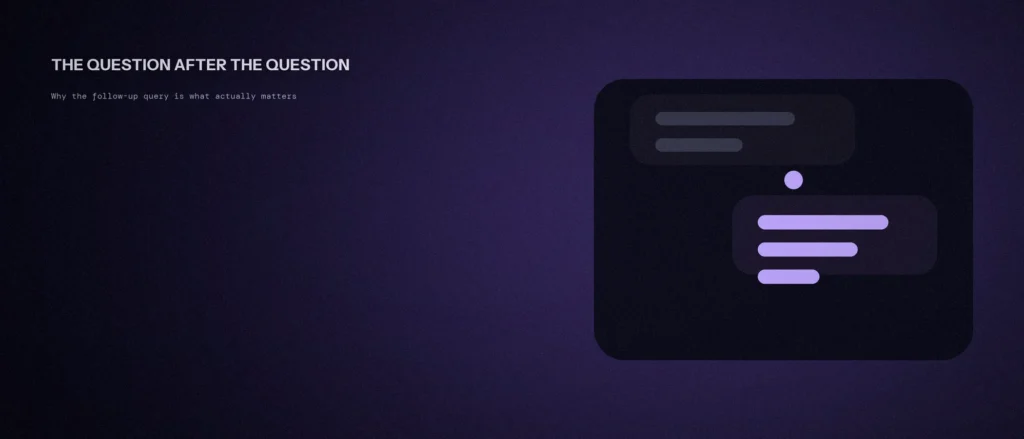
Someone asks an AI search tool “best plumber near me,” gets an answer, then immediately asks “do any of them do emergency callouts on weekends.” That second question is the one that actually decides who gets the call, and almost nobody’s website is written to answer it.
Conversational search changed what’s worth optimizing for. It’s not just the first question anymore, it’s the question that comes right after.
Quick summary, if you’re short on time:
- AI search tools carry context between questions, so someone’s second and third questions reveal what they actually need far more than their first, general one did.
- Google’s own systems can run multiple related searches from a single question, called query fan-out, pulling from several pages at once to build one answer.
- Most business websites only answer the opening question, “what do you do,” and go silent on the specific follow-ups that actually drive a decision.
- Visual search is part of this shift too, Google’s own data shows Lens now handles more than 25 billion queries a month.
- The fix isn’t more keywords. It’s writing down the real follow-up questions a customer asks after your opening answer, and actually answering them on the page.
Jump to a section:
- Why the first question isn’t the important one anymore
- The five kinds of follow-up questions
- Where most business content goes silent
- How to actually map your own follow-ups
- A prompt to plan for follow-up questions
- Questions worth answering directly
Why the first question isn’t the important one anymore
A search engine used to see one query, run one match, and stop. Conversational tools work differently, they carry context forward, so “best plumber near me” followed by “do any of them do emergency callouts on weekends” isn’t two unrelated searches, it’s one person narrowing down a real decision in real time.
Search Engine Land calls the follow-up question the connective tissue of a search journey, the part that actually reveals what someone needs, as opposed to the opening question, which is usually too broad to act on by itself.
Google’s own systems now work this way structurally too. Google’s own documentation describes a “query fan-out” technique, issuing multiple related searches across subtopics to build a single answer, rather than matching one query to one page the way search used to work.
The five kinds of follow-up questions
Follow-up questions aren’t random. They tend to fall into a small number of real patterns: clarification (“which of those is closest to me”), constraints (“does that work on weekends”), comparison (“is that cheaper than the other one”), validation (“are they actually reliable”), and action (“how do I book that”).
Every one of those is a real moment where a customer is deciding whether to trust and choose a specific business, not researching the category in general. A page that only answers the category-level question and skips these five misses the exact moment someone was ready to act.
Where most business content goes silent
Most small business websites are written to answer one question well: what do you do. The homepage explains the service, the About page explains the story, and then the page stops, right before the questions that actually matter to someone close to deciding.
This isn’t unique to text either. Visual search carries the same pattern. Google’s own data shows Lens now handles “more than 25 billion queries per month,” meaning a real share of searches start as a photo, not typed words, and the follow-up after that photo still needs an answer somewhere on your site. A page built only to rank for a typed keyword misses that entire path.
How to actually map your own follow-ups
Start with the question your business already answers well, then write down the three or four things a real customer asks right after hearing that answer. Not hypothetical questions, the ones your own staff actually get asked on the phone or in person every week. That list is worth more than any keyword tool for this specific purpose, because it’s already proven to be what real people ask.
Then check whether your site actually answers each one, in text a person or an AI system can find and lift cleanly, not buried in a PDF or only known by whoever answers the phone. This connects directly to writing content AI can extract, since a follow-up answer that isn’t written clearly on the page doesn’t exist as far as a conversational search tool is concerned, no matter how well your staff actually handles it in person.
A prompt to plan for follow-up questions
People now ask a question, then keep asking. Your page has a better chance of being used if it answers the next question too. The prompt below helps you find those. Fill in your topic, then check every idea against real customer questions.
Act as a customer research assistant. Help me plan the follow-up questions people ask after my main topic.
My topic:
– The main question people ask: [for example how much does a website cost]
– My business and city: [describe]
– What customers usually ask after that in real conversations: [list a few, if you know them]Please do the following:
1. List 10 likely follow-up questions, in the order a person would ask them.
2. Mark which 3 are the most important to answer on the same page.
3. Suggest how to answer each in two short sentences using only facts I give you.Rules:
– Do not invent facts about my business.
– Keep the questions in plain words customers would use.
Compare the list with real questions from your calls, emails and Search Console queries. Real questions always beat guessed ones.
Questions worth answering directly
What is a “follow-up query” in conversational search?
It’s the question someone asks right after an AI search tool answers their first, usually broader question. Because conversational tools carry context between questions, the follow-up reveals the real decision someone is trying to make, more specifically than their opening question did.
What is query fan-out?
It’s when an AI search system runs multiple related searches across different subtopics from a single question, pulling from several pages to build one combined answer, rather than matching one query to one single page the way traditional search worked.
How do I find out what follow-up questions my own customers actually ask?
Ask whoever answers your phone or handles walk-ins what people typically ask right after your team explains what you do. Those real, repeated questions are the most reliable source, more useful for this purpose than a generic keyword research tool.
What are the five kinds of follow-up questions?
Clarification (“which of those is closest to me”), constraints (“does that work on weekends”), comparison (“is that cheaper than the other one”), validation (“are they actually reliable”) and action (“how do I book that”). Each is a moment where a customer is deciding whether to choose a specific business.
Why does my staff answering questions by phone not help my website?
Because a follow-up answer that is not written clearly on the page does not exist as far as a conversational search tool is concerned. However well your staff handle it in person, the answer has to be findable in text a person or an AI system can lift cleanly.
How does visual search fit into follow-up questions?
Google’s own data shows Lens handles “more than 25 billion queries per month,” so a real share of searches start as a photo, not typed words. The follow-up after that photo still needs an answer somewhere on your site.
Where this actually matters
A website that only answers “what do you do” is optimized for a search behavior that’s already changing. The businesses that show up in conversational search are the ones that keep answering after the first question, not the ones with the most polished opening pitch.
Not sure if your own site actually answers the questions that come after the first one? We check this as part of every AI SEO and GEO engagement we run.