Every business wants ChatGPT or Google’s AI Overviews to quote their page. Very few write content that’s actually easy for AI to extract. Those are two different problems, and most content only solves the first one.
AI systems don’t read a page top to bottom the way a person skimming for interest does. They pull specific passages out, use them, and move on. Writing for that changes what “good content” actually looks like.
Quick summary, if you’re short on time:
- AI systems extract individual passages, not whole pages, so each section needs to work as a standalone answer, not just fit a narrative.
- Real testing from a Princeton and IIT Delhi study found adding quotations, statistics, and cited sources each produced a 30 to 40% relative visibility improvement.
- The same study found keyword stuffing, the old SEO trick, “offer little to no improvement” in AI systems, a genuine break from how classic SEO used to work.
- Google’s own documentation is direct that there’s no special AI file or markup needed, extractability comes from writing clearly, not from a technical trick.
- The paragraphs that get quoted most are the ones that already read like a complete answer on their own, out of context.
Jump to a section:
- What “easy to extract” actually means
- What actually improves it, according to real testing
- What matters less than people assume
- How to actually write an extractable paragraph
- A prompt to make a page easier to quote
- Questions worth answering directly
What “easy to extract” actually means
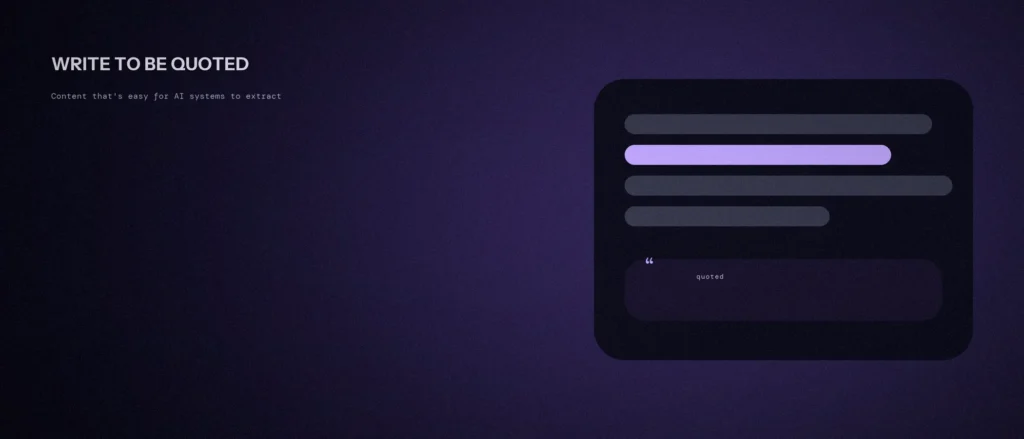
An AI system answering a question doesn’t read your entire page and form an opinion the way a person does. It pulls out the specific passage that answers the question, uses that passage, and often never touches the rest of the page at all.
That changes the unit that actually matters. It’s no longer the page as a whole, it’s each individual paragraph or section, standing entirely on its own. A paragraph that only makes sense after reading three paragraphs before it is a paragraph that’s hard to extract cleanly, no matter how well the page reads as a whole.
What actually improves it, according to real testing
This isn’t guesswork. A study from researchers at Princeton and IIT Delhi actually tested which content changes improved visibility in generative engine responses, and measured the results directly rather than assuming.
Three methods stood out clearly. Quotation Addition, Statistics Addition, and Cite Sources each produced “a relative improvement of 30-40%” on the study’s visibility metric. All three share something in common: they add something concrete and checkable to a paragraph, not just more words.
Fluency and simply being easier to understand also helped, producing a real but smaller boost. What didn’t help was the one thing old-school SEO leaned on hardest: the same research found keyword stuffing “offer[s] little to no improvement” in generative engine responses, a genuine break from how ranking used to work.
What matters less than people assume
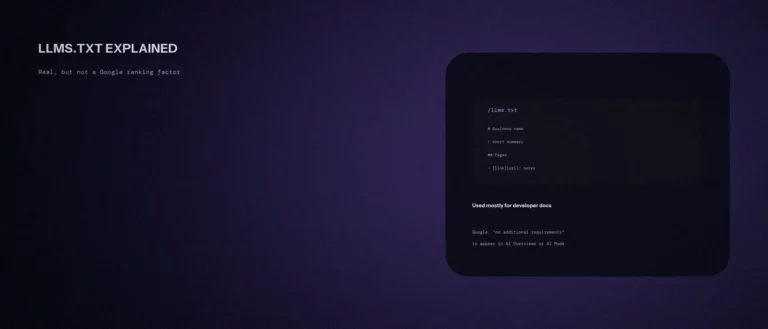
There’s a real temptation to treat AI extractability as a technical problem with a technical fix, a special file, a new markup format, a plugin. Google’s own documentation pushes back on that directly: “there are no additional requirements to appear in AI Overviews or AI Mode, nor other special optimizations necessary,” and “you don’t need to create new machine readable files, AI text files, or markup.”
The Princeton and IIT Delhi study found something similar from a different angle: simply claiming authority, adding language that sounds more credible without backing it with anything concrete, “demonstrated that Generative Engines are already somewhat robust to such changes.” Sounding authoritative isn’t the same as being extractable. Being specific is.
How to actually write an extractable paragraph
Put the real answer first in each section, not buried after three sentences of setup. A paragraph that opens with the actual point reads as a complete answer even if someone never sees the paragraph before it.
Back claims with something concrete: a specific number, a named source, a direct quote. This is exactly what the research above measured, and it lines up with the same principle covered in our guide to GEO: specificity is what gets pulled into an answer, not clever phrasing.
Keep each paragraph built around one idea. A paragraph doing three jobs at once, background, a caveat, and the actual answer, is harder to lift cleanly than three shorter paragraphs each doing one job.
A prompt to make a page easier to quote
AI systems quote text that is clear, direct and easy to lift. The prompt below asks an AI tool to check one of your pages for that. Paste in the text of a page, and use the answer as a to-do list for an edit.
Act as an editor who makes web pages easy for AI assistants and readers to quote.
Here is the page text:
[paste the text here]Please do the following:
1. Tell me whether each section answers its heading in the first sentence.
2. Find vague sentences that would not make sense if quoted alone.
3. Suggest a short, direct answer I could put at the top of the page, using only facts in my text.Rules:
– Do not add facts that are not in my text.
– Do not change my meaning.
– Keep every suggestion plain and short.
Apply only the edits that keep the page true and useful. A page that reads clearly to a person is usually the same page an AI tool finds easy to quote.
Questions worth answering directly
What actually helps content get quoted by AI systems like ChatGPT?
Research from Princeton and IIT Delhi found adding quotations, statistics, and cited sources each produced a 30 to 40% relative visibility improvement in generative engine responses. Concrete, checkable additions outperform vague or purely persuasive language.
Does keyword stuffing still work for AI search visibility?
No. The same research found keyword stuffing offers little to no improvement in how generative engines use content, a real break from how classic SEO ranking used to reward keyword density.
Do I need special markup or an AI text file to appear in AI Overviews?
No. Google’s own documentation states there are no additional requirements or special optimizations needed to appear in AI Overviews or AI Mode, and no new machine-readable files or markup are required.
Why do AI systems extract individual paragraphs instead of whole pages?
Generative engines pull specific passages that answer a query directly rather than reading and summarising an entire page. This means each section needs to work as a standalone answer, not rely on context from earlier paragraphs.
What did the Princeton and IIT Delhi study test?
Which content changes improved visibility in generative engine responses. Quotation Addition, Statistics Addition and Cite Sources each produced “a relative improvement of 30-40%” on the study’s visibility metric. Fluency helped by a smaller amount, and keyword stuffing offered little to no improvement.
How do I write an extractable paragraph?
Put the real answer first in each section, back claims with something concrete such as a number, a named source or a direct quote, and build each paragraph around one idea. A paragraph doing three jobs at once is harder to lift cleanly than three that each do one.
Where this actually matters
Writing for AI extraction and writing genuinely useful content turn out to be almost the same task: be specific, back claims with something real, and make each section stand on its own.
Not sure if your own content is actually structured to get pulled into an AI answer? We check this as part of every AI SEO and GEO engagement we run.