Rank first for a keyword today and you might still get fewer clicks than you did a year ago for the same position. That’s not a tracking bug. It’s AI Overviews, and the click-through data on what they actually do to organic traffic is now real and measured, not speculation.
Here’s what AI Overviews actually are, what the real numbers say about clicks, and what that means for a page that’s ranking well but not getting visited.
Quick summary, if you’re short on time:
- Google describes AI Overviews as a feature that helps people “get to the gist of a complicated topic more quickly” and acts as “a jumping off point to explore links to learn more.”
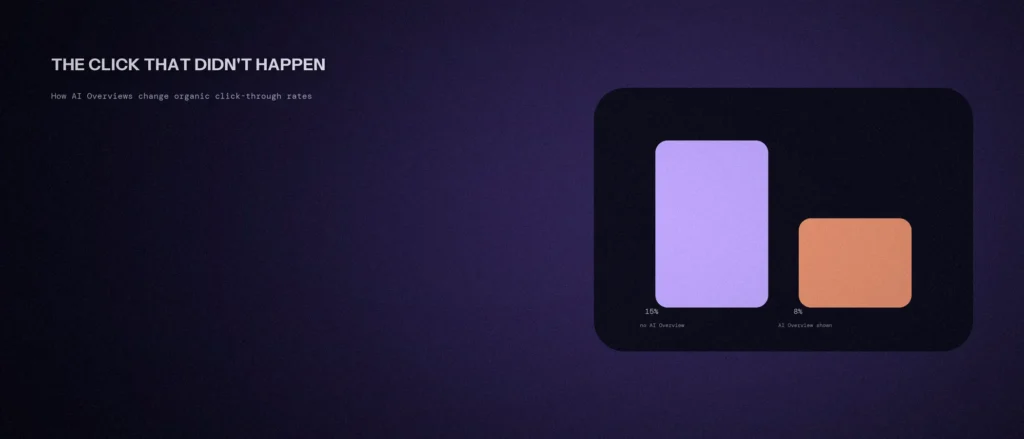
- Pew Research found users click a traditional search result in just 8% of visits when an AI summary appears, versus 15% when it doesn’t, nearly half the rate.
- Only 1% of visits result in a click on a link inside the AI summary itself.
- A 300,000-keyword Ahrefs study found position 1 organic click-through rate dropped 34.5% on average once an AI Overview appeared for that query.
- Being cited inside the AI Overview isn’t nothing, cited pages still see meaningfully more clicks than pages that rank well but go uncited.
Jump to a section:
- What AI Overviews actually are
- What the real click data shows
- Why clicks drop even at position 1
- What this actually means for your content
- A prompt to check your click data for AI Overviews
- Questions worth answering directly
What AI Overviews actually are
Google’s own documentation is direct: AI Overviews “help people get to the gist of a complicated topic or question more quickly, and provide a jumping off point to explore links to learn more.” It’s an AI-generated summary that appears above the normal list of blue links, built by pulling from multiple web pages at once rather than sending someone to a single result.
Google is also clear about when it shows up: “AI Overviews are only shown when our systems determine that it is additive to classic Search, and as such, often don’t trigger.” It’s not on every query, but on the queries where it does trigger, mostly broader informational questions, it changes the page before a single organic result is even visible.
What the real click data shows
Pew Research Center tracked actual browsing behavior from 900 U.S. adults across 68,879 real Google searches in March 2025, not a survey asking people what they think they’d click. The result: “users who encountered an AI summary clicked on a traditional search result link in 8% of all visits. Those who did not encounter an AI summary clicked on a search result nearly twice as often (15% of visits).”
The AI summary itself doesn’t make up that gap either. Only 1% of visits led to a click on a link inside the summary. And people weren’t just moving on to a different search, they were more likely to stop searching altogether: sessions ended without any further click 26% of the time when a summary appeared, against 16% when it didn’t.
An Ahrefs study measured the same shift from the ranking side, analyzing 300,000 keywords split evenly between ones triggering an AI Overview and similar informational keywords that didn’t. They found the presence of an AI Overview correlated with a 34.5% lower average click-through rate for the page sitting in position 1. Ranking first stopped meaning what it used to mean.
Why clicks drop even at position 1
The mechanism is straightforward once you see the actual page layout. An AI Overview sits above every organic result, including position 1, and it directly answers the kind of question that used to require a click to resolve, “what’s the difference between X and Y,” “how does this work,” “what does this mean.” If the summary answers that fully, there’s often no remaining reason to click through, regardless of how well the page below it is optimized.
This is the same shift covered from the reporting side in our post on Search Console’s AI Overviews reports, since Google itself has effectively confirmed this is a separate, measurable category of search behavior, not a minor variation on normal organic results.
What this actually means for your content
Ranking well still matters, since AI Overviews pull their citations from pages that are already ranking and structured clearly, not from nowhere. But ranking well is no longer the same goal as getting clicked. The realistic target shifts toward being one of the sources actually cited inside the summary, since Ahrefs’ own data shows cited pages see meaningfully higher click-through than pages that rank well but never get pulled into the summary.
Getting cited depends heavily on how extractable your content actually is, whether an answer sits in a clear, self-contained sentence or paragraph an AI system can lift cleanly, covered in more detail in our guide to writing for AI extraction. Content written to be skimmed by a person and content written to survive being pulled into a summary aren’t automatically the same thing.
A prompt to check your click data for AI Overviews
AI Overviews can change how many people click on a result. The prompt below helps you look at your own numbers without jumping to conclusions. Copy figures from Search Console for a few pages, and check the answer against the report.
Act as an SEO analyst. I will paste data from Google Search Console for a few pages.
Here is the data (page, clicks, impressions, average position, for two time periods):
[paste rows here]Please do the following:
1. Tell me which pages saw clicks fall while impressions stayed the same or rose.
2. List the other possible reasons for that pattern besides AI Overviews.
3. Suggest 3 checks I can do by hand, such as searching the query myself.Rules:
– Only use the numbers I pasted.
– Do not claim a change was caused by AI Overviews unless the data shows it.
– Say clearly when the data is too small to tell.
Search the queries yourself to see what Google shows. One clear example beats a guess from a table of numbers.
Questions worth answering directly
Do AI Overviews actually reduce clicks to my website?
Yes, based on real measured data. Pew Research found organic click-through nearly halves when an AI summary appears (8% versus 15%), and Ahrefs found a 34.5% average CTR drop for position 1 specifically once an AI Overview triggered for that query.
Does ranking #1 still matter if AI Overviews are taking the clicks?
It still matters, since AI Overviews cite from pages that are already ranking well and clearly structured. But the goal shifts from just ranking to actually being cited inside the summary, since cited pages get more clicks than uncited pages that rank in the same position.
Do people click the links inside an AI Overview itself?
Rarely. Pew Research found only 1% of visits resulted in a click on a link inside the AI summary, meaning the summary mostly answers the question on its own rather than functioning as a gateway to more clicks.
What does Google say AI Overviews are for?
Google says AI Overviews “help people get to the gist of a complicated topic or question more quickly, and provide a jumping off point to explore links to learn more.” They appear above the normal list of blue links and pull from multiple web pages at once.
Do AI Overviews appear on every search?
No. Google says they are “only shown when our systems determine that it is additive to classic Search, and as such, often don’t trigger.” They mostly appear on broader informational questions.
How big were the Pew Research and Ahrefs studies?
Pew Research Center tracked 900 U.S. adults across 68,879 real Google searches in March 2025. Ahrefs analysed 300,000 keywords, split evenly between ones that triggered an AI Overview and similar informational keywords that did not. Ahrefs found a 34.5% lower average click-through rate for position 1 when an AI Overview was present.
Where this actually matters
A ranking report that only shows position, without checking whether AI Overviews are triggering on those same keywords, is telling you half the story. The other half is whether anyone’s actually landing on the page.
Not sure how many of your own ranking keywords are already losing clicks to AI Overviews? We check this as part of every AI SEO and GEO engagement we run.