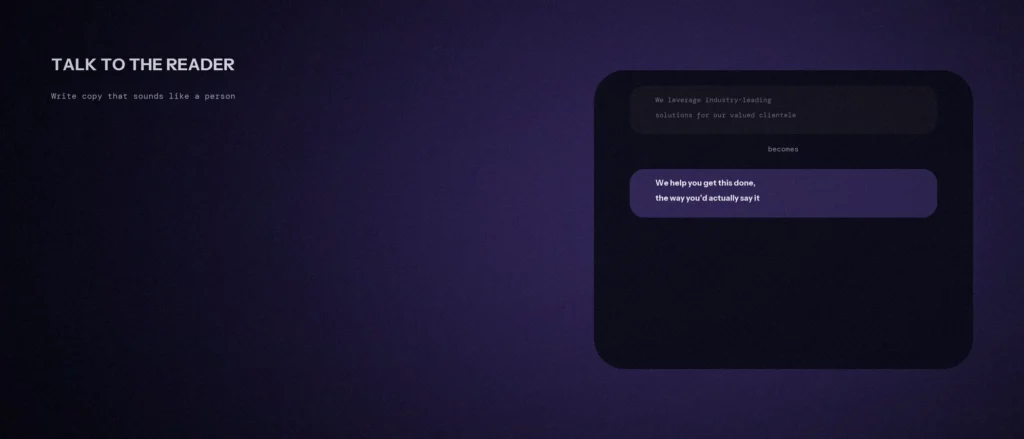
Read this sentence from a real homepage: “We leverage industry-leading solutions to deliver comprehensive value-added services to our valued clientele.” Now imagine saying that out loud to someone standing in front of you. You wouldn’t. You’d say “We help you get this done.” The gap between those two sentences is the whole problem.
Most website copy isn’t written badly because the writer lacks skill. It’s written badly because it was written the way businesses have always written, formal, safe, a little inflated, instead of the way an actual person talks. Here’s what the research says about fixing that, one sentence at a time.
Quick summary, if you’re short on time:
- The U.S. National Archives’ own writing style guide is explicit that “you” pulls readers into the document and makes sentences “shorter, more direct, and clearer.”
- Nielsen Norman Group’s research on tone of voice found casual, conversational tones performed better than formal ones, even in traditionally formal industries like banking.
- That same research found trustworthiness explains most of what makes a tone work, so conversational only helps if it still reads as credible, not silly.
- The fastest way to check your own copy is to read it out loud and notice every word you’d never actually say to a person.
- Brochure language isn’t wrong because it’s polished. It’s wrong because nobody talks that way, and readers notice the distance.
Jump to a section:
- Why brochure language creeps into every website
- What the research says about talking to the reader
- Conversational doesn’t mean unprofessional
- A simple method for rewriting a page
- A prompt to make your copy sound like a person
- Questions worth answering directly
Why brochure language creeps into every website
Nobody sets out to write “we leverage synergies.” It happens one small decision at a time: a founder wants to sound established, so “we help” becomes “we provide.” A line feels too plain, so “fast” becomes “expedited.” Each change feels like an upgrade. Stacked together, they turn a business into a brochure.
The result reads like it was written for a shareholder report, not for the person deciding whether to call you. This is the same gap we covered in our post on why “we provide quality service” means nothing: vague, inflated language and empty promotional language are two versions of the same habit, dressing up a sentence instead of saying the actual thing.
What the research says about talking to the reader
The clearest, most specific guidance on this comes from an unlikely source: the U.S. National Archives’ own internal writing style guide, built for exactly the kind of formal, bureaucratic writing most businesses accidentally imitate. Its instruction is direct: “‘You’ pulls readers into the document. It helps them understand how the document relates to them and what they need to do. And it helps make your sentences shorter, more direct, and clearer.”
Separately, Nielsen Norman Group’s research on tone of voice tested how different tones landed with real users across industries, including ones assumed to need formality. It found that “casual, conversational, and moderately enthusiastic tones performed best” overall, and that even a bank sample written casually was perceived as friendlier and more trustworthy than its formal counterpart.
Put together, two separate bodies of research, one from a government writing standard and one from user testing, point at the same fix: talk to the one person reading, not to an audience.
Conversational doesn’t mean unprofessional
This is where the advice gets misapplied. Writing like a person doesn’t mean writing like you’re joking around, and NN/g’s own research includes a warning about that too. One participant in their study said a playful tone “takes away some of the credibility,” and the researchers noted humor isn’t right for every organisation or moment.
The same study found that 52% of what makes a tone work at all comes down to trustworthiness, with friendliness adding only a small amount on top. So the goal isn’t casual for its own sake. It’s plain and direct, the way you’d actually explain your business to someone who asked, minus the jokes if your industry doesn’t call for them.
A simple method for rewriting a page
Take one paragraph of your homepage and run it through three checks:
- Read it out loud. Any sentence you’d never actually say gets flagged. “We leverage industry-leading solutions” fails immediately.
- Replace the noun with “you.” “Comprehensive value-added services” becomes “help with X, Y and Z” once you ask who it’s actually for.
- Cut the word that exists to sound impressive. Comprehensive, robust, cutting-edge, best-in-class. If the sentence works without it, it wasn’t adding information.
Do this one section at a time rather than rewriting the whole site at once. A homepage hero and a pricing page don’t need identical energy, and this is the same personality-versus-tone distinction we cover in our post on brand voice consistency across channels. The core voice stays the same. How warm or brief it sounds can flex by page.
A prompt to make your copy sound like a person
Copy sounds stiff when it is written for the brand and not for the reader. The prompt below asks an AI tool to point out the stiff parts. Paste in your text, and rewrite in your own words.
Act as an editor who makes business writing sound like a real person talking.
Here is my text:
[paste a paragraph or a page]Please do the following:
1. Mark the sentences that sound stiff, corporate or like a template.
2. Show a plainer version of 3 of them, using only my facts.
3. List the words I use often that a customer would not say.Rules:
– Do not add claims, numbers or names.
– Use short sentences and everyday words.
– Do not make it sound like a famous brand.
Read your text out loud. If you would not say a sentence to a customer, change it.
Questions worth answering directly
Why does website copy end up sounding formal and impersonal?
It usually happens gradually, as plain words get swapped for ones that sound more established, “help” becoming “provide,” “fast” becoming “expedited.” Each change feels safer, but stacked together they create distance between the business and the reader.
Does using “you” in website copy actually help?
Yes. The U.S. National Archives’ own writing style guide states that “you” pulls readers into the document, helps them understand how it relates to them, and makes sentences shorter, more direct and clearer.
Is conversational copy less professional than formal copy?
Not according to the research. Nielsen Norman Group found casual, conversational tones performed better than formal ones across industries, including banking. The key factor was trustworthiness, not formality, so conversational copy still needs to read as credible.
How do I keep copy friendly without sounding unprofessional?
Aim for plain and direct, not jokey. Nielsen Norman Group found trustworthiness explains 52% of the variability in desirability, and warned that playful tones can take away credibility in some contexts.
Where should I start rewriting my website copy?
Take one paragraph of your homepage and run three checks: read it out loud, replace vague nouns with you, and cut words that exist to sound impressive. Do one section at a time.
Should I use we or you?
Both. The U.S. National Archives style guide lists you and we among the pronouns to use, and says you pulls readers into the document and helps make sentences shorter, more direct and clearer.
Where this actually matters
A visitor deciding whether to trust your business is reading your words the way they’d listen to a person, not a document. Writing that sounds like one is one of the few changes that costs nothing and can be done to your existing site today.
Not sure if your own website still sounds like a brochure? We work through this as part of every website engagement we run.