Read your website’s homepage, then read your last five Instagram captions, then read the email your sales team actually sends when someone asks for a quote. If those sound like three different people wrote them, and for most small businesses they do, that’s not a copywriting nitpick. It’s the reason people hesitate before trusting you.
Brand voice inconsistency doesn’t usually come from bad writing. It comes from nobody ever deciding what your one voice actually sounds like, so every channel invents its own.
Quick summary, if you’re short on time:
- Nielsen Norman Group’s own research found trustworthiness explains 52% of what makes a brand feel desirable to users, more than any other factor tested.
- A brand’s personality should stay consistent everywhere, but the tone can flex: a careers page can sound warmer than a financial report without being a different brand.
- NN/g’s guidance is explicit that tone of voice belongs in your omnichannel strategy, covering “email, physical products, and the in-store experience,” not just the website.
- When channels genuinely conflict instead of just varying in warmth, casual social captions next to a stiff, jargon-heavy website, that reads as two different companies, not one flexible one.
- Fixing this doesn’t require rewriting everything at once. It starts with naming the personality traits that shouldn’t change, then checking each channel against them.
Jump to a section:
- Why sounding like three companies actually costs you
- The difference between personality and tone
- Where brand voice usually breaks down
- How to actually check your own consistency
- A prompt to check your brand voice across channels
- Questions worth answering directly
Why sounding like three companies actually costs you
Nielsen Norman Group’s own user research on tone of voice found that “52% of the variability in the desirability scores is explained by trustworthiness” more than any other single factor they tested. Trust isn’t a soft, secondary metric here. It’s the thing doing most of the work in whether someone actually wants to do business with you.
A voice that shifts unpredictably between channels quietly undermines exactly that. If a visitor reads a confident, plain-spoken homepage, then lands on an Instagram caption full of slang and emoji, then gets a stiff, over-formal email reply, nothing about the content itself has to be wrong for the overall impression to be: who am I actually talking to here?
The difference between personality and tone
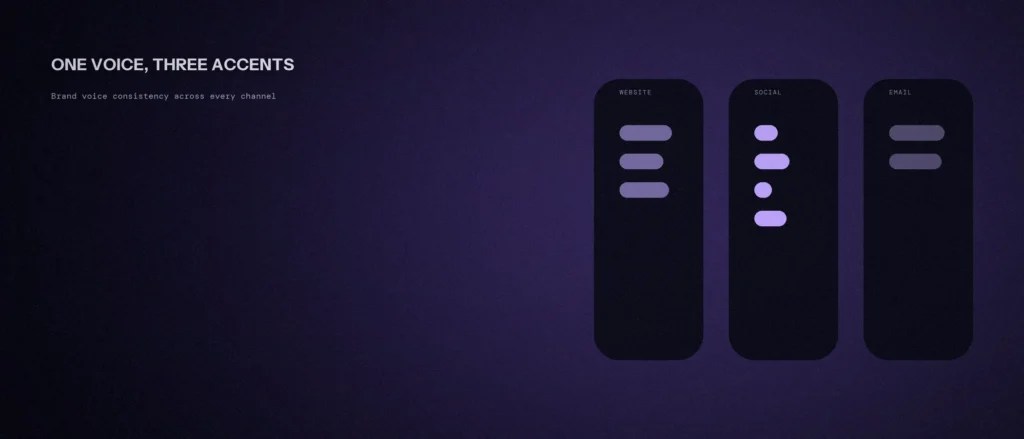
The fix isn’t making every channel sound identical. NN/g’s own framework is specific about this: “keep your brand personality consistent, but vary the tone to fit the user’s emotional state and the topic.” A pricing page and a careers page targeted at new graduates are allowed to sound different in energy. What isn’t allowed to change is the underlying personality behind both.
That personality gets defined along a small number of dimensions, formal versus casual, serious versus funny, respectful versus irreverent, matter-of-fact versus enthusiastic. Pick where your business sits on each of those once, and every channel has the same reference point, even when the specific tone shifts to match the moment.
Where brand voice usually breaks down
The most common failure isn’t tone flexing appropriately, it’s tone changing for no reason other than who happened to write that particular piece. The website was written once by an agency and never touched again. Social media is run day to day by whoever’s fastest on a phone. Sales emails are whatever each person on the team personally writes. None of those three people ever compared notes.
This is the same underlying gap covered from a different angle in why About Us pages sound generic: generic language and inconsistent voice both come from the same root cause, nobody deliberately decided what the business actually sounds like, so it defaults to whatever’s easiest in the moment.
How to actually check your own consistency
Pull up your homepage, your most recent social captions, and a real sales email side by side. Don’t judge them on quality individually, judge whether a stranger reading all three would guess they came from the same company. Specific word choices, sentence length, how formal or playful each one is, that comparison surfaces the mismatch faster than trying to describe your brand voice in the abstract.
Once the mismatch is visible, write down three or four personality traits your business actually is, not aspirational ones, and check each channel against them. The website and the Instagram captions don’t need matching sentence structure. They need to sound like the same personality is behind both, just adjusting its tone to fit a different room. This is closely related to the one-sentence test, since a business that can’t describe itself in one clear sentence usually can’t keep its voice consistent across channels either, both come from the same missing foundation.
A prompt to check your brand voice across channels
If your website, ads and social posts sound like three different companies, visitors notice. The prompt below helps you compare them. Paste a sample from each place and ask what a stranger would think.
Act as a brand editor. I will paste short samples of my writing from three places.
My website:
[paste a paragraph]My ads:
[paste 2 or 3 ad texts]My social media:
[paste 2 or 3 posts]Please do the following:
1. Describe the voice of each sample in three plain words.
2. Point out where the voices clash.
3. Write a short voice guide of 5 rules for me, based only on what my samples say about how I want to sound.Rules:
– Do not invent qualities I did not show.
– Use plain words.
– Do not tell me to sound like a famous brand.
Keep the five rules on one page and use them the next time you write anything for the business. Recheck in a month.
Questions worth answering directly
Does brand voice mean every channel has to sound exactly the same?
No. Personality should stay consistent, but tone can flex to fit the channel and moment, a careers page can sound warmer than a financial report without being a different brand. The problem is unplanned inconsistency, not situational tone variation.
Why does inconsistent brand voice actually hurt trust?
Nielsen Norman Group’s research found trustworthiness explains 52% of what makes a brand desirable to users, more than any other factor tested. A voice that shifts unpredictably across channels makes it harder for someone to form a clear, trusting impression of who they’re dealing with.
How do I check if my own brand voice is actually consistent?
Put your homepage, recent social captions, and a real sales email side by side, and judge whether a stranger would guess they came from the same company. Then define three or four real personality traits and check each channel against them, rather than trying to make every piece of content sound identical.
What is the difference between brand personality and tone?
Personality is who your brand is, and it should stay the same everywhere. Tone is how it sounds in a given moment and can flex. Nielsen Norman Group’s advice is to “keep your brand personality consistent, but vary the tone to fit the user’s emotional state and the topic.”
Where does brand voice usually break down?
Usually not because tone flexed on purpose, but because whoever wrote each piece decided alone. The website was written once by an agency, social media is run by whoever is fastest on a phone, and each person writes their own sales emails. None of them compared notes.
How many personality traits should I define?
Three or four traits your business genuinely has, not aspirational ones. Then check each channel against them. Your website and your Instagram captions do not need matching sentence structure, only the same personality behind both.
Where this actually matters
A business can have a clear offer and a decent website and still lose trust simply because it sounds like a different company depending on where someone encounters it. Voice consistency isn’t a branding luxury, it’s part of what makes someone believe they’re dealing with one real, coherent business.
Not sure if your own website, ads and social actually sound like the same company? We work through this as part of every website engagement we run.