Anthropic just started quietly adding an AI watermark to every piece of text Claude writes. Not visibly, not with a label you can see, but with something baked into the writing itself. If you use AI tools to help write website content, the obvious question is whether this changes anything for your rankings.
Short answer: no, but the reason why is worth actually understanding, not just taking on faith.
Quick summary, if you’re short on time:
- Anthropic now adds an invisible, machine-readable mark into Claude’s text output, mainly to comply with the EU AI Act’s Article 50.
- Anthropic’s own help page is direct that this “doesn’t change the meaning, quality, or readability” of the text.
- The mark can survive copy-paste and some editing, but Anthropic itself says a detected mark isn’t fully conclusive, and a missing mark doesn’t prove AI wasn’t involved.
- Google’s own documentation says using AI to generate content only breaks its spam policy when it’s done “without adding value for users,” regardless of whether it’s AI or human-written.
- A watermark inside Claude’s text has no connection to how Google’s ranking systems evaluate your page.
Jump to a section:
- What Anthropic actually announced
- How the watermark actually works
- Why this exists at all
- Does this affect your SEO?
- What this actually means for your content
- A prompt to review your own writing
- Questions worth answering directly
What Anthropic actually announced
Starting with Claude models launched on or after August 2, 2026, Anthropic began adding what it calls a machine-readable mark to text Claude generates. Anthropic’s own help documentation describes it as “an imperceptible watermark directly into the text itself.”
The mark applies across Anthropic’s own products, including the Claude app, the developer API, Claude Code, Claude Cowork and Claude Tag. Anthropic rolled this out worldwide, not only for users based in the EU.
How the watermark actually works
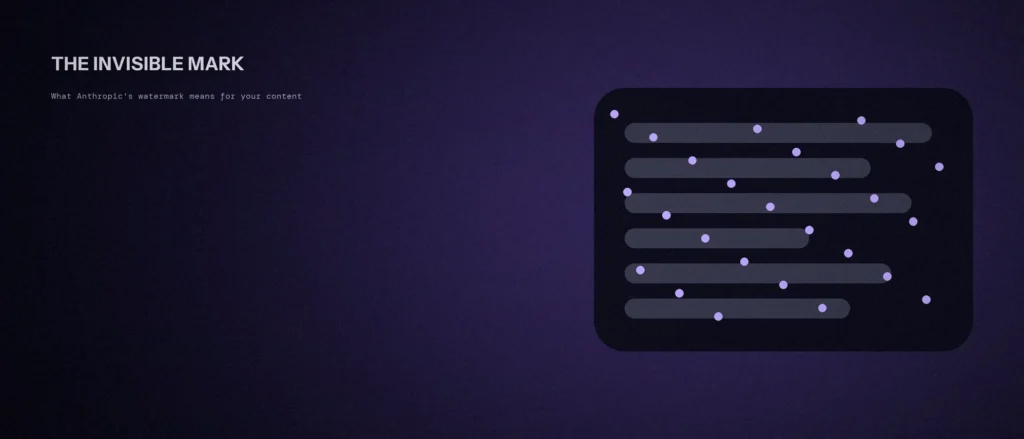
This isn’t a hidden character or a chunk of invisible text tacked onto your document. Anthropic’s own page is specific about the effect: the mark “doesn’t change the meaning, quality, or readability of Claude’s response.”
What actually happens is closer to a subtle statistical pattern in which words Claude picks when several equally good choices exist. That pattern is detectable by Anthropic’s own tools without being visible or readable to a person.
Two honest caveats come straight from Anthropic itself. First: “because the watermark is part of the text, it will travel with the text when it’s copied and pasted elsewhere, and may persist through some editing,” meaning it’s not guaranteed to survive every rewrite. Second, and more important: a detected mark “is not fully conclusive” proof of AI authorship, and a missing mark “doesn’t mean the content wasn’t AI-generated or processed,” since heavy editing, paraphrasing or translation can remove it entirely.
Why this exists at all
This isn’t an SEO feature or a content-quality tool. It exists because of Article 50 of the EU AI Act, which requires providers of AI systems that generate synthetic content to mark that output in a machine-readable way so it can be identified as artificially generated.
Anthropic chose to apply the mark globally rather than build a separate EU-only version, which is why every Claude user is affected, not just those in Europe.
Does this affect your SEO?
No, and the reason is straightforward once you separate the two systems. The watermark is Anthropic’s compliance tool, built for regulators and future detection tools, not for Google. Google’s own ranking systems have no access to Anthropic’s private detection method, and nothing in Google’s documented ranking process reads or checks for it.
What actually governs whether AI-assisted content ranks is Google’s spam policy, and its wording is specific. Google’s own documentation states that using generative AI tools “to generate many pages without adding value for users may violate Google’s spam policy on scaled content abuse.” The trigger is a lack of value, not the use of AI itself.
Google has said this consistently since its original 2023 guidance on AI content: automation has long been used for genuinely useful content, like sports scores and weather updates, and the same principle extends to AI-assisted writing that actually helps the reader. This lines up with the same standard covered in our guide to GEO: trust and usefulness matter more than which tool typed the words.
What this actually means for your content
If you use AI tools to draft or assist with website content, nothing about your workflow needs to change because of this announcement. The watermark doesn’t get checked by Google, doesn’t affect crawling or indexing, and isn’t a ranking signal in any documented system.
What still matters is the same thing that mattered before Anthropic’s announcement: whether the finished page is accurate, adds real value, and isn’t published purely to fill a content calendar. Google’s own guidance also recommends disclosing how content was created “when it would be reasonably expected,” which is good practice regardless of watermarking, and separate from it entirely. Google updated its generative AI guidance on 1 October 2026 to say it is critical to manually review and fact check AI-generated content before publishing. Our post on how to fact check AI generated content gives a routine for that.
A prompt to review your own writing
Watermarks or not, readers and search engines care whether your page is useful. The prompt below asks an AI tool to review a draft the way a careful editor would, looking for empty filler and claims with no source. Paste in your own draft, and read the answer as a second opinion, not a verdict.
Act as a strict editor. I will paste a draft blog post.
Here is the draft:
[paste your text here]Please do the following:
1. Mark any sentence that sounds like generic filler that could appear on any website.
2. List any claim that has no source, number or example behind it.
3. Suggest how to make 3 of the weakest paragraphs more specific, using only facts I give you.Rules:
– Do not add facts, statistics or quotes that are not in my draft.
– Do not rewrite the whole post. Point to the problems and show one example fix each.
– Keep the tone plain, like a person explaining something to a customer.
Fix the weak parts yourself, with real details from your own work. A post written with real experience will hold up whether or not a tool can spot how it was made.
Questions worth answering directly
Does Anthropic’s Claude watermark affect Google rankings?
No. The watermark is Anthropic’s own compliance tool for the EU AI Act and isn’t connected to Google’s ranking systems. Google’s documented spam policy judges AI-assisted content on whether it adds value for users, not on whether an AI watermark is present.
What is the Claude watermark and how does it work?
It’s an imperceptible, machine-readable pattern built into the sequence of word choices Claude makes, applied to models launched on or after August 2, 2026. Anthropic states it doesn’t change the meaning, quality or readability of the text.
Can the Claude watermark be removed by editing the text?
It can weaken or disappear. Anthropic itself says the mark may persist through some editing, but heavy editing, paraphrasing or translation can remove it, and a missing mark doesn’t prove the content wasn’t AI-generated.
Does Google penalize AI-generated content?
Not simply for being AI-generated. Google’s own documentation says using AI to generate many pages without adding value for users violates its spam policy on scaled content abuse, meaning the standard is usefulness, not the tool used to produce it.
Which Claude products add the watermark, and since when?
It applies to text from Claude models launched on or after August 2, 2026, across the Claude app, the developer API, Claude Code, Claude Cowork and Claude Tag. Anthropic rolled it out worldwide, not only for users in the EU.
Why does Anthropic add a watermark at all?
Because of Article 50 of the EU AI Act, which requires providers of AI systems that generate synthetic content to mark that output in a machine-readable way. Anthropic chose to apply it globally instead of building an EU-only version.
Where this actually matters
Anthropic’s watermark is a real, well-documented change, but it solves a regulatory transparency problem, not a search ranking one. Conflating the two leads to worrying about the wrong thing.
The standard that actually decides whether your content performs, AI-assisted or not, hasn’t moved. We help clients build content that clears that bar as part of every AI SEO and GEO engagement we run.