
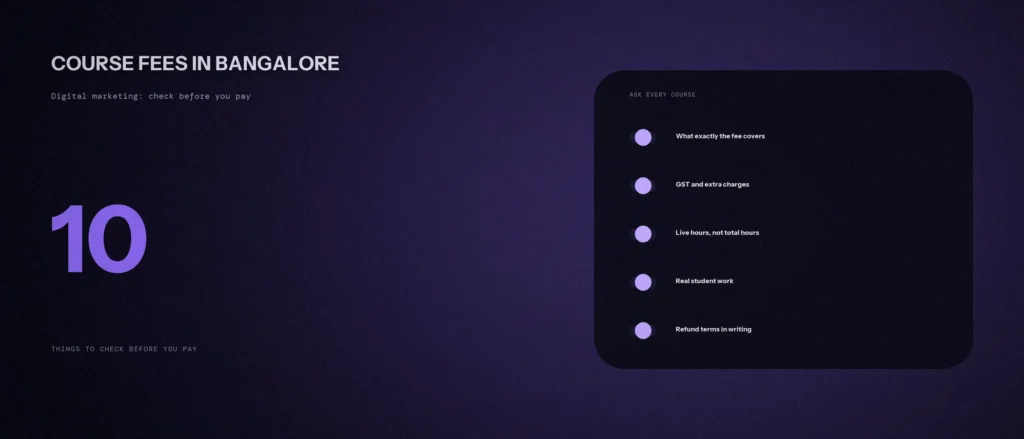
Digital marketing course fees in Bangalore range widely, and the price on the poster rarely tells you what you are buying. Two courses can cost the same and be completely different: one is 20 hours of live teaching with real projects, the other is a set of recorded videos with a certificate at the end. You cannot compare them by the fee alone.
This post gives you 10 things to check before you pay for any digital marketing course in Bangalore. We run a course ourselves, the Zunelo Academy, so you should read this knowing that. To keep it fair, we have not listed any other institute’s fees, because they change and we would not want to print a wrong number. Instead, we explain what to ask, and we answer each question for our own course at the end, including where our own page falls short. We checked our course pages and Google’s and HubSpot’s training pages on 11 October 2026.
Quick summary, if you’re short on time:
- Ask what the fee covers, and what costs extra, and get the final amount in writing.
- Count the real hours, and ask whether the sessions are live or recorded.
- Ask to see real student work, and who teaches and whether they still do the work.
- Be careful of placement promises. ASCI’s guidelines for education advertising say ads must not suggest enrolment guarantees a job unless it can be substantiated, and must not claim “100% placement”.
- Ask what you are paying for that you cannot get free. HubSpot Academy says its training is 100% free and online.
Jump to a section:
- Why the fee alone tells you little
- The 10 things to check
- Placement claims: what India’s ad rules say
- How we answer these for our own course
- What a digital marketing course should cover
- Warning signs
- A prompt to compare two courses
- Questions about course fees
Why the fee alone tells you little
A fee is a total. What you are really buying is a number of hours, taught a certain way, by a certain person, with certain things included. If you do not know those, you cannot work out what an hour of teaching costs, or whether a lower fee is cheaper.
Use a simple method. For every course you are considering, write down five numbers: the total fee including every tax and extra, the total hours of live teaching, the number of students in a batch, how many projects you finish, and how long you have access afterwards. Then divide the fee by the live hours. That is a rough price per live hour, and it is often more useful than the headline fee.
The 10 things to check
1. What the fee includes
Ask for a list. Does it cover study material, tool access, projects, the certificate, exam fees for any certification, and support after the course ends? “Includes everything” means nothing until someone writes down what everything is.
2. Taxes and extra charges
Ask whether the fee you were quoted already includes GST, and what the final amount is. Ask about registration fees, material fees and exam fees too. Get the final number in writing before you pay anything.
3. Real hours of teaching
A course may advertise “60 hours” and count recorded videos, practice time and self-study in that number. Ask how many of those hours are live, with a person teaching and answering questions, and on which days and times. Then check that the schedule fits your life, because a course you cannot attend is a wasted fee.
4. Live, recorded or mixed
Both can be good. They are different products at different prices. Recorded content is useful and cheap to produce. Live teaching costs more because someone has to be there. Ask which one you are buying, and ask to attend a demo class.
5. Who teaches
Ask for the trainer’s name and ask what they do for work today. Someone who runs client campaigns this month will teach what works this month. Someone who left the industry years ago may teach what worked then. Ask to see their profile or a recent sample of their work.
6. Batch size
“Small batch” is not a number. Ask how many students are in a batch, and whether you will get time to ask questions or get your own work reviewed. A class of 8 and a class of 60 are different experiences at the same fee.
7. Real student work
Ask to see projects done by past students, not examples made by the trainers. If it is a new course with no past students, ask what the finished project will look like, and who reviews it.
8. Placement and salary claims
Treat any promise of a job or a salary as something to question, including phrases such as placement assistance or placement support. The next section explains what India’s advertising rules say.
9. Refunds, missed classes and delays
Ask three things in writing: what happens if you cancel before the start, what happens if you cancel after the first class, and what happens if you miss a session. If the answers are not written down on the site or in the enrolment form, they are only promises.
10. What you are paying for that is free elsewhere
A lot of digital marketing knowledge is free. HubSpot Academy’s home page says its training is “100% free and online”, with certifications in digital marketing, content marketing and social media marketing. Google’s Skillshop lists e-learning courses and certifications for Google Ads, Google Analytics and Business Profile; we did not see a price on that page, so check whether the course you want is free. Free material teaches concepts. What a paid course should add is live feedback, a real project and someone to correct your mistakes. If a course cannot say what it adds, you may not need it.
Placement claims: what India’s ad rules say
The Advertising Standards Council of India (ASCI) has guidelines for advertising by educational institutions, programmes and platforms, which apply to coaching classes and edtech platforms that offer training. We read the PDF on 11 October 2026. Four points matter when you read a course advertisement:
- An ad must not state or lead people to believe that enrolling will guarantee a job, admission, promotion or salary increase, unless the advertiser can substantiate it. It must also carry a disclaimer that past record is no guarantee of future prospects.
- An ad must not claim a numerical value of 100% for abstract claims that cannot be measured, and the guidelines give “100% placement” and “100% job assistance” as examples.
- Claims about the share of a batch placed, or about highest or average pay, must relate to the latest completed academic year and be backed by evidence.
- An ad that states the number of students placed must also state the total number of students in that class.
ASCI’s guidelines are a self-regulatory code, so this is a standard to hold an advertiser to, not a law. In practice, it gives you good questions: how many students were in the batch, how many were placed, in which year, and where is it written?
How we answer these for our own course
These are the answers from our digital marketing course page and our refund policy, as of 11 October 2026. We have marked the places where our page does not answer the question, because a fair comparison has to include them.
| Check | What our pages say |
|---|---|
| 1. What the fee includes | ₹24,999 covers 20 live sessions, a starter pack, five configured AI agents, a capstone project, three months of support and the alumni network |
| 2. Taxes and extras | The page says “all-in” and “no upsells”, and that no GST is added on top, so ₹24,999 is the amount |
| 3. Real hours | 20 live sessions of one hour each, Monday to Friday, 7 to 8 PM IST. That is 20 live hours |
| 4. Live or recorded | Live online. The page does not say whether sessions are recorded for people who miss one |
| 5. Who teaches | Imraan Shariff, who runs Zunelo’s client accounts |
| 6. Batch size | “Small, by design”. The page gives no number |
| 7. Real student work | Not yet shown. The page lists a capstone project on a real business, and a waitlist for the first batch |
| 8. Placement | No placement guarantee. The best student in each batch is offered an internship at Zunelo |
| 9. Refunds | Full refund if you cancel at least 7 days before the start. 50% within the last 7 days before session 1. No refund once session 1 has taken place, with a seat transfer to the next batch where possible |
| 10. What is free elsewhere | The tools used in the course are free and open source. What we add is live teaching, a project and review |
Two gaps in our own page: the missing batch number, and no statement on missed sessions. The GST line was a third gap until we added it while writing this. We are telling you because those are exactly the questions you should ask any course, including ours.
What a digital marketing course should cover
Fees are easier to judge once you know what should be in the syllabus. A digital marketing training institute that teaches the full set usually covers SEO, Google Ads, social media, email marketing, content, analytics and a practical look at AI tools. Be careful of marketing courses that spend most of the time on one tool, and of any that treat AI as an extra. Ask for the module list in writing, and ask how many hours go to each marketing channel. If you want to learn marketing strategies, check that a real project applies them, and that you leave with skills for the marketing tools businesses use every day.
Warning signs
- A fee that changes depending on who asks. A fee should be the same for everyone, apart from a stated discount.
- Pressure to pay today. A good course can wait a day while you check the answers above.
- A guaranteed job or salary. See the ASCI points above.
- No sample class. If they will not let you see a session, you are buying blind.
- Tools that are years out of date. Check the syllabus for recent topics: GA4, AI search, and current Google Ads automation.
- A certificate as the main selling point. A certificate shows you attended. A project shows what you can do.
A prompt to compare two courses
An AI tool can do the arithmetic and write the questions. It cannot see a course, so give it what each course told you in writing.
Act as a careful, sceptical adviser helping me compare two digital marketing courses. Use only what I paste.
My details, for each course:
– Fee quoted, and whether tax is included: [amount, yes or no or unknown]
– Live hours, recorded hours and the schedule: [numbers]
– Batch size: [number or unknown]
– Who teaches and what they do now: [text]
– Projects I would finish, and what is reviewed: [text]
– Placement or salary claims, exactly as written: [paste]
– Refund and missed-class terms: [paste]Please do the following:
1. Work out the fee per live hour for each course, showing the sum, and say which numbers are missing.
2. Mark each claim as written down, said verbally, or not stated.
3. Flag any placement or salary claim that gives no batch size, year or evidence.
4. Write five questions I should ask each course, in plain English, ordered by how much they would change my decision.Rules:
– Use only my pasted information. Do not invent fees, hours or placement data.
– If a number is missing, say so before calculating.
– Say clearly when something is your opinion.
– Write in plain, simple English.
Send the questions by email or WhatsApp so you have the answers in writing.
Questions about course fees
How much does a digital marketing course cost in Bangalore?
It varies a lot with length, format and teacher, so we do not quote a range. Collect written quotes from the courses you are considering, and compare the fee per live hour and what is included.
Is a higher fee a sign of a better course?
Not on its own. A higher fee can mean more live teaching, a smaller batch and an experienced teacher. It can also mean a larger marketing budget. Check hours, batch size and student work.
Is GST included in course fees?
It depends on the institute, so ask. Get the final amount you will pay, including tax, written down before you pay anything.
Can I learn digital marketing for free?
You can learn a lot. HubSpot Academy says its training is 100% free and online, and Google offers its own courses through Skillshop. A paid course is worth considering when you want live feedback and a project reviewed.
Is a placement guarantee a good sign?
No. ASCI’s guidelines say an ad must not suggest enrolment guarantees a job unless it can be substantiated, and must not claim 100% placement. Ask for the batch size, the number placed, the year and the evidence.
Online or classroom: which is better?
Neither is better in general. Online live classes save travel time. Classrooms can give more in-person contact. What matters is whether you get live teaching, real projects and feedback on your own work.
Should I pay the full fee upfront?
Only if the refund terms are written down and you are comfortable with them. If the course offers instalments, ask for the total you will pay across all of them, including any interest or processing fee.
Where this matters
A course fee is only meaningful next to the hours, the teacher, the batch size and the work you will finish. Ask the 10 questions in writing, compare the fee per live hour, and be careful with any promise of a job.
If you would like us to answer any of these about our own course, send us a WhatsApp message and we will reply in writing.