Everyone is selling AI agents for marketing, and most of what is written about them is either a prediction or a product page. This post is different. It is a plain list of the jobs we really hand to AI agents at Zunelo, written from the roles and rules we use, and the three jobs we keep away from them.
First, what we mean by the word. Anthropic’s engineering article on building effective agents describes workflows as systems where models and tools are orchestrated through predefined code paths, and agents as systems where the model dynamically directs its own process and tool use. Anthropic groups both under the label agentic systems, and “agentic AI” is the term you will see most. We use the word more loosely: for us, an agent is a written role, a set of rules it must follow, and the tools it may use, run on an AI model such as a generative AI model. Think of a small marketing team where each agent drafts one kind of work and a person approves it. A person reviews every output. We re-read our agent definitions and rules on 11 October 2026 before writing this.
Quick summary, if you’re short on time:
- We hand agents the repeatable, checkable work: first drafts, briefs, audits, reports and reply drafts.
- Every output is a draft. A person reviews it before anything goes live or reaches a client.
- Agents never send messages, never publish or push to a live site, and never invent prices, results or promises.
- Each agent has written rules and a source of truth. Without them, the output is a guess in confident language.
- Agents need checking. Our own fact-checks this month corrected claims in published posts.
Jump to a section:
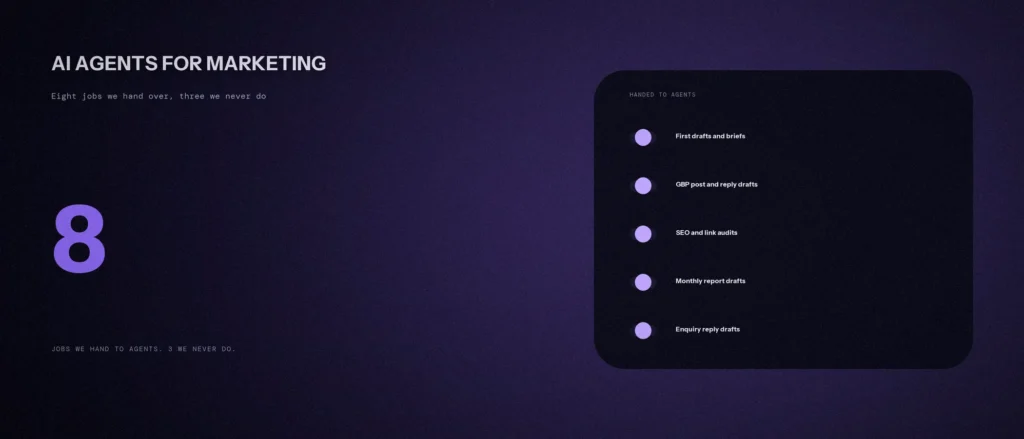
- The 8 jobs we hand to agents
- The 3 jobs we never hand over
- What needs checking
- How to start without wasting a month
- A prompt to pick your first agent job
- Questions about AI agents for marketing
The 8 jobs we hand to agents
Each of these has a written role and rules. For each one, we say what the agent does, what it must not do, and who checks it.
1. First drafts of blog posts and page copy
What it does: drafts posts and page copy in our house style, with the publish checklist applied: Rank Math title and description, internal and external links with short anchor text, and FAQs.
What it must not do: publish. The output is a draft file.
Who checks: a person reads it and re-checks every factual claim against the source.
2. Content briefs
What it does: builds a brief before writing: what the page must answer, section by section, and what competing pages cover. It can use keyword and content-analysis tools for the terms.
What it must not do: decide what to publish. That is a person’s call.
Who checks: whoever approves the topic.
3. Google Business Profile post and review-reply drafts
What it does: drafts posts, service updates and review replies for one client at a time, following the client’s profile and the format already in use.
What it must not do: use a placeholder or generated image, claim a price the client has not confirmed, or post anything. Healthcare clients follow their own reply standard.
Who checks: the client’s approval chain, before anything is live.
4. Local SEO audits
What it does: runs the baseline audit of a site and its Business Profile, and reports findings.
What it must not do: report a page as missing before it has checked the whole page inventory from the sitemap and navigation, or list a finding it has not verified on the real page. Unverified items go in a separate list.
Who checks: a person confirms the findings that go in front of a client.
5. Technical SEO checks on our own site
What it does: checks crawlability, indexing, titles, internal links, speed and schema against our keyword map, and ranks the findings by impact and effort.
What it must not do: change the site. It is read-only, and fixes are proposed, not applied.
Who checks: a person decides which fixes to make.
6. Link and anchor audits
What it does: scans every page for internal links, broken links and repeated link text. Earlier this month a scan of our own local copy covered 132 pages and 1,281 body links, and found that no link said “click here”, but that the same “Explore” button text pointed to 12 different pages. We then changed the buttons so each one carries its card’s heading.
What it must not do: fix links on its own.
Who checks: a person reviews the list and decides what changes.
7. Monthly report drafts
What it does: builds the client report in one locked format from a results ledger, using analytics numbers from Search Console and GA4. The rank movement leads, and every number carries its source and date.
What it must not do: change the format, report outside the client’s locked keywords, or use a number without a source.
Who checks: a person reads it before it is sent.
8. Reply drafts for inbound enquiries
What it does: turns an enquiry into a draft reply, using our discovery questions, and logs the enquiry with a next action.
What it must not do: send. It creates a draft in the mailbox for a person to review and send.
Who checks: the person who sends it.
The 3 jobs we never hand over
1. Sending anything
No email, WhatsApp message or review reply leaves because an agent decided to send it. A draft that is slightly wrong costs a minute to fix. A message that is sent cannot be taken back, and it speaks for a real person or a client.
2. Publishing or pushing to a live site
Agents write and check. A person publishes. Our work on the website happens on a local copy, and the person who owns the site pushes it live. This one rule removes the whole class of mistakes where an unreviewed change reaches the public.
3. Quoting prices, promising rankings or inventing results
Agents may only use prices from our written price ladder. They do not promise rankings or placements, and they do not make up results, client names or testimonials. A language model writes fluent text whether or not the fact behind it is real, so numbers and promises are the places where we do not allow guessing.
What needs checking
Agents make mistakes, and the mistakes read well. We have seen three kinds:
- Stale facts. A claim that was true once, or never was. Our own checks this month corrected statements in published posts, for example a line about llms.txt that Google’s own AI guidance contradicts. We explain the method in our post on fact checking AI generated content.
- Rules that were too loose. The first time we ran one of these agents on a real client task, we had to fix the agent’s instructions and the task pack afterwards. Rules written in advance are never complete.
- Confident wrong answers. Without a source to check against, the output sounds equally sure whether it is right or not.
That is why every agent has a source of truth to read first, and why a person reviews every output. We would rather lose a few minutes in review than lose a client’s trust.
How to start without wasting a month
- Pick one job you do every week that has a clear right answer, such as a report or a first draft.
- Write down the rules before you write the prompt. What sources it may use, what it must never do, and what the output looks like.
- Decide who approves the output and where the draft will wait for them.
- Run it on one real example and fix the rules where it went wrong.
- Time it. Count the minutes you spend now, and the minutes you spend reviewing. If the review takes as long as the job, the agent is not helping yet.
We teach a hands-on version of this in the Zunelo Academy course, where students configure five agents for Google Business Profile, SEO, ads, content and reporting. You can start without it, with the steps above.
A prompt to pick your first agent job
An AI tool can help you rank your own weekly tasks. It cannot see your work, so list it as it really is.
Act as a careful operations adviser. Help me choose the first marketing job to hand to an AI agent, using only what I list.
My details:
– My business and who I serve: [for example “a physiotherapy clinic in Whitefield”]
– My repeating marketing tasks, each with minutes per week and what goes wrong if it is done badly: [list 5 to 10]
– Which of those tasks have a clear right answer I can check: [mark each yes or no]
– Who would review the output before it goes anywhere: [name or role]Please do the following:
1. Rank my tasks from best to worst candidate for a first agent job, with one reason each.
2. For the top two, write the rules the agent should follow: sources it may use, things it must never do, and the format of the output.
3. Name any task on my list that should never be handed to an agent, and say why.
4. Tell me how to measure whether the agent helped after four weeks, using my own minutes.Rules:
– Use only my list. Do not invent time savings or benchmarks.
– Never suggest an agent sends messages or publishes without review.
– Say clearly when something is your opinion.
– Write in plain, simple English.
Run the top job once by hand with the rules it wrote, and fix the rules before you rely on them.
Questions about AI agents for marketing
What is an AI agent in marketing?
Anthropic describes agents as systems where the model directs its own process and tool use, as opposed to workflows that follow predefined code paths. In practice, a marketing agent is a model with a role, rules and tools that does a defined job, such as drafting a report.
Can AI agents replace a marketer?
Not in our experience. They take the repeatable drafting and checking work. A person still decides what to publish, what to promise and what the client needs.
What marketing jobs are safe to hand to an agent?
Jobs with a clear right answer and a person who reviews the result: first drafts, briefs, audits, report drafts and reply drafts. Anything that sends, publishes or promises should stay with a person.
Do I need to code to use AI marketing agents?
Not necessarily. The hard part is writing clear rules and checking outputs, which is a thinking job. Some setups need technical steps to install, and the right tool depends on what you want to automate.
Are AI agents allowed to send emails for me?
Technically some can. We do not allow it. A draft that waits for review costs a minute, and a wrong email that is already sent cannot be undone.
How do I stop an agent making things up?
Give it a source to read first, tell it to use only that source, tell it to say what is missing, and check the output against the source. Rules reduce guessing, and they do not remove the need to check.
How long does it take to see a benefit?
It depends on the job. Measure the minutes you spend before and after, including review time, over four weeks. If review takes as long as doing the job yourself, the rules need work.
Where this matters
An AI agent is useful when it has a clear job, written rules, a source of truth and a person who reviews the result. Start with one weekly task, and keep sending, publishing and promising in human hands.
If you would like help setting up a first agent for your own marketing, send us a message and tell us which weekly task you would hand over first.