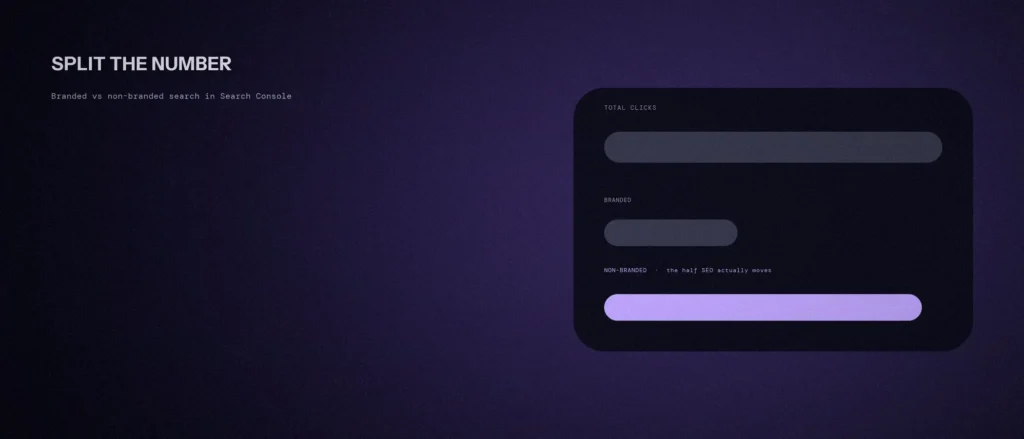
Branded vs non-branded search is the split that turns a confusing Search Console report into a clear one. Open the report, look at total clicks, and it feels like a report card for your SEO. It usually isn’t. A big chunk of those clicks are people who already knew your name, and lumping them in with everyone else hides whether SEO is actually working.
Doing that split is the single change that makes the Performance report honest. Here’s what each number is really telling you once you do.
Quick summary, if you’re short on time:
- Branded queries are searches that include your business name or close variants; non-branded queries are everyone looking for what you do without knowing you exist yet.
- Google added a built-in branded queries filter to Search Console, announced November 2025 and rolled out to eligible sites by March 2026, so you no longer need to build a regex to separate the two.
- Branded clicks mostly measure demand you already created elsewhere: word of mouth, ads, offline. Non-branded clicks are the closest thing to a real SEO scoreboard.
- Google itself notes “some queries may be misclassified” by the filter, so treat the split as directionally useful, not exact.
- Ranking first for your own business name is not an achievement, and a high branded click-through rate tells you almost nothing about your SEO.
Jump to a section:
- What the branded and non-branded split actually is
- The built-in filter, and its limits
- What your branded numbers are telling you
- What your non-branded numbers are telling you
- A prompt to read your branded and non-branded queries
- Questions worth answering directly
What the branded and non-branded split actually is
A branded query is a search that includes your business name, a close variant, a misspelling, or a product or service uniquely tied to your brand. Someone searching “zunelo digital” or “zunelo seo agency” already knows you exist. They’re not discovering you, they’re navigating to you.
A non-branded query is everything else: “seo agency in bangalore,” “how to rank on google maps,” “local seo pricing.” These are people looking for what you do, with no idea your business is one of the options. This is the traffic SEO is actually supposed to win.
When Search Console shows you one combined number, these two very different things get averaged together, and the branded half, which SEO barely influences, makes the whole picture look better or worse than your actual search performance.
The built-in filter, and its limits
You used to have to build a regex filter by hand, listing your brand name and every misspelling. Google removed that step. The branded queries filter was announced on November 20, 2025 and became available to all eligible sites by March 2026.
It uses an internal AI-assisted system to classify queries as branded or not, across languages, misspellings and product names, and it applies to impressions, clicks, click-through rate and average position in the Search results Performance report. There’s also a card in the Insights report showing the branded and non-branded click breakdown.
One honest limit, straight from Google: “some queries may be misclassified due to the contextual nature of brand detection.” You also can’t manually correct the classification. Treat the split as directionally right, not precise to the query, and some smaller sites won’t have enough volume to qualify for the filter at all.
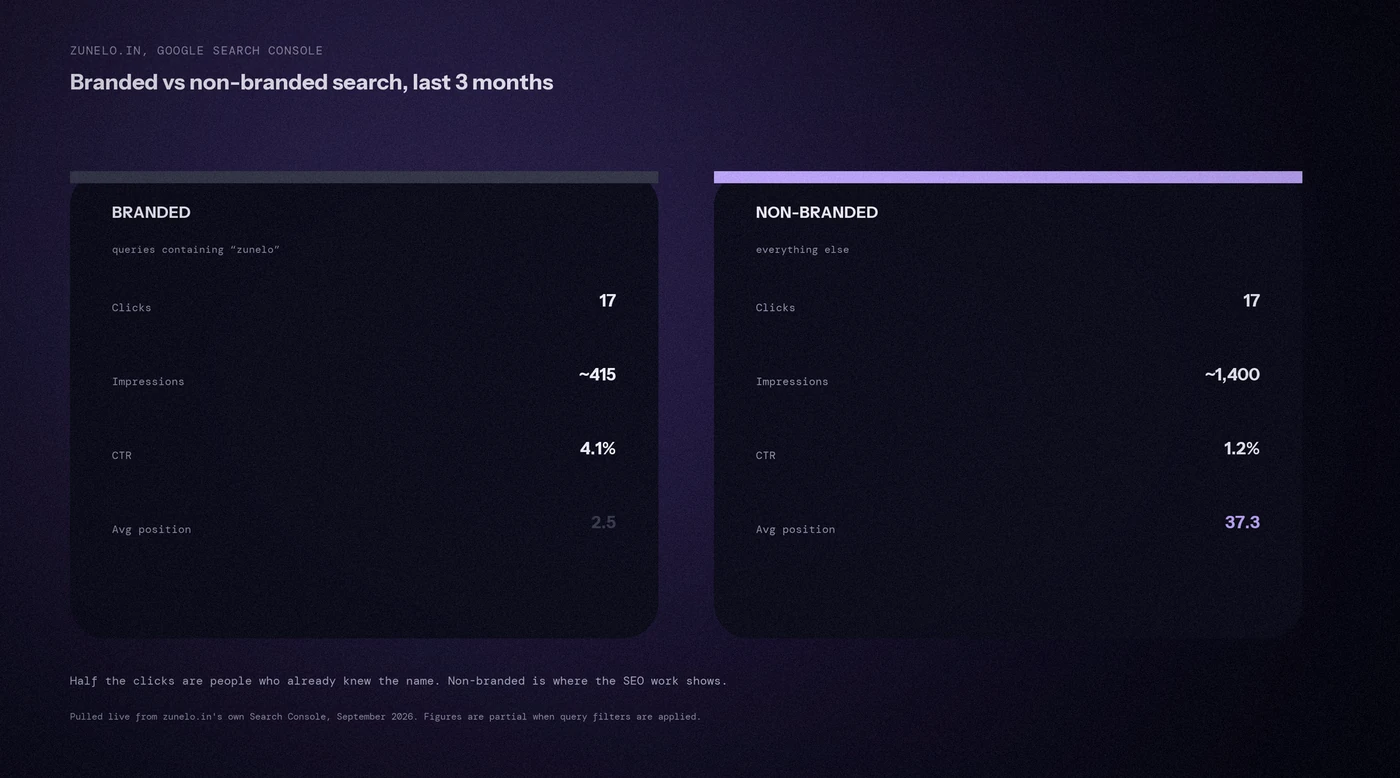
Here’s what the split looks like on our own site. Over the last three months, zunelo.in got 17 branded clicks and 17 non-branded clicks, an even split. But branded queries rank at an average position of 2.5, while non-branded queries sit at 37.3. Read as one combined number, the site looks like it’s doing fine. Split apart, it’s clear the SEO work is still early and most of the traffic is people who already knew the name.
What your branded numbers are telling you
Branded clicks are a measure of demand you created somewhere other than SEO. If your branded searches go up, the cause is usually an ad campaign, a press mention, a referral, a networking event, something offline. It’s a useful signal, just not a signal about your organic search work.
Branded click-through rate is almost always high, often above 30 or 40%, because someone searching your exact name intends to click your result. A high number here isn’t a win, it’s the expected default. A sudden drop is worth investigating, because it can mean a competitor is bidding on your name or your listing has a problem.
Branded average position sitting at 1 or close to it is also the expected default, not an achievement. If you’re not ranking first for your own business name, that’s a problem to fix, but ranking first there proves nothing about whether you can rank for anything else.
What your non-branded numbers are telling you
Non-branded clicks are the closest thing Search Console gives you to a real SEO scoreboard. This is people finding you while searching for what you offer, not for you. When this number grows month over month, your SEO is doing its job. When the combined number grows but this one is flat, the growth came from somewhere else.
Non-branded impressions rising while clicks stay flat is a specific, useful signal: you’re showing up for more searches but not earning the click, which usually points at title tags, meta descriptions or the position you’re ranking at. This is the same kind of read covered in how to read a Core Web Vitals report without a developer background, the number matters less than what it’s pointing you toward.
Non-branded average position is where ranking progress actually shows up. A move from position 12 to position 7 for a cluster of non-branded queries is real SEO movement, even before it produces a visible jump in clicks, because most clicks happen on page one.
A prompt to read your branded and non-branded queries
Branded searches include your name. Non-branded searches do not. The two tell you different things. The prompt below helps you sort your own Search Console queries. Export your query list, paste in some rows, and check the sorting by hand.
Act as an SEO analyst. I will paste search queries from Google Search Console.
My brand name and common misspellings: [list them]
Here are my queries with clicks and impressions:
[paste rows here]Please do the following:
1. Sort the queries into branded and non-branded.
2. Tell me what share of clicks each group has.
3. Point out 3 non-branded queries that look worth improving, and say why.Rules:
– Only use the numbers I pasted.
– If a query is unclear, mark it as unsure.
– Do not guess at rankings I did not give you.
Check the sorting yourself, since AI tools miss misspellings. Then watch the non-branded share over time, since that is where new customers are usually found.
Questions worth answering directly
What’s the difference between branded and non-branded search?
Branded searches include your business name or a close variant, made by people who already know you. Non-branded searches are for what you do, made by people who don’t know your business exists yet. SEO mainly influences the non-branded half.
How do I separate branded and non-branded traffic in Search Console?
Google added a built-in branded queries filter, announced in November 2025 and rolled out to eligible sites by March 2026. It sits in the Search results Performance report and classifies queries automatically, so you no longer need to build a regex filter by hand.
Is the branded queries filter accurate?
Directionally, yes, but not perfectly. Google states some queries may be misclassified because brand detection depends on context, and you can’t manually correct the classification. Use the split to understand trends, not to audit individual queries.
Which number in Search Console actually shows if SEO is working?
Non-branded clicks and non-branded average position. Branded metrics mostly reflect demand created outside search, like ads or word of mouth. Growth in non-branded traffic is the closest thing to a direct SEO scoreboard.
When did Search Console add the branded queries filter?
It was announced on November 20, 2025 and became available to all eligible sites by March 2026. It applies to impressions, clicks, click-through rate and average position, and the Insights report has a card showing the branded and non-branded click breakdown. Smaller sites may not have enough volume to qualify.
What did the split show on Zunelo’s own site?
Over three months, zunelo.in got 17 branded clicks and 17 non-branded clicks. But branded queries ranked at an average position of 2.5, while non-branded queries sat at 37.3, so the SEO work is still early and most of the traffic came from people who already knew the name.
Where this actually matters
Reporting on combined Search Console clicks makes a quiet month look fine and a strong month look weak, depending on what happened with your brand that had nothing to do with SEO. Splitting the two is what lets you see your actual search performance.
Not sure how to read your own Search Console split, or whether your growth is branded or earned? We go through this as part of every SEO engagement we run.