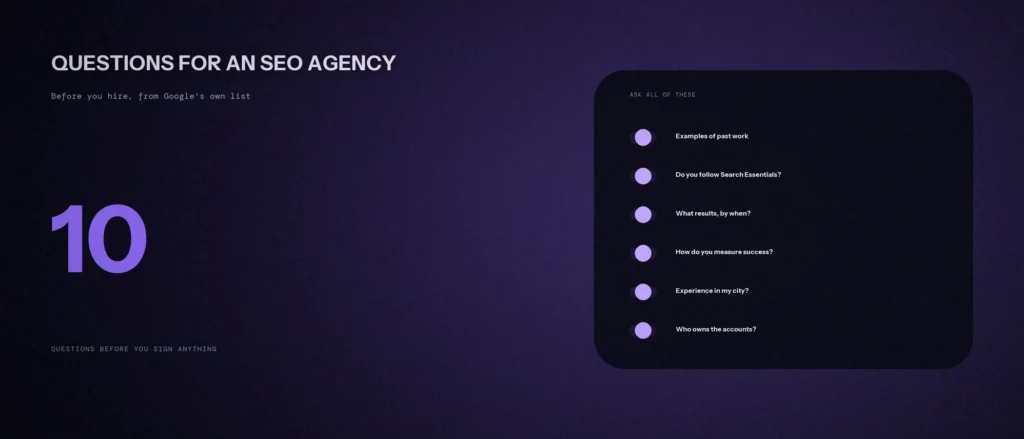
Choosing and hiring an SEO agency is a decision where the buyer knows least and the seller knows most. Reports are full of jargon, results take months, and almost every agency says it gets “first page rankings”. The good news is that Google has published a list of questions to ask an SEO, and a list of warning signs. This post turns that list into 10 questions to ask an SEO agency before you hire an SEO agency, whether you are comparing SEO companies, a freelancer or a digital marketing agency, with what a good answer sounds like and what should worry you.
We are an SEO agency ourselves, so you should read this knowing that. We have kept every point tied to Google’s own page, which we re-read on 11 October 2026 (it was last updated on 5 June 2026), and we say clearly where something is our own opinion. We would be glad for you to ask us all 10 questions too. If you are still deciding how much to spend, our post on how much you should spend on SEO comes first.
Quick summary, if you’re short on time:
- Google’s page suggests asking for examples of previous work, whether they follow Google Search Essentials, what results and timeframe to expect, how success is measured, and their experience in your industry and city.
- Google says no one can guarantee a number one ranking, and to be wary of anyone who claims a “special relationship” with Google or a “priority submit”.
- If an agency offers an SEO audit, Google says to grant read access to Search Console only, and not write access at that stage.
- Google says you are ultimately responsible for the actions of any company you hire.
- If a small local business is deciding whether to hire at all, Google says you can probably do much of the work yourself, starting with its SEO starter guide.
Jump to a section:
- Do you need an agency at all?
- The 10 questions
- Red flags, from Google’s own list
- How to run the conversation
- Audits and access
- A prompt to check a proposal
- Questions about hiring an SEO agency
Do you need an agency at all?
Google’s page on hiring an SEO says that if you run a small local business, you can probably do much of the work yourself, and recommends starting with the SEO starter guide. It adds that knowing the basics helps you notice if an SEO wants to use a technique that is not recommended.
It also says that a great time to hire is when you are considering a site redesign, the earlier the better, or planning to launch a new site, so the site is designed to be search engine friendly from the start. A good SEO can also help an existing site.
The 10 questions
These are the questions that help you choose between SEO agencies. They apply to any SEO strategy proposal, and to technical audit offers and search engine optimization retainers alike. We are not ranking agencies or naming a best SEO provider, because no list can do that for your business.
Questions 1 to 8 come straight from Google’s list of useful questions to ask an SEO, in slightly shorter words. Question 9 follows Google’s advice on tools and AI search guidance, and question 10 is our own addition, marked in the table.
| # | Question | A good answer sounds like | Worry if |
|---|---|---|---|
| 1 | Can you show me examples of your previous work and share some success stories? | Specific cases or case studies with what was done, over what period, and where the numbers came from. They offer references | Only vague claims, or screenshots with no context |
| 2 | Do you follow the Google Search Essentials? | A plain yes, and they can say what that rules out | They dodge, or talk about “tricks” |
| 3 | What results do you expect, and in what timeframe? | A range with conditions, and honest about what they do not control | A guaranteed ranking or a fixed date |
| 4 | How do you measure success? | Named measures tied to your goals: enquiries, calls, rankings for agreed keywords, from tools you can check | Only “traffic” or a score from their own tool |
| 5 | What is your experience in my industry? | Real examples from similar businesses, or an honest account of what is new to them | Claims to know everything |
| 6 | What is your experience in my country or city? | They understand your local market, search habits and competitors | No sense of your location |
| 7 | How will we communicate, and how often will you report? | A named person, a regular schedule, and reports you can verify in your own accounts | No reports, or reports you cannot check |
| 8 | Will you share every change you make and the reasoning behind it? | Yes, in writing, with a plain explanation of each recommendation | Secrecy, or “proprietary methods” with no explanation |
| 9 | Where does your advice come from, and how do you handle AI search advice? | They cite Google’s official documentation, and their AI search advice matches Google’s guidance | Advice from “internal Google metrics”, or tactics Google says to ignore |
| 10 | Who owns the accounts, content and access, and what happens if we stop? | You own your accounts, domain and content, and they will hand everything back. (Our own addition, not on Google’s list.) | They hold your accounts or content, or the answer is unclear |
Also watch whether the agency is interested in you. Google’s page says your SEO should ask about what makes your business unique, who your competitors are, how search results can help, and how your customers find you. If they are not interested, find someone who is.
Red flags, from Google’s own list
- A guaranteed first place. Google says no one can guarantee a number one ranking, and that if someone guarantees first place in search results you should find someone else.
- A “special relationship” with Google or a “priority submit”. Google says to beware of SEOs that claim these.
- Unsolicited emails. Google says to be wary of firms that email you out of the blue, and to reserve the same scepticism for them as for other too-good-to-be-true offers.
- Secrecy. Be careful if a company is secretive or will not clearly explain what it intends to do. Ask for explanations if something is unclear.
- Link schemes and mass submission. Google says to avoid SEOs that talk about link popularity schemes or submitting your site to thousands of search engines, and that you should never have to link to an SEO.
- Deceptive content. Google warns that if an SEO creates deceptive or misleading content on your behalf, your site could be removed from Google’s index.
- Tools described as “approved” by Google. Google says it does not evaluate or endorse third-party SEO tools, and that these tools do not have access to Google’s internal ranking data.
The point about responsibility is worth repeating. Google says you are ultimately responsible for the actions of any companies you hire, so make sure you know exactly how they intend to help.
How to run the conversation
- Write your goal first. For example “more phone enquiries from Bangalore for two services”. Without one, every proposal looks fine.
- Ask the 10 questions in the same order to each agency, and write down the answers. Compare them afterwards, not during the call.
- Ask for references and call them. Google suggests asking past clients whether the SEO provided a useful service, was easy to work with, and produced positive results.
- Ask what they need from you. Content approval, access, quick decisions. SEO stalls when the client side is slow.
- Ask for the first 90 days in writing. What will be done, in what order, and what you will see when.
- Compare the SEO services line by line. List what each agency will do for the fee, such as audits, content, local work and reporting.
- Do not decide on price alone. A low price with unclear work and a high price with clear work are not the same comparison.
Audits and access
An SEO audit, including a technical audit, is often the first thing an agency sells. It is also where many agencies show whether they can explain their work, so use it to optimize your choice as well as your site.
Many agencies offer a free or low-cost audit. Google’s page says to consider carefully what is involved, and to grant read access to Search Console only, and not write access at that stage. It says an audit should give you realistic estimates of improvement and an estimate of the work involved.
It also says that if an SEO has FTP access to your server, they should be willing to explain all the changes they are making. Our suggestion, not Google’s: give the smallest access that does the job, keep the owner login in your own hands, and write down who has what.
If an agency uses a third-party tool in the audit, Google suggests checking their recommendations against its official guidance before making significant changes. Two questions it lists: do they cite official Google documentation as supporting evidence, and is their advice on AI experiences (called AEO or GEO) aligned with Google Search’s official guidance?
A prompt to check a proposal
An AI tool can read a long proposal quickly and flag the claims worth a second look. It does not know the agency, so give it the real text and check every flag yourself.
Act as a careful, sceptical adviser helping a small business owner review an SEO agency’s proposal. I will paste the proposal.
My details:
– My business and goal: [one or two lines]
– The proposal or email, pasted in full: [paste]
– Monthly fee and contract length quoted: [details]
– What I was promised for the first 90 days: [paste, or say not stated]Please do the following:
1. List every claim about results, rankings, traffic or timing, and mark each as “specific and checkable” or “vague”.
2. List anything that sounds like a guarantee, a special relationship with Google, secret methods or link schemes.
3. Tell me which of these 10 questions the proposal does not answer: examples of work, following Google Search Essentials, expected results and timeframe, how success is measured, industry experience, local experience, reporting, explaining every change, where advice comes from, and who owns accounts.
4. Write five follow-up questions I should send to the agency.Rules:
– Use only the text I gave you. Do not guess at facts about the agency.
– Say clearly when something is your judgment and not a fact.
– Write in plain, simple English.
Send the follow-up questions in writing and keep the replies. How an agency answers a direct question is itself useful information.
Questions about hiring an SEO agency
What questions should I ask an SEO agency?
Google’s list suggests asking for examples of previous work, whether they follow Google Search Essentials, what results to expect and in what timeframe, how success is measured, and what experience they have in your industry and city. The table in this post adds four more.
Can an SEO agency guarantee a number one ranking?
No. Google says no one can guarantee a number one ranking on Google, and that if an SEO guarantees first place you should find someone else.
How do I know if an SEO agency is good?
Look for specific examples, clear measures tied to your goals, honest timeframes and plain explanations of what they do. Google suggests checking business references and asking past clients if the SEO produced positive results.
Should I give an agency access to my Search Console?
For an audit, Google says to grant read access only, and not write access at that stage. Give the least access that does the job, and keep ownership of the account yourself.
How long does SEO take to show results?
It depends on your site, your competition and the work done, and it is usually months and not days. Google’s own list includes asking what timeframe to expect, so make every agency answer it, with conditions.
Is it safe to hire an agency that cold-emails me?
Google says to be wary of firms that email you out of the blue, and to reserve the same scepticism for unsolicited emails about search engines as for any too-good-to-be-true offer. Judge any agency on the questions above, however it found you.
Do I need to hire an SEO at all?
Not always. Google says a small local business can probably do much of the work itself, starting with the SEO starter guide. It can be worth hiring when you plan a redesign or a new site, or when you lack the time or know-how.
Where this matters
A good agency will be happy to answer all 10 questions in writing. A weak one will avoid them, or answer with a guarantee. Write your goal, ask the same questions of each agency, check references, and give only the access the job needs.
If you would like to put these questions to us, send us your website address and we will tell you what we see.