On 1 October 2026, Google updated its guidance on using generative AI content on your website. The new lines say that generative models do not retrieve facts, they predict a likely sequence of words, so their output can contain inaccuracies. Google then adds that it is critical to manually fact check and review all AI-generated content for accuracy and trustworthiness before publishing.
If you use generative AI, or artificial intelligence, to help write your website, this is the page to read twice. This post explains what changed, what the review should cover, and a simple routine to fact check AI generated content before it goes live. We checked every Google statement below against Google’s own pages on 4 October 2026. Where the advice is our own judgment, we say so.
Quick summary, if you’re short on time:
- Google’s guidance page, last updated 1 October 2026, says it is “critical” to manually fact check and review all AI-generated content before you publish it.
- The review also applies to metadata that can appear in search results, such as meta descriptions and image alt text.
- Google does not ban AI content. It says appropriate use is not against its guidelines, but using it to generate many pages without adding value may break its scaled content abuse policy.
- A good review has a few steps: list every claim, check each one against a primary source on the same day, cut what you cannot prove, and record when you checked.
- Google says AI or automation disclosures are useful where a reader might wonder how the content was created.
Jump to a section:
- What Google changed
- Why AI gets facts wrong
- What the review must cover
- A fact-checking routine you can copy
- Is AI content against Google’s rules?
- How we do it at Zunelo
- A prompt to list the claims in your draft
- Questions about fact checking AI content
What Google changed
The change is in the guidance on generative AI content in Google Search Central. The page now says three things in a row:
- Generative models do not retrieve facts. They predict a likely sequence of words based on their training data.
- Because of this, generative AI outputs may contain inaccuracies, also known as hallucinations.
- It is critical to manually fact check and review all AI-generated content for accuracy and trustworthiness before publishing.
Search Engine Land reported the change on 1 October 2026, and the Google page shows the same date as its last update. The rest of the page is not new. It still says generative AI can be useful when researching a topic and adding structure to original content.
Why AI gets facts wrong
An AI writing tool is built to produce text that reads well. It is not looking up a fact and copying it. That is why it can write a confident sentence about a Google setting, a law or a price that is simply wrong, and why the sentence looks just as polished as a correct one.
Google’s own blog on AI content says issues like misinformation exist in both human-generated and AI-generated content, so the fix is the same for both: check before you publish. Never trust a source name or quote you have not opened yourself.
The risk is highest in the details a reader may act on: dates, numbers, names of settings, legal or medical statements, and anything that says “Google requires” or “the rule is”. These are also the lines a customer will remember if they are wrong.
What the review must cover
Google’s page does not stop at the article text. It says the review also applies to metadata, such as meta description elements and the alt text for images, which can appear in search results. For structured data, it says to follow the general guidelines and the policies for the individual search features, and to validate the markup so the page stays eligible for search features.
| What to check | Why it matters |
|---|---|
| Facts in the article text | Dates, numbers, settings and rules are where AI is most likely to be wrong |
| Meta titles and descriptions | Google says these can appear in search results, so they need the same review |
| Image alt text | Google lists it with metadata that needs checking |
| Structured data (schema) | It must follow Google’s guidelines and be valid, and it should match what is on the page |
| Your own claims about your results | An AI draft may invent numbers or praise you cannot back up |
A fact-checking routine you can copy
This is the order we use. It takes longer than editing for style, and it is the part that protects your readers.
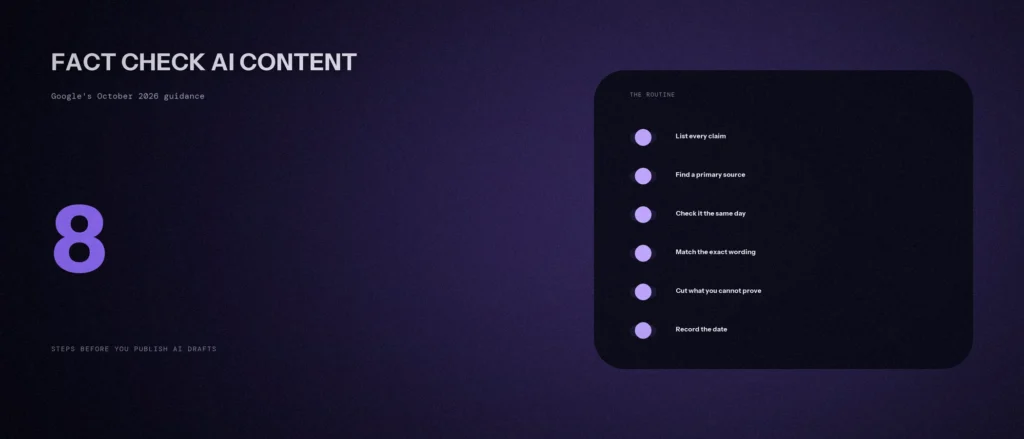
- List every factual claim. Go through the draft and mark each sentence that states a fact: a date, number, setting name, rule, price or result.
- Find a primary source for each one. That means the platform’s own help page, the law or regulator’s own text, or the company’s own page. Another blog that says the same thing is not a source.
- Check it the same day. Open the source today and note its “last updated” date. Help pages change, and a fact that was right last month may not be now.
- Match the exact wording. If the draft says “Google requires X”, the source must say that. If it only says “recommends”, change your sentence.
- Cut what you cannot prove. Remove claims like “most plugins can” or “a common reason is”. Say what the source does say instead.
- Check the extras. Read the meta title, meta description, image alt text and schema with the same care as the article.
- Read it as a customer. Would a customer who acted on every line be misled anywhere? If yes, fix it or remove it.
- Write down the date you checked. If a page says “we checked on 4 October”, make sure that really is the date.
A person must do steps 2 to 4. Google’s wording is “manually” for a reason: an AI tool checking its own text is the same system that made the mistake.
Is AI content against Google’s rules?
No, and Google says so directly. Its guidance on AI-generated content says appropriate use of AI or automation is not against its guidelines. The problem is when it is used to generate content mainly to manipulate search rankings, which is against its spam policies.
Google’s spam policies name the risk at scale. Its definition of scaled content abuse is many pages generated mainly to manipulate rankings, and its examples include using generative AI tools to generate many pages without adding value. Google also says AI gives content no special gains: if it is useful, helpful and original, it might do well, and if it is not, it might not.
Two more points from the same guidance:
- Disclosure. Google says AI or automation disclosures are useful where someone might think “How was this created?”, and to consider adding them when that would be reasonably expected. It also says to think about giving readers more background on how automation was used.
- Bylines. Google says giving AI an author byline is probably not the best way to make clear when AI is part of the process. It suggests accurate author bylines where readers would reasonably expect them.
The September 2026 spam update is also rolling out. Google’s status page says it began on 24 September 2026, applies globally to all languages, and may take up to two weeks to complete. The status page entry does not say what the update targets, so do not read the new AI guidance as a description of it. If you want to understand what makes Google lose trust in a whole site, our post on programmatic SEO and Google’s trust covers the scaled-pages problem.
How we do it at Zunelo
We use AI tools to help research, outline and draft. We do not publish what they write without a check. Every post and page goes through the routine above before it goes live: we open Google’s own pages that day, note their last updated dates, match the wording, and remove anything we cannot trace to a source.
Here is an example from this week. When we re-checked our own Smart Bidding post, one line did not match Google’s page. We had told readers to wait until they had conversion history before using Target CPA, and Google’s page says advertisers can start using it with no history. We fixed it. That is the point of the routine: it catches mistakes that read well.
We cannot promise this makes content rank. Google has said that using AI gives content no special gains. What it does is stop us from publishing something false under our name, which is worth doing on its own. Our post on whether AI watermarking affects SEO looks at a related question, which is whether Google can tell AI text at all.
A prompt to list the claims in your draft
Step 1 of the routine, listing every claim, is slow and easy to do badly by eye. An AI tool is good at listing, so use it for that and keep the checking for yourself. Paste in your real draft.
Act as a careful fact-checking assistant for a small business website. I will paste a draft article. Do not rewrite it and do not try to confirm the facts yourself. Your job is to list every claim a reader could act on, so a person can verify each one.
My draft:
[paste the full draft here]The topic and who it is for: [one line]
Please do the following:
1. Make a table with one row for every factual claim: a short quote from the draft, the type of claim (date, number, rule, setting name, price, result or opinion), and the kind of primary source that would prove it (for example, the platform’s own help page).
2. Mark the claims that say what a platform “requires”, “allows” or “recommends” so I can check the exact word.
3. Flag generalisations that cannot be proved, such as “most”, “usually” or “a common reason”, and suggest a more careful wording.
4. List anything in the meta title, meta description or image alt text that states a fact.Rules:
– Do not tell me a claim is true or false. Say only what needs checking.
– Do not invent sources, links or quotes.
– If you are unsure whether something is a claim, include it.
– Write in plain, simple English.
Then check every row yourself, against a source you open that day. The table makes the checking faster, but it does not replace it.
Questions about fact checking AI content
Does Google ban AI-generated content?
No. Google says appropriate use of AI or automation is not against its guidelines. It is against the spam policies when it is used to generate content mainly to manipulate search rankings, including generating many pages without adding value.
Do I have to label my content as AI-generated?
Google does not make it a rule for every page. It says AI or automation disclosures are useful where a reader might wonder how the content was created, and suggests adding them when that would reasonably be expected. Ecommerce sellers have extra rules in Google Merchant Center.
Does the fact check apply to meta descriptions and alt text?
Yes. Google says the review also applies to metadata, such as meta description elements and image alt text, which can appear in search results. Structured data should also follow Google’s guidelines and be validated.
Can I list AI as the author of an article?
Google says giving AI an author byline is probably not the best way to show readers that AI was part of the process. It suggests accurate author bylines where readers would reasonably expect them, and clear information about how AI was used.
Can an AI tool fact check its own writing?
Not on its own. Google’s wording is that you should manually fact check and review AI-generated content. An AI tool can help list the claims to check, but a person should verify each one against a primary source.
Do I need an AI detector tool?
Google’s guidance asks you to review accuracy and trustworthiness before you publish. It does not ask you to run detector tools. What matters is that every claim has been checked by a person and that the page is useful, original and honest about how it was made.
Is publishing lots of AI pages risky?
It can be. Google’s spam policies list using generative AI tools to generate many pages without adding value as an example of scaled content abuse. A smaller number of pages that are checked, original and useful is the safer path.
Where this matters
Google has put into writing what careful publishers already do: treat an AI draft as a first draft that someone must check. List the claims, check them against sources you open that day, cut what you cannot prove, and read the metadata with the same care as the article.
If you want AI used in your marketing without the risk of publishing something false, our AI SEO and GEO service builds the fact-check step into the work.