Add an author bio to a page and nothing measurable happens the next day for your SEO. That is true, and it is not the point. Google says E-E-A-T is not a specific ranking factor, so the useful question is different from the one most SEO articles ask. It is: what does Google say makes content trustworthy, and does a real author bio help show it?
This post explains what Google’s helpful content guidance says about E-E-A-T, bylines and author information, what it says about fake authors, whether bios have anything to do with AI citations, and what a good bio contains. We re-read Google’s page on 30 October 2026, and its last-updated date is 5 October 2026. Where something is our own advice, we say so. For the wider picture of what makes a visitor believe a business, see our post on trust signals on a business website.
Quick summary, if you’re short on time:
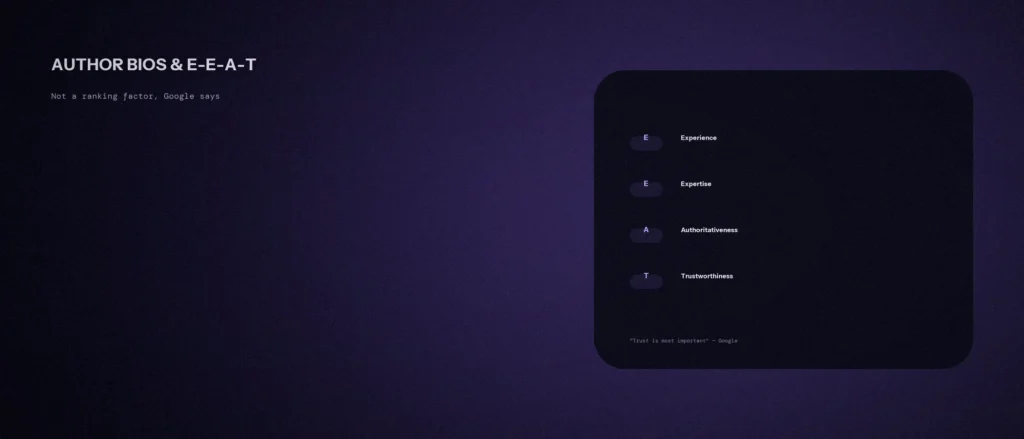
- E-E-A-T stands for experience, expertise, authoritativeness and trustworthiness. Google says that of these, trust is most important, and that E-E-A-T itself isn’t a specific ranking factor.
- Google says search quality raters are trained to understand E-E-A-T, but that rater data is not used directly in its ranking algorithms. So no bio or badge can raise a score.
- Google asks whether it is self-evident who authored your content, whether pages carry a byline where one might be expected, and whether bylines lead to further information about the author.
- Google strongly encourages accurate authorship information, and says fabricating creator profiles, such as AI-generated headshots, made-up names or false credentials, is a form of deception that makes a page untrustworthy.
- Google’s AI features guide gives no technical requirement for appearing in AI Overviews beyond being indexed and eligible for a snippet. We found no Google statement that author bios change AI citations.
- A real bio is worth writing because it helps readers decide whether to trust you, not because it moves a ranking directly.
Jump to a section:
- What Google says
- E-E-A-T is not a score
- Who, How and Why
- What Google says about fake authors
- Do author bios affect AI citations?
- What a useful bio contains
- A short checklist
- What we do on our own site
- A prompt to draft your bio
- Questions about author bios
What Google says
The source is Google’s page on creating helpful, reliable, people-first content. Its main points on E-E-A-T are:
- It is a mix of factors. Google’s systems identify a mix of factors that can help determine which content demonstrates experience, expertise, authoritativeness and trustworthiness.
- Trust comes first. Of these aspects, Google says trust is most important. The others contribute to trust, and content does not need to demonstrate all of them.
- It is not one ranking factor. Google says E-E-A-T itself isn’t a specific ranking factor, but that using a mix of factors that can identify content with good E-E-A-T is useful.
- Some topics get more weight. Google says its systems give even more weight to content that aligns with strong E-E-A-T for topics that could significantly impact the health, financial stability or safety of people.
The same page lists questions about expertise. Two of them are about authors: does the content present information in a way that makes you want to trust it, such as clear sourcing, evidence of the expertise involved, and background about the author or the site that publishes it, through links to an author page or an About page? And is it written or reviewed by an expert or enthusiast who demonstrably knows the topic well?
E-E-A-T is not a score
This is the point many articles miss. Google says E-E-A-T itself isn’t a specific ranking factor, so there is no number to raise by adding a bio or a badge. The same page explains where E-E-A-T comes from. Google says search quality raters are people who give it insight on whether its algorithms seem to be providing good results, and that raters are trained to understand if content has strong E-E-A-T. It also says raters have no control over how pages rank, and that rater data is not used directly in its ranking algorithms. It compares the feedback to a restaurant getting comment cards from diners.
On 28 October 2026, Ryan Jones made the same case in an opinion piece on Search Engine Land. He says to stop turning E-E-A-T into on-page tricks, such as invented personas or footer badges, and to make content that earns links and clicks. Part of his argument rests on patents. A patent does not show that Google uses a method, so we do not rely on those parts.
Our own advice, which is not a Google statement: write a bio because it is honest and useful to a reader, not as an E-E-A-T fix. A bigger lever is content that adds something new. Google’s Search Central post on AI search, from 21 May 2025, says to focus on making unique, non-commodity content that visitors will find helpful and satisfying. Numbers from your own accounts, or a test you ran on your own site, are two ways to do that.
Who, How and Why
Google also suggests asking three questions of your content.
- Who created it. Is it self-evident to visitors who authored the content? Do pages carry a byline where one might be expected, and do bylines lead to further information about the author and the areas they write about?
- How it was created. Google says sharing details about processes can help readers understand any role automation played, and that AI or automation disclosures are useful where someone might think “How was this created?”
- Why it was created. Google says “why” is perhaps the most important: you should be creating content primarily to help people.
Our own view, which is not a Google statement, is that a bio answers “who” and a short note about your process answers “how”. For AI-assisted content, our post on fact checking AI generated content covers what to check before you publish.
What Google says about fake authors
This part of the page is blunt. Google strongly encourages adding accurate authorship information, such as bylines, to content where readers might expect it. It then adds: avoid using deceptive authorship information. It says fabricating creator profiles, such as by using AI-generated headshots, made-up names or false credentials to make content appear as if it was written by human experts, is a form of deception, that any deception makes a page untrustworthy to both users and its automated quality systems, and that it is a signal of a low-quality page.
So an invented “Dr” with a stock photo is worse than no bio at all. If you do not have a named expert, use the real author, and say what they know and do.
Do author bios affect AI citations?
People ask this a lot, and the honest answer is that we have not found a Google statement that says so. What Google’s pages do say is narrower:
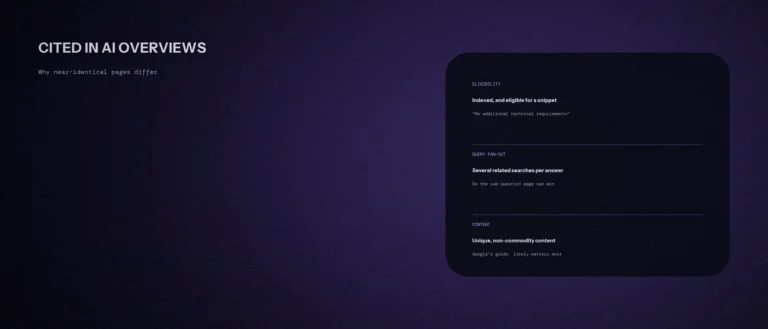
- To be eligible as a supporting link in AI Overviews or AI Mode, a page must be indexed and eligible to be shown in Search with a snippet, and Google says there are no additional technical requirements.
- Google’s Search Central post on AI search says to focus on unique, non-commodity content that is helpful and satisfying for visitors, which fits the “who, how and why” questions above.
So a real author bio is a sensible part of making content trustworthy, which Google says is what its systems aim to reward. We would not promise that it changes whether you are cited. Other AI assistants have their own rules, and we have not checked those for this post.
What a useful bio contains
- A real name and role. “Dr. Asha Rao, orthodontist” and not “Admin” or “Our Team”.
- Checkable experience. Years in practice, a qualification, a registration number where that is normal, or work a reader can verify.
- A reason they are writing about this topic. One line connecting them to the subject of the page.
- A link a sceptic can follow. A professional profile, an author page or published work.
- A photo of the real person, if you use one. Not a stock image and not an AI-generated headshot, which Google names as deception.
- Honest scope. Say what they review or write about, and who reviewed medical, legal or financial claims.
- A date. When a page was written or last checked, so readers know it is current. Do not change dates to look fresh, which Google also lists as something to avoid.
Here is a made-up example for a clinic’s page. Replace every detail with the truth:
Written by Dr. Asha Rao, orthodontist at Example Dental Clinic in Indiranagar, Bangalore. She has treated patients with braces for 12 years and is registered with the Karnataka State Dental Council. This page was last reviewed on 11 October 2026.
The numbers and council in that example are invented. Never copy credentials you do not hold.
A short checklist for search engines and readers
- Every article that gives advice carries a byline with a real name.
- The byline leads to a bio, and the bio links to a real profile or author page.
- Credentials and certification in the bio are ones the person holds.
- Medical, legal and financial pages say who reviewed them.
- You can add Person schema markup for the author. It is optional, and it must match the visible bio. Google’s own page asks for accurate authorship information on the page, so make the page itself clear first. This is our advice on markup, not a Google requirement.
- Dates are honest, and search engines and readers can see when the page was last reviewed.
What we do on our own site
We looked at our own blog setup on 11 October 2026. Every post carries an author card with a real name, a role and a short biography, and the page’s structured data includes a Person for the author, with a link to a LinkedIn profile and a job title. Our authors are real people and the byline matches the person who wrote or oversaw the piece. We have not created invented authors.
We also found a gap. Google asks whether bylines lead to further information about the author. On the live site on 30 October 2026, our byline linked to the author’s LinkedIn profile, and each author also has a page on our blog (for example the one for Mohammed Annas). The byline did not link to that page, so on 30 October 2026 we changed it to link to the author’s page, and the LinkedIn profile stays in the author card. It is a good example of the kind of check to run on your own site.
A prompt to draft your bio
An AI tool can tidy a bio quickly, but only from facts you give it, and it must not invent credentials. Check every line before it is published.
Act as a careful editor writing a short author bio for a business website. Use only the facts I give you.
The facts:
– Full name and job title: [details]
– Years of experience and where: [details]
– Qualifications or registrations I hold: [list, or say none]
– What I write or review about on this site: [topic list]
– A link to a real profile or page about me: [address]
– Anything I should not claim: [for example, I am not a doctor]Please do the following:
1. Write a bio of 50 to 70 words in the third person.
2. Write a one-line version for a byline.
3. List anything in my facts that a reader could not check, so I can add evidence or remove it.Rules:
– Use only my facts. Do not invent qualifications, awards, years, clients or numbers.
– Do not use words like “world-class”, “leading” or “renowned”.
– Write in plain, simple English.
Compare the result with your real documents, and delete anything you cannot show.
Questions about author bios
Is E-E-A-T a ranking factor?
Google says E-E-A-T itself isn’t a specific ranking factor. It says its systems use a mix of factors that can identify content with good E-E-A-T, and that trust is the most important aspect.
Do author bios help SEO?
Google does not describe a bio as a ranking switch. It asks whether it is clear who created content and whether bylines lead to more information about the author, which a bio supports. Treat it as a trust signal for readers.
Is it wrong to use a made-up author name?
Yes, according to Google. It says fabricating creator profiles with made-up names, AI-generated headshots or false credentials is a form of deception, and it makes a page untrustworthy.
Do I need an author bio on every page?
Google says to add accurate authorship information where readers might expect it. Blog posts, guides and advice pages are the usual places. A contact or legal page does not need one.
Should I say when AI helped write something?
Google says AI or automation disclosures are useful where someone might think “How was this created?”, and suggests adding them when that would be reasonably expected. A short note about your process works.
Do author bios affect whether AI tools cite my page?
We have not found a Google statement that says so. Google says a page needs to be indexed and eligible for a snippet, with no additional technical requirements. A bio is still good for trust.
What if my business has no named expert?
Use the real person who writes or reviews the content, and say plainly what they do. If nobody on staff is an expert, say where the information comes from, with clear sourcing, which Google also lists as helping readers trust content.
Where this matters
Author bios are a small, honest way to show readers who is behind a page. Write them with real names and checkable facts, link to something real, and never invent a person.
If you would like your content and authorship signals reviewed, see our AI SEO and GEO service, or send us your website address and we will tell you what we see.