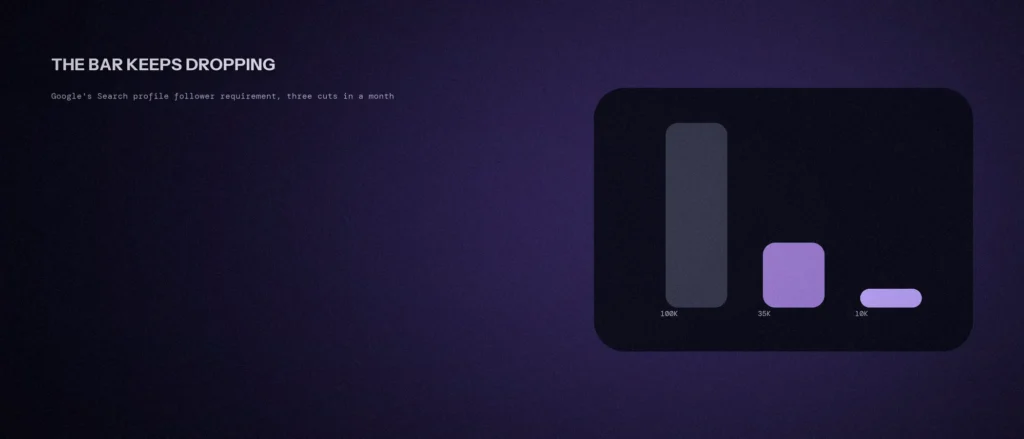
A month ago, claiming a Google Search profile meant having 100,000 followers on YouTube, Instagram or X. That bar has dropped twice since, and now sits at 10,000. If you’d already written this feature off as something for major creators only, it’s worth a second look, with an honest read on who it actually helps right now.
Here’s what changed, what a Search profile actually does, and who should genuinely act on this versus keep watching.
Quick summary, if you’re short on time:
- Google has cut the follower requirement to claim a Search profile from 100,000 to 10,000 across YouTube, Instagram, X or TikTok, in three moves over about a month.
- A Search profile gathers your content from across platforms into one followable identity inside Google Search and Discover, with a follow button that increases your odds of surfacing in someone’s Discover feed.
- Google also shipped a design update to how articles display in a profile, and single-login support for managing several sub-brand profiles from one account.
- 10,000 followers is still out of reach for most local service businesses. It’s realistic territory for a personal brand, coach, or consultant with an active following.
- The trend, three threshold cuts in a month, matters more than the current number. This is worth tracking even if you don’t qualify yet.
Jump to a section:
- What actually changed
- What a Search profile actually does
- Who this is realistically for right now
- What to actually do about it
- A prompt to plan your Google Search profile
- Questions worth answering directly
What actually changed
Google’s own announcement is specific about the number: Google’s own blog post states “we’ve lowered the eligibility threshold to 10,000 followers across YouTube, Instagram, X, or TikTok.” That’s down from 100,000 when Search profiles launched, with a stop at 35,000 in between, three cuts inside about a month.
Two smaller changes shipped alongside it. Article display inside a profile got a visual refresh, “image thumbnails are now optimized to help your articles look their best, and we’ve increased the length of headlines.” And accounts managing multiple sub-brands can now do it from one login instead of juggling separate accounts for each profile.
What a Search profile actually does
A Search profile pulls your content from across platforms, YouTube, Instagram, TikTok, X, and your own site, into one followable identity that shows up directly inside Google Search and Discover. Each entry point carries a follow button, and following raises the odds your content surfaces in that person’s Discover feed going forward, a direct, ongoing visibility channel that doesn’t depend on ranking for a specific query each time.
This sits close to the same identity-and-trust signal covered in our post on entity clarity, both are about Google being able to confidently attach content to one real, verified identity rather than treating it as anonymous text on a page.
Who this is realistically for right now
Ten thousand followers is a real number, and it rules out most local service businesses immediately. A clinic, a consultant’s practice, or a home-services business rarely has that kind of following on a single platform, and chasing follower count purely to unlock this feature would be a poor use of budget for most of them.
It’s genuinely realistic for a different group: an individual coach, a consultant, or a personal brand who has already built a real audience on one platform through years of content, not a business account posting service updates. If that describes you or someone on your team, claiming the profile is a low-effort, real visibility gain. If it doesn’t, the right move is watching the trend, not forcing the number.
What to actually do about it
If you’re already past 10,000 followers on any of the four supported platforms, claim the profile. It costs nothing but a few minutes, and the follow button becomes a real, compounding channel into Discover that most competitors in a local market still won’t have.
If you’re not close, don’t manufacture the follower count. The more useful move is building the kind of content and entity signals that matter regardless of this specific feature, consistent identity across platforms, content Google can clearly attribute to a real person or business. Three threshold cuts in a month is a strong signal Google wants more publishers in this system, not fewer, so the number is worth rechecking again in a few months rather than dismissed permanently.
A prompt to plan your Google Search profile
A search profile helps people follow and find you on Google. The prompt below helps you plan what to share and how to keep it up. Fill in your own details, and check Google’s current rules before you apply.
Act as a content planner for a small business that wants a useful Google Search profile.
My business:
– What I do and for whom: [describe]
– Where I already publish: [website blog, YouTube, social media]
– How often I can post each month: [number]Please do the following:
1. Suggest 6 topics I could share that are useful to my customers.
2. Say what I would need to keep posting regularly.
3. List what I should check in Google’s own help pages before I start.Rules:
– Do not state current eligibility rules as fact. Tell me to check Google’s documentation.
– Do not suggest buying followers or engagement.
– Keep it simple.
Confirm the current requirements in Google’s help pages before you apply. Then choose a posting pace you can keep for six months.
Questions worth answering directly
How many followers do you need for a Google Search profile now?
10,000 followers across YouTube, Instagram, X, or TikTok, as of Google’s September 2026 update. That’s down from 100,000 at launch, with an intermediate step at 35,000 before this latest cut.
Is a Google Search profile worth it for a small local business?
Usually not yet. Most local service businesses don’t have 10,000 followers on a single platform, and building that following purely to unlock this feature is rarely a good use of budget. It’s more realistic for an individual coach, consultant, or personal brand with an existing real audience.
What does following someone’s Search profile actually do?
It increases the likelihood their content surfaces in your Discover feed, the personalized feed on the Google app home screen, creating an ongoing visibility channel that doesn’t depend on ranking for a specific search each time.
What else did Google change alongside the lower threshold?
Two smaller things. Article display inside a profile got a visual refresh, with optimised image thumbnails and longer headlines. And accounts that manage several sub-brands can now do it from one login instead of separate accounts for each profile.
Which platforms does the follower count come from?
Google’s announcement names YouTube, Instagram, X and TikTok. Search profiles pull your content from those platforms and your own site into one followable identity inside Google Search and Discover.
Who should claim a Search profile right now?
Someone with a real audience already: an individual coach, consultant or personal brand past the threshold on a supported platform. For them it is a low-effort visibility gain. For a typical local service business, watching the trend is the better move than forcing the follower count.
Where this actually matters
The follower number will likely keep moving, and the direction has been consistently downward. Worth a five-minute check now if you’re close, and worth revisiting again in a few months if you’re not.
Not sure whether your own online presence has the identity and entity signals AI systems and Google actually trust? We check this as part of every AI SEO and GEO engagement we run.