Read five “About Us” pages from five completely different businesses and you’ll notice something uncomfortable. They all say almost the same thing. A passionate team, a commitment to quality, a customer-first approach. Swap the logo at the top and nobody would know which business you were reading about.
That’s not a writing problem. It’s a trust problem, and it’s been studied directly.
Quick summary, if you’re short on time:
- Stanford’s Web Credibility research gives two guidelines that explain exactly what an About Us page is for: “show that there’s a real organization behind your site” and “show that honest and trustworthy people stand behind your site.”
- Generic phrases like “passionate team” and “quality service” don’t satisfy either guideline, because they can’t be verified and don’t name anyone real.
- A third guideline, “make it easy to verify the accuracy of the information on your site,” is the one most About Us pages skip entirely.
- The fix isn’t better writing. It’s replacing vague claims with specific, checkable details, real names, a real reason the business started, a real number.
- A simple rewrite test catches most of the problem: if a sentence could appear word for word on a competitor’s page, it isn’t doing its job.
Jump to a section:
- What an About Us page is actually supposed to do
- Why the generic version fails
- The mission statement trap
- What actually makes it work
- Three real rewrites
- A simple rewrite test
- A prompt to rewrite a generic About Us page
- Questions worth answering directly
What an About Us page is actually supposed to do
This isn’t a matter of opinion about tone or branding. Stanford’s Web Credibility guidelines, built from studying how people actually judge whether to trust a website, give a direct answer. One guideline states plainly: “show that there’s a real organization behind your site.” Another adds the human half of the same idea: “show that honest and trustworthy people stand behind your site.”
A third guideline is the one almost every business misses: “make it easy to verify the accuracy of the information on your site.” An About Us page’s real job is proof, not personality. It exists to answer “is this a real business run by real people I can trust,” not to sound impressive.
Why the generic version fails
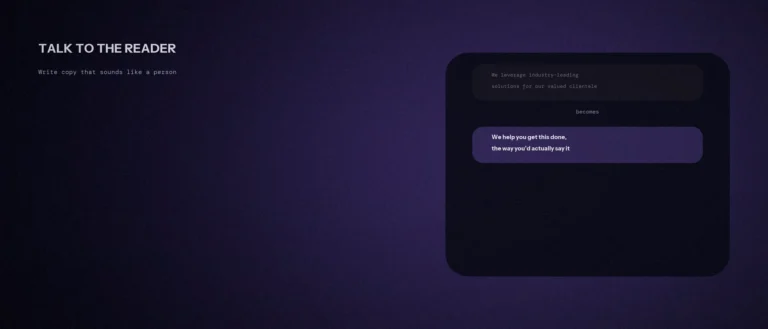
“We are a passionate team committed to delivering quality service” fails all three guidelines at once. There’s no real organization named. There’s no real person standing behind it. And there’s nothing in that sentence a visitor could ever check, because it isn’t a claim, it’s a mood.
This kind of writing isn’t dishonest. It’s just empty. Every business believes it cares about quality, so saying so proves nothing and differentiates nothing. A visitor reading it learns exactly as much about your business as they knew before they clicked.
The mission statement trap
Most business owners don’t set out to write something generic. They sit down to write their About Us page, and the format itself pulls them toward abstraction. “Our mission is to deliver excellence” feels like the right kind of sentence for the occasion, formal, positive, safe. It’s also exactly the sentence that fails every credibility test, because a mission statement describes an intention, not a fact.
The trap is thinking the page needs to sound like a mission statement at all. Nobody decides to trust a business because its mission is “excellence.” They decide to trust it because something specific about the story, the people, or the track record gave them a reason to. A mission statement is the easiest thing to write and the least useful thing to read.
What actually makes it work
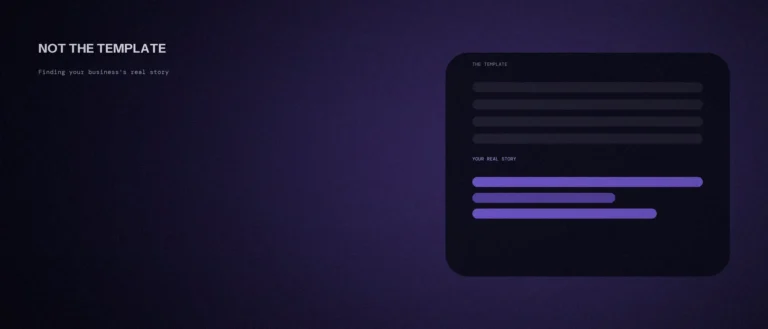
Specificity is what turns an unverifiable claim into a credible one. “Founded in 2019 by two electricians who were tired of quoting jobs they never got called back for” names real people, a real number, and a real reason, and it can’t be copy-pasted onto a competitor’s site because it isn’t true for them.
The same logic applies to every part of the page. A real name and photo instead of “our team.” A specific number of years or projects instead of “experienced.” A real reason the business exists instead of a mission statement that could belong to anyone. None of this requires clever writing. It requires being willing to be specific instead of safe.
Three real rewrites
A bakery writing “we use only the finest ingredients” could say instead “we bake with flour milled twice a week at a mill forty minutes from the shop, because bread made from week-old flour tastes different, and we noticed.” The second version names a real supplier relationship and a real reason, the first is what every bakery’s About page already says.
A plumber writing “we pride ourselves on reliability and professionalism” could say “our founder spent nine years fixing other people’s rushed jobs before starting this company, so every job here gets photographed and explained before the invoice goes out.” The second version explains why the business exists and what a customer can actually expect, the first is a pair of adjectives.
A consultant writing “we are passionate about helping businesses grow” could say “before this, our founder ran the marketing team at a 40-person startup and watched three good products fail from bad positioning, that’s the specific problem this business was built to fix.” The second version gives a visitor a real reason to believe this person understands their situation, the first could be the opening line of almost any consultancy’s website.
A simple rewrite test
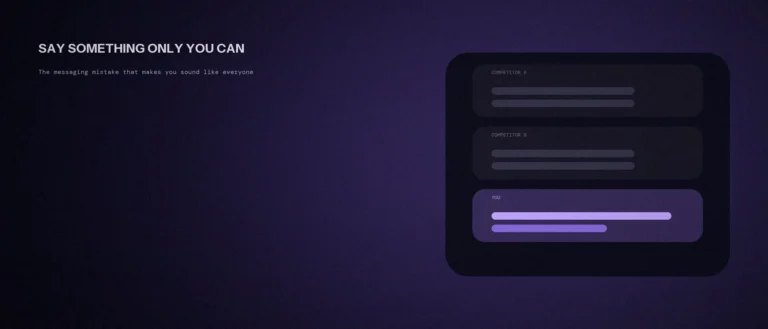
Take any sentence on your About Us page and ask one question: could this sentence appear word for word on a competitor’s page and still be true? If yes, it isn’t saying anything specific to your business, and it’s safe to cut or rewrite.
Run this test on your homepage too, not just the About page. The same clarity problem shows up in the first thing a visitor reads, covered in more depth in our guide to the homepage hero: vague, safe language fails in both places for the same reason.
A prompt to rewrite a generic About Us page
Most About Us pages say the same things: passionate team, quality service, customer first. The prompt below asks an AI tool to find the generic parts and ask you for the real details. Paste in your current page, answer the questions it asks, and write the final version in your own words.
Act as an editor who helps small businesses write honest, specific About Us pages.
Here is my current About Us text:
[paste it here]Please do the following:
1. Mark every sentence that any business could say about itself.
2. Ask me 8 questions about my real story, such as why I started, one customer problem I solved, and what I do differently.
3. After I answer, draft a new version using only my answers.Rules:
– Do not invent history, awards, numbers or customer names.
– Use plain words and short sentences.
– Keep the page about what the customer gains, not just about me.
Read the new draft out loud. Anything you would not say to a customer face to face should go. Then add one real detail, such as a project or a customer problem, that only you could write.
Questions worth answering directly
What should an About Us page actually include?
Real, verifiable details: real names and faces, a specific reason the business started, real numbers where relevant. Stanford’s Web Credibility research points to this directly, credibility comes from showing a real organization and real people stand behind the site, not from a mission statement.
Why do most About Us pages sound the same?
Because they rely on generic, unverifiable phrases like “passionate team” or “quality service” that every business could claim. These phrases don’t name anyone real or provide anything a visitor could check, so they fail to build the trust an About Us page is meant to create.
How do I know if my About Us page needs rewriting?
Test each sentence by asking if it could appear word for word on a competitor’s page and still be true. If it could, it’s too generic to be doing its job and should be replaced with something specific to your actual business.
Why does a mission statement usually make an About Us page worse?
A mission statement describes an intention, not a fact, which means it can’t be verified and rarely differentiates one business from another. Visitors trust specific details about people, history and track record far more than a stated mission, because those details can actually be checked.
Do I need professional photos or a big team to write a good About Us page?
No. Specificity matters more than production value. A single real photo and one true, specific story about why the business started does more for credibility than polished stock photography paired with generic copy.
Where this actually matters
An About Us page isn’t a place to sound impressive. It’s a place to be checkable. The businesses that get this right aren’t better writers, they’re just willing to be specific instead of safe.
Not sure if your own website is saying anything real about your business? We work through this as part of every website engagement we run.