“Don’t let two pages target the same keyword” is repeated so often in SEO that it gets treated as a Google rule. It isn’t. Google has said the opposite, more than once.
That doesn’t mean keyword-to-URL mapping is pointless. It means the real reason to build one has nothing to do with appeasing an algorithm, and everything to do with not wasting your own writing time.
Quick summary, if you’re short on time:
- Google’s John Mueller has said multiple pages appearing for the same query “doesn’t seem problematic to me just because it’s ‘more than 1.'”
- Ahrefs manually reviewed 80 keywords with multiple ranking pages on their own site and found only one case that actually needed fixing.
- The real value of a keyword-to-URL map is planning clarity: knowing which URL already owns a topic before you commission new content for it.
- The map only needs to resolve genuine overlaps, where two pages answer the identical intent, not every case where a keyword happens to appear on more than one page.
- Building it takes three real inputs: your existing URLs, what they already rank for, and the intent behind each target keyword.
Jump to a section:
- What is a keyword-to-URL map?
- What Google actually says about multiple pages and one keyword
- What happened when Ahrefs checked 80 real cases
- Why build a map at all, then
- How to actually build one
- When two pages genuinely do overlap
- Using AI to build a first draft of the map
- Questions worth answering directly
What is a keyword-to-URL map?
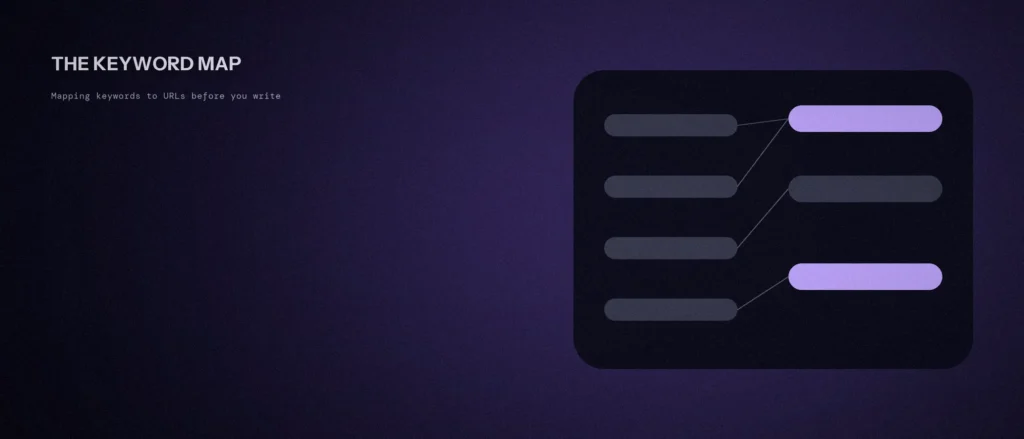
A keyword-to-URL map is a simple sheet that gives each target keyword one home: the page on your site meant to rank for it. Each row usually holds the keyword, the page address, the search intent behind it, and whether the page is live, planned or needs work.
Here is what one row looks like, as an example and not real data: keyword “emergency plumber,” page /emergency-plumber/, intent “ready to book,” status “live.”
What Google actually says about multiple pages and one keyword
An SEO asked Google’s John Mueller directly whether pages ranking together for the same query signals a problem. His answer was specific: “if you have 3 different pages appearing in the same search result, that doesn’t seem problematic to me just because it’s ‘more than 1.'”
He added the part most cannibalization advice skips: “You need to look at the details, you need to know your site, and your potential users.” Pages aren’t duplicates just because they show up on the same results page together.
What happened when Ahrefs checked 80 real cases
Advice is one thing. Someone actually checking is another. Ahrefs manually reviewed 80 keywords on their own site where more than one page was ranking for the same query.
Out of those 80, only one case actually needed fixing. The other 79 were pages serving genuinely different intents, a glossary explainer and a tool landing page, for instance, that happened to both be relevant to the same search term without competing for the same click.
That single number is worth sitting with. If keyword overlap were inherently a problem, a much larger share of those 80 would have needed action.
Why build a map at all, then
If Google isn’t penalising overlap, the reason to map keywords to URLs shifts entirely. It stops being about avoiding a penalty and becomes about not duplicating your own work.
Without a map, it’s easy to commission a new page for a keyword a URL from eighteen months ago already half-covers, splitting whatever authority that old page built instead of adding to it. The map’s job is catching that before a brief gets written, not appeasing an algorithm afterward.
It also forces a real decision on intent, covered in more depth in our guide to search intent and page type: two pages can legitimately share a keyword if one is informational and one is transactional, but two informational pages built for the identical question are a real problem worth catching early.
How to actually build one
Start with what already exists, not with a fresh keyword list. Export every indexed URL alongside the queries it already gets impressions for in Google Search Console; this is your site’s current, real keyword-to-URL relationship, whether anyone planned it or not.
Then lay your target keyword list next to that export. For each keyword, check whether an existing URL already has meaningful impressions for it. If yes, that URL owns the keyword; new content should support it, not duplicate it. If no existing URL is close, that’s a genuine content gap worth a new page.
The last step is intent, not keyword text. Group the remaining keywords by what a searcher actually wants, informational, commercial comparison, or ready-to-buy, and assign one clear primary intent to each planned or existing URL.
When two pages genuinely do overlap
Real overlap looks specific: two pages targeting the same keyword, the same intent, and pulling roughly equal impressions for the identical query in Search Console, with neither one clearly winning. That’s the pattern Ahrefs’ one real case matched.
The fix is usually consolidation: merge the weaker page’s genuinely useful content into the stronger one, then 301 redirect the weaker URL. Deleting the weaker page outright without a redirect throws away whatever backlinks or authority it built.
Using AI to build a first draft of the map
AI is genuinely useful here for the grouping and gap-spotting step, once you’ve exported the real data yourself.
“I’m building a keyword-to-URL map. Here’s my current site’s URLs and the top query each one gets impressions for in Search Console: [paste your export].
Here’s my target keyword list for the next quarter: [paste list].
Task:
1. For each target keyword, tell me if an existing URL already plausibly owns it, based on the queries it’s already getting impressions for.
2. Flag any pair of existing URLs that look like they’re targeting the same intent, not just a similar keyword.
3. For genuine gaps, group the remaining keywords by likely search intent (informational, commercial, transactional) so I can plan one page per intent, not one page per keyword.”
The output is only as reliable as the Search Console export behind it. Don’t skip pulling your own real data first and hand the model a guess instead.
Questions worth answering directly
Does Google penalise two pages for targeting the same keyword?
No. Google’s John Mueller has stated multiple pages appearing for the same query isn’t inherently problematic. The exception is when pages serve the identical intent and genuinely compete, which is a real but much less common situation than most cannibalization advice implies.
How common is real keyword cannibalization?
Rarer than commonly assumed. Ahrefs manually reviewed 80 cases of multiple pages ranking for the same keyword on their own site and found only one that actually needed fixing.
What’s the actual point of a keyword-to-URL map if overlap isn’t usually a problem?
Avoiding wasted content investment. Without a map, it’s easy to commission a new page for a keyword an existing URL already half-covers, splitting authority instead of building on it. The map catches that before a page gets written.
How do I tell if two of my pages genuinely overlap?
Check Google Search Console for the specific query. If two URLs pull roughly equal impressions for the identical keyword and serve the same intent, with neither clearly winning, that’s real overlap worth consolidating with a 301 redirect.
Where should I start when building a keyword-to-URL map?
With what already exists, not a fresh keyword list. Export every indexed URL alongside the queries it already gets impressions for in Google Search Console, then lay your target keyword list next to that export and check whether an existing URL already covers each keyword.
Can two pages legitimately share a keyword?
Yes, if they serve different intents, such as one informational page and one transactional page. Two informational pages built for the identical question are a real problem worth catching early, and that is what the map is meant to resolve.
Where this actually pays off
Chasing “one keyword, one page” as a rule leads to over-engineering a non-problem. Building the map for the right reason, to plan content instead of duplicate it, is what actually saves time and effort.
Not sure whether your own site’s keywords and URLs are mapped, or quietly overlapping? We do this mapping as part of every SEO engagement we run.