A page can be well written, fast, properly linked, and still never rank, because it is the wrong type of page for the query. Search intent is the part of SEO that gets talked about constantly and applied loosely.
It is not really about which keywords to target. It is about which shape of page Google has already decided a given query deserves, and building anything else is fighting the algorithm instead of working with it.
Quick summary, if you’re short on time:
- Search intent classification is not a marketing invention. It traces back to a real 2002 academic paper that split queries into informational, navigational and transactional categories, later expanded to include commercial investigation.
- The fastest, most reliable way to check intent for any query is to read the actual SERP, not guess from the keyword itself. Google has already told you what it thinks the query wants.
- A blog post cannot rank for a query Google wants answered with a product page, and a product page cannot rank for a query Google wants answered with a comparison guide, no matter how well either is written.
- Intent mismatch is one of the most common, least diagnosed reasons a genuinely good page never ranks.
- Checking intent takes minutes and should happen before a single word of content gets written, not after a page underperforms.
Jump to a section:
- Where this actually comes from
- The four types of search intent, in plain terms
- Read the SERP, don’t guess the keyword
- Matching page type to what the SERP shows
- What happens when the page type is wrong
- A real example, worked through
- Using AI to check your own intent match
- Questions worth answering directly
Where this actually comes from
Search intent classification is not a content marketing buzzword. It comes from a real piece of research, Andrei Broder’s 2002 paper “A Taxonomy of Web Search”, published in ACM SIGIR Forum while Broder was at IBM Research.
Broder split queries into three categories based on what the user was actually trying to accomplish, not the words they typed: navigational, informational, and transactional. The industry later added a fourth, commercial investigation, to cover the very common case of someone comparing options before a purchase without being ready to buy yet.
The reason this matters more than twenty years later is that Google’s ranking systems are built around inferring exactly this kind of intent from a query, then rewarding pages that match it.
Ranking well is not only about relevance to the topic. It is about relevance to the shape of answer being sought.
Worth a small caveat: Broder’s original “transactional” category was broader than how the SEO industry uses the word today, covering things like downloads and general web-mediated services, not only purchase-ready buying intent. The practitioner simplification is reasonable, just not a word-for-word match to the 2002 paper.
This is also not only an academic or SEO-industry framework. Google’s own Search Quality Evaluator Guidelines use a parallel model with different labels for the same underlying idea: Know (informational), Do (transactional), Website (navigational), and Visit-in-person, a fourth category for local intent that sits outside the other three.
Different names, same logic, coming directly from the guidelines Google gives its own human quality raters.
The four types of search intent, in plain terms
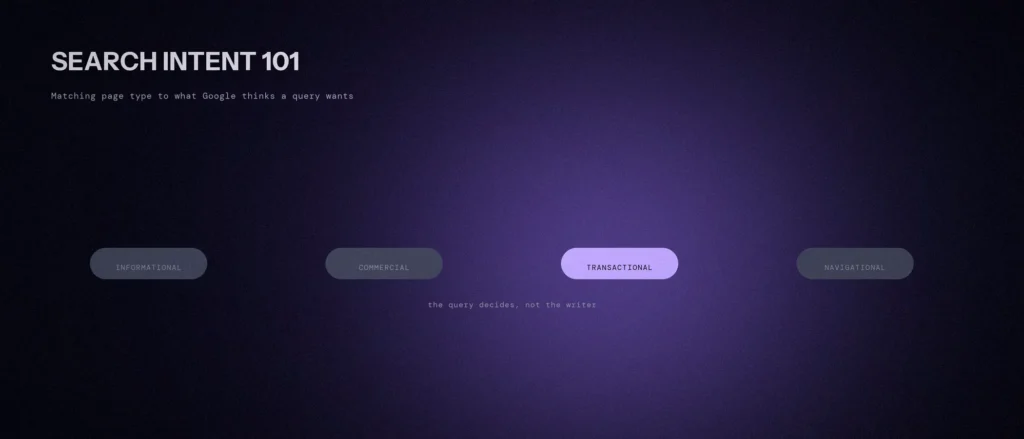
Informational intent means the person wants to learn or understand something, “how does compound interest work,” with no purchase or specific destination implied. Navigational intent means they already know exactly where they want to go and are using search as a shortcut, “zunelo pricing page,” typing a brand or product name because it is faster than typing a URL.
Transactional intent means they are ready to act right now, buy, sign up, download, book, “buy nike air zoom size 9.” Commercial investigation sits between informational and transactional: they are seriously considering a purchase but still comparing options, “best running shoes for flat feet,” genuinely useful information, but with buying intent sitting underneath it.
Most real queries lean toward one of these clearly enough that Google’s results reflect it. Recognising which one a query falls into is the entire foundation of what page you should actually be building.
Read the SERP, don’t guess the keyword
The single most reliable way to check intent is not to think harder about the keyword. It is to search it yourself and look at what is already ranking.
Google has effectively run this experiment already, at scale, using real click and engagement data no individual site owner has access to, and the current results are the answer key.
If the top results are mostly listicles, guides, and comparison articles, the query wants informational or commercial-investigation content, not a product page. If the top results are mostly product or category pages with prices and an add-to-cart button, it wants a transactional page.
If a single brand’s homepage or a specific known page dominates, it is navigational, and there is no realistic way to outrank that with fresh content. Featured snippets, “People also ask” boxes, and shopping carousels are further signals: Google is telling you, directly, what it believes this query deserves.
| Signal in the SERP | Likely intent |
|---|---|
| Listicles, guides, “how to” content | Informational |
| Featured snippet, People also ask, knowledge panel | Informational |
| Product or category pages, shopping carousel, visible prices | Transactional |
| A single dominant brand or homepage, sitelinks | Navigational |
| Comparison, review, or “best of” articles, “vs” content | Commercial investigation |
Matching page type to what the SERP shows
Once the intent is clear, the page type mostly picks itself. Informational intent calls for a genuinely useful blog post, guide, or explainer, built to answer the question thoroughly, not to funnel someone toward a sale they were not looking for yet.
Transactional intent calls for a clean product or service page, with pricing, a clear next step, and none of the padding a blog post would need to justify its length. Commercial investigation calls for a comparison, review, or “best of” style page that is honestly useful for deciding, not just thinly disguised advertising for one option.
Navigational intent generally is not something to compete for with new content at all, since the person already knows exactly where they are going.
A common mistake is building the page type that is easiest to produce rather than the one the intent actually calls for, a product page for a query that wants a guide, or a thin blog post for a query that wants a direct, transactional landing page.
The content can be genuinely good and still lose, because it answers a different question than the one Google is trying to satisfy.
What happens when the page type is wrong
A page fighting the wrong intent rarely fails obviously. It gets indexed, it may even rank on page two or three, and then it plateaus no matter how much more content, links, or on-page work gets added, because more of the wrong thing is still the wrong thing.
It often shows a real, specific pattern in analytics too: decent impressions, weak click-through rate, and a high bounce rate from the people who do click, because what they found did not match what they were expecting based on the intent behind their search.
This is also one of the quieter causes behind keyword cannibalisation, when a site has several pages loosely targeting the same topic but none of them actually matches the dominant intent, so none of them consolidates the ranking signal the way one well-matched page would.
A real example, worked through
Take “local seo services bangalore.” Searching it shows a mix of agency service pages with clear offerings and pricing, not blog posts explaining what local SEO is in the abstract. That is a strong transactional-leaning, buy-ready signal: someone searching this already knows what local SEO is and is evaluating who to hire.
A long educational blog post targeting this exact phrase would be fighting the wrong intent, however well written. A clear, specific service page, which is what actually exists for it, is the correct match.
Compare that to “what is local seo,” which pulls almost entirely definitional, explainer-style content. That query wants to be taught, not sold to, and a service page trying to rank for it would be just as mismatched in the other direction.
The same distinction shows up inside buying intent too, not just between buying and learning. “Buy running shoes” pulls almost entirely product and category pages, someone ready to purchase right now, no comparison needed.
“Best running shoes for flat feet” pulls comparison and review content instead, someone still deciding, who wants an honest guide before they buy anything. Both are commercial in nature. Only one of them wants a product page.
Using AI to check your own intent match
Working out whether an existing page’s format actually matches its target query’s intent is a fast, structured check to hand to AI.
“Act as an SEO specialist helping me check search intent match for a page I already have.
My situation:
– The exact target query: [your keyword]
– What page type I currently have targeting it: [blog post / product page / service page / comparison page / landing page]
– What the top 5 organic results for this query actually are, in your own words: [describe what you see when you search it: mostly guides, mostly product pages, mostly comparison content, a dominant brand result, etc.]
– Any SERP features present: [featured snippet / People also ask / shopping results / local pack / none that I noticed]Task:
1. Based on what is actually ranking, tell me which of the four intent types, informational, navigational, transactional, commercial investigation, this query most likely falls into.
2. Tell me plainly whether my current page type matches that intent or fights it.
3. If it is mismatched, tell me what page type would actually fit, not just what changes to make to the existing one.”
The output is only as good as an honest description of the real SERP. Actually search the query and look before answering the prompt, rather than guessing what probably ranks.
Questions worth answering directly
Can good content overcome the wrong page type for a query’s intent?
Rarely, and not reliably. A page can be well written and still underperform if it answers a different kind of question than the one Google believes the query is asking. Matching intent comes before content quality, not after it.
What is the fastest way to check a query’s intent?
Search it yourself and look at what is actually ranking. The mix of page types, plus any featured snippets, shopping results, or local pack presence, tells you directly what Google believes the query wants.
Is commercial investigation the same as transactional intent?
No. Commercial investigation means someone is seriously comparing options but not ready to buy yet, so they want honest comparison content. Transactional intent means they are ready to act now, which calls for a direct product or service page instead.
Should every page on a site target navigational queries?
No, and mostly this is not a realistic target at all. Navigational queries usually mean the searcher already knows exactly which page or brand they want, so competing for them with new content rarely works.
Where does the four-category intent model actually come from?
The core three categories, informational, navigational and transactional, come from Andrei Broder’s 2002 academic paper “A Taxonomy of Web Search.” Commercial investigation was added later by the SEO industry to cover comparison-driven searches that fall between informational and transactional.
Intent mismatch often sits underneath structural issues too, worth checking against our post on site structure and click depth.
Where this actually pays off
Matching page type to intent is one of the few genuinely free wins left in SEO. It costs nothing but a few minutes searching the query and looking honestly at what is already there.
It prevents months of adding content, links, and effort to a page that was never going to rank because it was answering the wrong question from the start.
Not sure whether your existing pages actually match what Google thinks their target queries want? Share your site and we will check real intent alignment, page by page, as part of every SEO engagement we run.