If you learned Google Ads match types years ago and haven’t looked at them since, what you learned is out of date. “Exact match” doesn’t mean exact anymore. Phrase match doesn’t work the way it used to either. Both have quietly widened over the years to the point where the old textbook definitions actively mislead people. Here’s what each match type really does today, and how they fit with automated bidding.
Quick summary, if you’re short on time:
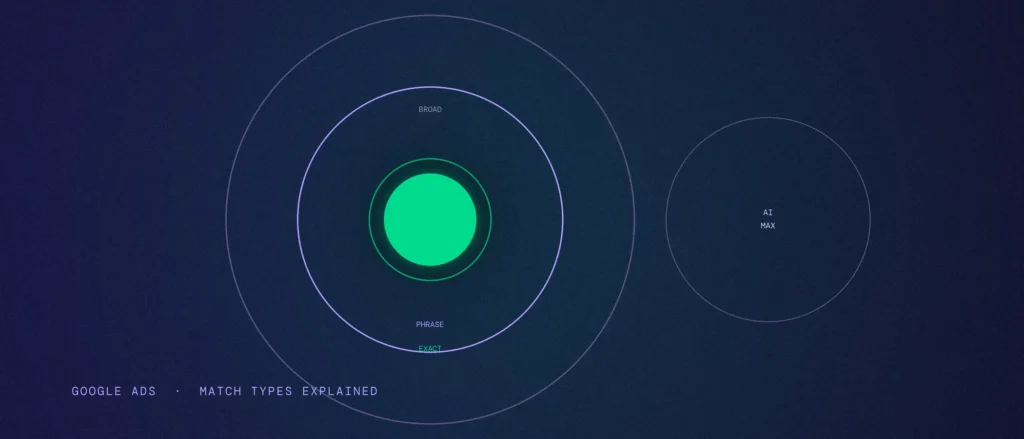
- Exact match today includes close variants: misspellings, plurals, reordered words, missing or extra function words like “the” and “and,” and word stems. It is not literally exact anymore.
- Phrase match is treated as intent-based. It still respects the meaning and rough order of your keyword, but it’s broader than the old strict version.
- Broad match, when paired with Smart Bidding and solid conversion tracking, uses signals like your landing page and account history to find relevant searches, not just overlapping words.
- Don’t load the same keyword into all three match types in one ad group. Give each match type a distinct job instead.
- AI Max for Search goes further than broad match, matching beyond your keyword list entirely. It’s a separate decision from choosing a match type, not just “broad match, but more.”
Jump to a section:
- Exact match: no longer exact
- Phrase match: intent, not just word order
- Broad match with Smart Bidding
- Where AI Max for Search fits in
- Why the same keyword shouldn’t sit in all three
- How to actually choose, ad group by ad group
- What this looks like in practice
- Using AI to apply this to your account
- Questions worth answering directly
Exact match: no longer exact
Exact match used to mean what it sounds like: your ad showed only for that precise search, nothing else. That stopped being true years ago. Today, exact match still shows for close variants of your keyword, which now covers misspellings, singular and plural forms, reordered words, added or removed function words like “the,” “a” and “and,” and different word stems, so “flooring” can match “floor.”
This isn’t a loophole, it’s how Google has officially defined exact match for a while now. The practical effect is that exact match is still your tightest, most controlled option, but “tightest” doesn’t mean “only that literal phrase” the way it did in the past. Check your search terms report even on exact match campaigns, since close variants can pull in searches you wouldn’t have predicted.
Phrase match: intent, not just word order
Phrase match has drifted the furthest from its original definition. It used to mean your keyword phrase, in that order, could appear anywhere in a longer search. Since Google expanded close variant matching in 2021, phrase match behaves more like an intent match: Google looks for searches that carry the same meaning as your phrase, not just the same words in the same sequence.
Phrase match still has a real job. It’s genuinely useful for branded terms, where you want your brand name to appear but don’t need to lock every word order, and for geo-modified searches, like a service plus a location, where some flexibility around word order actually helps you catch more relevant variations without opening the floodgates the way broad match can.
Broad match with Smart Bidding
Old broad match had a bad reputation for good reason: without Smart Bidding, it matched on loose word overlap and could burn budget on barely-related searches. Modern broad match works differently. Paired with Smart Bidding and real conversion tracking, Google uses signals beyond your keyword text, your landing page content, the other keywords already in your account, and your active bid strategy, to judge whether a search is actually relevant.
This is genuinely Google’s own current recommendation for accounts with enough conversion data: broad match plus Smart Bidding plus strong conversion tracking. It is not a recommendation for every account. If your conversion tracking is thin or your account is brand new with little history, broad match has less signal to work with and is more likely to drift toward searches that look related but aren’t, which is exactly the old broad match problem resurfacing.
Where AI Max for Search fits in
AI Max for Search is a separate, newer layer, not just an aggressive version of broad match. Regular broad match still uses your keyword list as a starting signal. AI Max goes further: it can match and generate ads for searches beyond your keyword list entirely, working from your landing pages and assets rather than being anchored to keywords you’ve chosen.
Treat AI Max as its own decision, made deliberately, not something you fall into by default. It trades keyword-level control for reach, which can work well on a mature, well-tracked account and can also spend budget in directions you didn’t intend on an account that isn’t ready for that much automation.
Why the same keyword shouldn’t sit in all three
A common, understandable mistake: loading the same keyword into exact, phrase and broad match inside the same ad group, thinking it covers all your bases. In practice, Google’s own auction logic usually favours the more precise match type when multiple versions of the same keyword could serve the same search, so the broader versions often just sit there doing nothing while quietly complicating your reporting.
A cleaner structure gives each match type an actual job. Exact match holds your proven, converting terms, the ones you already know work, kept tightly controlled. Phrase match handles measured expansion around those proven terms. Broad match, run separately with Smart Bidding, is where you actually let Google test and discover new relevant searches, in a campaign you’re watching, not blended invisibly into your best-performing exact match terms.
How to actually choose, ad group by ad group
Start with what you already know converts. If a search term has a track record, keep it in exact match and protect it. That’s your foundation, not the place to experiment.
Use phrase match where you want some flexibility but still need the core meaning intact, brand terms, service-plus-location combinations, anything where a slight rewording is fine but a completely different intent isn’t. Reserve broad match for genuine discovery, ideally in its own campaign with Smart Bidding switched on and conversion tracking you actually trust, so you can see clearly what it’s finding without it muddying your proven exact match performance.
What this looks like in practice
A Bengaluru pest control company might run “termite treatment bangalore” in exact match, since it’s a known, converting search with clear commercial intent. The same account could run “pest control services bangalore” in phrase match to catch reasonable variations around that core phrase. A separate broad match campaign, with Smart Bidding and real conversion data feeding it, might be given a wider seed like “termite problem home” to discover searches the account owner wouldn’t have thought to bid on directly, checked weekly rather than left to run unsupervised.
Three match types, three different jobs, in three places where their behaviour can actually be evaluated on its own, instead of one keyword duplicated three times and left to sort itself out.
Using AI to apply this to your account
Deciding which match type a given keyword should sit in, and whether your account is actually ready for broad match or AI Max, depends on account-specific details a generic guide can’t know. That’s exactly the kind of judgment call a structured prompt handles better than a quick guess.
“Act as a Google Ads strategist helping me set my match type structure for a specific keyword or campaign.
Account context:
– The keyword or search theme in question: [describe it]
– Is this a proven, converting term already, or one I’m testing for the first time: [proven / new / not sure]
– Which match type is it currently running in, if any: [exact / phrase / broad / not live yet]
– Is conversion tracking verified and trustworthy in this account: [yes / unverified / no]
– Roughly how much conversion history does this account have: [months of solid data / a little / none yet]
– Current bid strategy: [Smart Bidding / manual / not sure]
– Am I currently running AI Max for Search anywhere in this account: [yes / no]
– Monthly budget for this campaign: [amount]Task:
1. Recommend which match type, or whether AI Max, fits this specific keyword based on my answers above, not general advice.
2. Tell me plainly if my account isn’t ready for broad match or AI Max yet, and what’s missing before it would be.
3. Check whether what I’ve described risks the same-keyword-in-three-match-types mistake, and flag it if so.
4. Give me one concrete next step to test or tighten this specific match type decision this week.”
This is a reasoning aid, not a replacement for actually opening your account. It can’t see your real search terms report, conversion data, or account history, only what you tell it. Answer honestly rather than optimistically, since the recommendation is only as good as what you put in.
Questions worth answering directly
Is exact match still the safest option?
It’s still the tightest and most predictable, but “exact” now includes close variants like misspellings, plurals and reordered words. Check your search terms report even on exact match to see what’s actually triggering your ads.
Should I avoid broad match entirely?
Not necessarily. Broad match paired with Smart Bidding and solid conversion tracking is Google’s own current recommendation for accounts with enough data. Without that data and tracking, broad match is riskier and more likely to drift toward loosely related searches.
What’s the difference between broad match and AI Max for Search?
Broad match still uses your keyword list as a starting point. AI Max for Search can match and generate ads for searches beyond your keyword list entirely, based on your landing pages and assets. It’s a separate, more automated layer, not just a stronger version of broad match.
Is it wrong to use all three match types in the same ad group?
Loading the same keyword into all three in one ad group usually just wastes effort, since Google’s auction tends to favour the more precise version anyway. Give each match type its own role in its own campaign instead.
How do I know if my account is ready for broad match?
Enough historical conversion data for Smart Bidding to learn from, and conversion tracking you actually trust, are the two real prerequisites. A brand new account with little data is usually better served starting on exact and phrase match first.
Getting your match type structure right pairs directly with building a negative keyword list before launch, one decides which searches you are chasing, the other decides which ones to actively rule out.
Where this actually pays off
Match types aren’t a one-time setup decision. They’re a structure you keep checking, since what counts as “exact” or “broad” has shifted before and will likely shift again. The businesses getting the most out of Google Ads right now aren’t the ones avoiding automation entirely or handing everything to it blindly. They’re the ones giving each match type a clear job and actually watching what each one does.
Not sure whether your current match type setup is protecting your proven keywords or quietly diluting them? Share your account and we’ll go through it together, as part of every Google Ads management engagement we run.