“How long will SEO take?” is the first question almost every business owner asks, and the worst answers are the confident ones. “First page in 30 days” and “results in 90 days” sound reassuring, and nobody can promise them. The better answer is a list of what you should see at each stage, so you can tell whether the work is moving even before the rankings do.
This post gives you that list. It starts with what Google says about timing, then shows the real timeline of our own website since launch, month by month, and then sets out what to check at month 1, month 3 and month 6. We read Google’s SEO starter guide (last updated 10 December 2025) and its page on asking Google to recrawl pages on 11 October 2026, and we pulled our own Search Console numbers on 21 October 2026. Where something is our own method, we say so. If you are choosing an agency at the same time, our post on 10 questions to ask an SEO agency covers what to ask about timelines.
Quick summary, if you’re short on time:
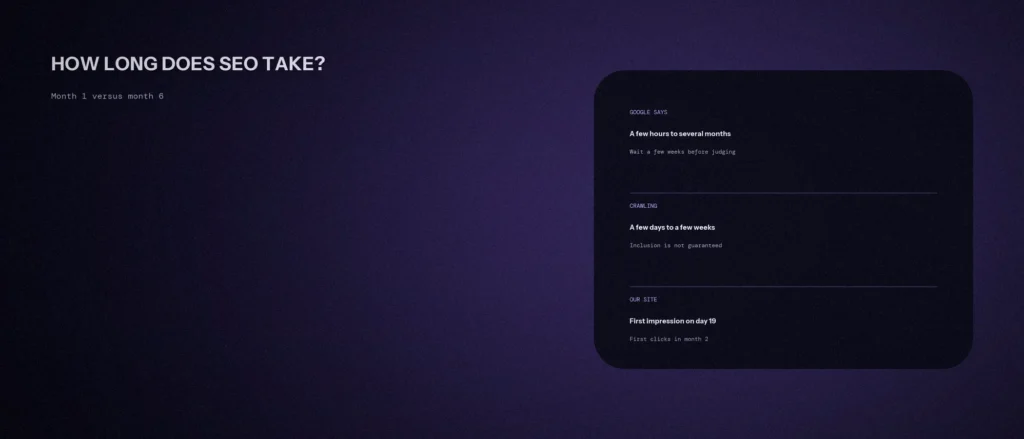
- Google says every change takes some time to show. Some changes might take effect in a few hours, others could take several months, and it suggests waiting a few weeks before judging whether your work helped.
- Google says crawling can take anywhere from a few days to a few weeks, and requesting a crawl does not guarantee inclusion.
- Our own site, launched on 1 July 2026, got its first impression on 19 July and its first clicks in August.
- In month 1, judge the groundwork: pages indexed, tracking working, problems fixed. Rankings are too early.
- Be careful of any agency that names a fixed number of days for a page-one ranking. Google gives no such figure.
In plain terms: SEO takes time, and a realistic timeline is a range, not a promise. How long SEO takes depends on your competition in the search engine, your site, and your SEO strategies, including technical SEO, content and links. We use Google Search Console and Google Analytics to see SEO results, and a Google Business Profile for local work. Organic traffic usually follows impressions, and an SEO campaign can take longer than you hope, so ask for an SEO audit and a baseline first. These SEO efforts show up in stages, which is what the checks below are for.
Jump to a section:
- What Google says about timing
- A real timeline: our own site, month by month
- What to check at month 1, month 3 and month 6
- Why it can be slower than you hoped
- How to read an agency’s timeline promise
- A prompt to build your own check schedule
- Questions about SEO timelines
What Google says about timing
Google’s SEO starter guide has a short answer to “how long until I see impact in search results?”. It says every change you make will take some time to be reflected on Google’s end. Some might take effect in a few hours, and others could take several months. In general, it says, you likely want to wait a few weeks to assess whether your work had beneficial effects in Google Search results. It also warns that not all changes will result in noticeable impact.
The page on asking Google to recrawl your URLs adds two more facts. Crawling can take anywhere from a few days to a few weeks. And requesting a crawl does not guarantee that inclusion in search results will happen instantly or even at all. It also says that requesting a recrawl several times for the same URL will not get it crawled any faster.
Put together, Google gives a range from hours to months, and no promise. That is the honest base for any timeline.
A real timeline: our own site, month by month
Our own website, zunelo.in, launched on 1 July 2026. We have been publishing and improving pages since. Here are the numbers from Search Console’s Performance report, for Google web search, as of 18 October 2026 (the latest day with data on 21 October).
| Month | Days with data | Impressions | Clicks |
|---|---|---|---|
| July 2026 | 13 (from 19 July) | 53 | 0 |
| August 2026 | 31 | 1,588 | 16 |
| September 2026 | 30 | 3,051 | 26 |
| October 2026 (to 18 Oct) | 18 | 5,399 | 37 |
What this shows, and what it does not:
- The first impression took 18 days. The site launched on 1 July, and Search Console’s first recorded impression was on 19 July.
- The first clicks came in month two. July had none. August had 16.
- Impressions per day grew from about 4 in July to about 300 in October. That is mostly the number of pages and queries growing, not rankings jumping.
- The pages that matter most are still low. Our six Bangalore service and course pages averaged position 45.4 in the 28 days to 18 October, with 2 clicks between them. A page that gets impressions at position 45 is on the fifth page of results.
- We are at month three and a half. We cannot tell you from our own data what month six looks like, and we will not guess.
Our own result is a data point, not a rule. A site with older pages, more links or less competition would move faster. A site with more competition would be slower.
What to check at month 1, month 3 and month 6
This is our own method. It is a way to judge progress with something other than rankings. Google’s guide supports the idea of waiting a few weeks before judging, and the stages below follow from how crawling and indexing work.
Month 1: the groundwork
- Are your important pages indexed? Check the Page indexing report.
- Does tracking work? Calls, form submissions and WhatsApp taps should all be counted. Our post on setting up GA4 for a new website covers it.
- Were the obvious problems fixed: broken pages, missing titles, duplicate pages, slow pages?
- Is a baseline written down, with a source and a date? Without one, you cannot show progress later.
Do not judge rankings at month 1. Google says crawling alone can take a few days to a few weeks.
Month 3: the first movement
- Are impressions growing in Search Console for the pages you changed?
- Has the average position of your tracked keywords moved, even from position 80 to position 50?
- For local businesses, are Business Profile views, calls and direction requests moving?
- Have any enquiries come from search? Count them from your own records.
Read the numbers properly. Our post on Search Console metrics explains why average position can move for reasons that are not good or bad news.
Month 6: the first real verdict
- Are your target pages on the first two pages for the terms that bring customers?
- Is the number of enquiries from search higher than your baseline?
- Which pages are working, and which should be rewritten or dropped?
Even at month six, results depend on the market. A local service in a quiet area may be on page one by then, and a competitive city keyword may still be on page three.
Why it can be slower than you hoped
- New sites start with no history. Google has to find, crawl and decide about every page.
- Competition sets the bar. When we looked at who ranks for “digital marketing agency in bangalore” on 12 October, the first page was agency home pages and third-party “top 10” lists. Moving up means beating pages that have been there for years.
- Indexing is not guaranteed. Google says so. On 21 October, four of our own pages, including two service pages, were still “discovered, currently not indexed”.
- Changes take time to be reflected. Google says so, and recommends waiting a few weeks to judge a change.
- Not every change matters. Google says not all changes will result in noticeable impact in search results.
How to read an agency’s timeline promise
| What you are told | What to ask |
|---|---|
| “Page one in 30 days” | For which keyword, in which city, and what happens if it does not? Google gives no such timeline |
| “Results in 3 to 6 months” | What exactly will you be able to show me at month 3, and in writing? |
| “Guaranteed rankings” | Google says no one can guarantee a number one ranking. Treat it as a warning sign |
| “We will see traffic quickly” | Which number, from which tool, compared with which baseline? |
A good agency will give you leading indicators, such as pages indexed, impressions and tracked positions, and say what each should look like at each stage. It will also tell you what it cannot know.
A prompt to build your own check schedule
An AI tool can lay out a schedule from your own numbers. It cannot see Google, so give it your baseline and the promise you were made.
Act as a careful, sceptical SEO analyst. Help me judge whether my SEO is on track, using only my numbers.
My details:
– My business, city and the keywords that matter: [list 3 to 5]
– When SEO work started, and what the agency or freelancer promised about timing: [dates and exact words]
– My Search Console numbers by month since the start: [impressions, clicks, average position]
– My Business Profile numbers by month, if I have them: [views, calls, directions]
– Enquiries I got from search, from my own records: [numbers by month]Please do the following:
1. Put my numbers in a table by month, and show the percentage change from month to month, with the sums.
2. Say what I should expect to check at month 1, month 3 and month 6, using only my data and Google’s statement that changes can take from a few hours to several months.
3. Compare the promise I was given with what the data shows, and say where the promise cannot be tested.
4. List five questions to ask the agency.
5. Say what you cannot know from these numbers.Rules:
– Use only my numbers. Do not invent benchmarks or typical timelines.
– Do not say a ranking is guaranteed or likely by a date.
– Say clearly when something is your opinion.
– Write in plain, simple English.
Check each table by hand against the Search Console export before you rely on it.
Questions about SEO timelines
How long does SEO take to work?
Google says some changes can take effect in a few hours and others several months, and suggests waiting a few weeks before judging. There is no fixed number, and it depends on your site, your competition and the work done.
Can SEO give results in 30 days?
Some changes can show within a few weeks, such as a page being indexed. A first-page ranking for a competitive keyword in 30 days is not something Google promises, and an agency that promises it is making a guess.
Why are my impressions rising but clicks are not?
Because more pages are showing for more searches, mostly at lower positions where few people click. That was our pattern too: impressions per day went from about 4 to about 300 in three months while clicks grew slowly.
Does requesting indexing speed things up?
It can help Google find a page, but Google says crawling can take a few days to a few weeks, that inclusion is not guaranteed, and that repeated requests for the same URL will not make it faster.
What should I judge at month 1?
The groundwork: indexed pages, tracking that works, problems fixed and a baseline written down. Rankings are too early to judge.
How long does local SEO take?
No one can give a fixed timeline for local ranking either. Changes to a Business Profile can appear quickly, and ranking depends on relevance, distance and prominence. Track views, calls and directions monthly against a baseline.
Should I pay for SEO if results take months?
Only if the work and the reporting are clear. Ask what you will see at month 1, month 3 and month 6, and what you can cancel and when.
Where this matters
SEO timelines are ranges, not promises. Judge month 1 on groundwork, month 3 on movement and month 6 on enquiries, and be careful of anyone who names a date for page one.
If you would like help setting up a baseline and a check schedule for your own site, send us the address and we will tell you what we see.