Send Google Ads traffic to your homepage and watch the cost per lead climb. It’s one of the most common, most fixable mistakes in a new account. A homepage has to speak to everyone. An ad click comes from one person searching for one thing, and your landing page needs to speak to only that.
This post covers what a landing page needs that a homepage usually skips, and why Google itself checks for it.
Quick summary, if you’re short on time:
- Google’s own Quality Score documentation names “landing page experience” as one of three components, defined as “how relevant and useful your landing page is to people who click your ad.”
- A homepage introduces a whole business. A landing page answers one search.
- The five things a landing page needs and a homepage usually lacks: a matching headline, one clear action, proof close to that action, no exit links, and a form that matches the ad’s promise.
- A weak landing page experience can quietly raise your cost per click, even with a good ad.
Jump to a section:
- What Google actually checks
- Why a homepage usually fails the job
- Five things a landing page needs
- When sending traffic to the homepage is fine
- A prompt to audit your own landing page
- Questions worth answering directly
What Google actually checks
Google’s Quality Score documentation lists three components behind the score, and one of them is landing page experience. Google defines it as “how relevant and useful your landing page is to people who click your ad.” Each component gets a rating of “Above average,” “Average,” or “Below average,” and Google says a low rating “may indicate an opportunity to make improvements.”
Google also admits Quality Score doesn’t capture everything: “There are factors related to your ad quality that might not be captured by Quality Score.” So a bad landing page can hurt you even beyond what the score shows, through fewer conversions and a higher real cost per lead.
Why a homepage usually fails the job
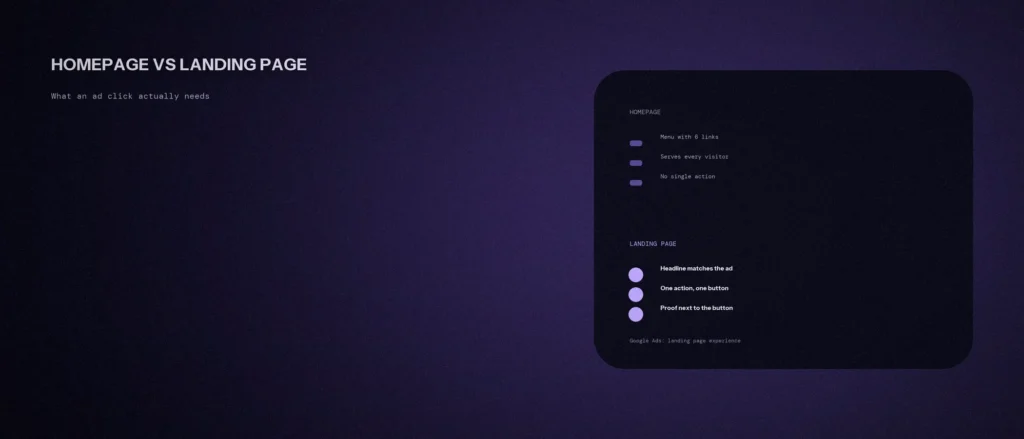
A homepage is built to serve every visitor: a first-time browser, a returning customer, a job applicant, a journalist. It has a menu, several sections, and more than one thing you could click. That’s the right job for a homepage.
An ad click is a different visitor entirely. They typed one specific search, clicked one specific ad, and expect one specific answer. Land them on a page built for everyone, and they have to search again just to find what the ad promised. Some will. Most will leave.
Five things a landing page needs
These are the differences that matter most, in the order I’d fix them.
- A headline that matches the ad. If the ad says “same-day AC repair,” the page should say the same thing in the first line, not “welcome to our company.”
- One action, not several. A homepage links to services, about, blog and contact. A landing page has one button: call, book, or get a quote. Every other link is a distraction from the reason they clicked.
- Proof near the action, not buried below. A review, a guarantee or a real number should sit close to the button, not three scrolls down where most visitors never reach.
- No easy way out. A homepage’s navigation menu, blog links and footer are useful on a homepage. On a landing page, each one is a door for the visitor to leave before they act. Strip the menu down or remove it.
- A form that matches what the ad promised. If the ad offers a free quote, the form should ask for a quote, not create an account. Extra fields cost you leads. Our post on how many form fields is too many covers this in more depth.
When sending traffic to the homepage is fine
Not every business needs a separate landing page for every ad. If your business has one simple offer and your homepage already does everything a landing page would, a dedicated page adds little. The test is simple: does your homepage answer the exact search that brought the click, in the first screen, with one clear action? If yes, it’s already working as a landing page. If no, build one.
A prompt to audit your own landing page
Checking your own page against its ad is easier with a structured list. Fill in your details, then look at the real page yourself, since the AI can’t see your live site.
Act as a conversion-focused landing page reviewer. Help me check whether my landing page matches my ad.
Here is the situation:
– The ad headline and description: [paste them]
– The keyword the ad targets: [keyword]
– The landing page headline and first paragraph: [paste them]
– The one action I want a visitor to take: [call, book, form]
– What links or menu items are on the page: [list them]Please do the following:
1. Say whether the page headline matches what the ad promises, and if not, why.
2. List anything on the page that could distract a visitor from the main action.
3. Suggest one change to make the action clearer.Rules:
– Only use the details I gave you.
– Do not invent visitor numbers or conversion rates.
– Keep the advice practical for a small business.
Open the page on your phone after this and click through it as a stranger would. If you hesitate over what to do next, a real visitor will too.
Questions worth answering directly
Does Google actually penalize sending ads to a homepage?
Google doesn’t penalize a homepage specifically, but its landing page experience component of Quality Score checks how relevant and useful the page is to the ad. A homepage that doesn’t match the search usually scores lower, which can raise your cost per click.
What is the single biggest difference between a homepage and a landing page?
Focus. A homepage has to serve every kind of visitor with many possible actions. A landing page serves one visitor, from one search, with one action. Everything that doesn’t support that one action should be removed.
Do I need a different landing page for every ad group?
Not always, but for different intents, yes. A page built around “emergency plumber” and one built around “bathroom renovation quotes” should say different things, even for the same business. Group ads by intent and match the page to the group.
Should a landing page have a navigation menu?
Generally, keep it minimal or remove it. Every menu link is a way for a visitor to leave before taking the action you want. A logo and a way back to the homepage is usually enough.
How does landing page experience affect my ad cost?
Google’s documentation says a below-average rating on this component “may indicate an opportunity to make improvements.” In practice, weaker relevance to the ad can mean a lower Quality Score, which can raise how much you pay for the same position.
What should be above the fold on a landing page?
A headline that matches the ad, one sentence on what the visitor gets, and the main action button. Everything a visitor needs to decide should be visible without scrolling, even on a phone.
Where this actually matters
A landing page is not a smaller homepage. It’s a different job: answer one search, remove every distraction, and make the one action obvious. Fix that before you spend more on clicks.
Want your ads and landing pages checked together? Our Google Ads management starts with exactly that audit.