Most Google Ads copy is written by looking at the keyword list and repeating it back. “Emergency plumber Bangalore” becomes a headline that says “Emergency Plumber Bangalore,” followed by a description that says the same thing in a longer sentence. It looks relevant. It rarely is, because relevance was never about repeating the words.
It’s about matching what the person typing them actually wants. Here’s what Google’s own guidance says about the difference, and how to write copy that reflects it.
Quick summary, if you’re short on time:
- Google defines ad relevance as “how closely your ad matches the intent behind a user’s search,” not how many keywords the ad repeats.
- Its own advice is to “match the language of your ad text more directly to user search terms” and to “be more specific in your ad text.”
- For responsive search ads, Google says to “focus on providing as many unique headlines as you can,” up to 15 headlines and 4 descriptions per ad.
- Google warns against pinning identical or very similar text to the same slot, since it restricts the system and can lower Ad Strength.
- Advertisers who improve Ad Strength from “Poor” to “Excellent” see 15% more clicks and conversions on average, according to Google’s own figures.
Jump to a section:
- What relevance actually means
- Matching intent versus repeating keywords
- Why unique headlines beat repeated ones
- How to actually write one
- A prompt to write ads that match search intent
- Questions worth answering directly
What relevance actually means
Google’s own documentation defines ad relevance plainly: “how closely your ad matches the intent behind a user’s search.” Intent, not vocabulary. Someone searching “emergency plumber” at 11pm wants to know one thing above everything else: will someone actually come tonight. An ad that repeats the phrase back to them without answering that question matches their words and misses their point.
This is one of the three parts of Quality Score, covered in more depth in our post on Quality Score. Ad relevance is the part you control most directly, since it comes down to the words you actually write.
Matching intent versus repeating keywords
Google’s own advice for improving relevance reads like a rebuke to keyword repetition: “match the language of your ad text more directly to user search terms,” “ensure the details in your ad match the intent of your keywords,” and “be more specific in your ad text.” Notice what’s missing: nothing about using the exact keyword more times.
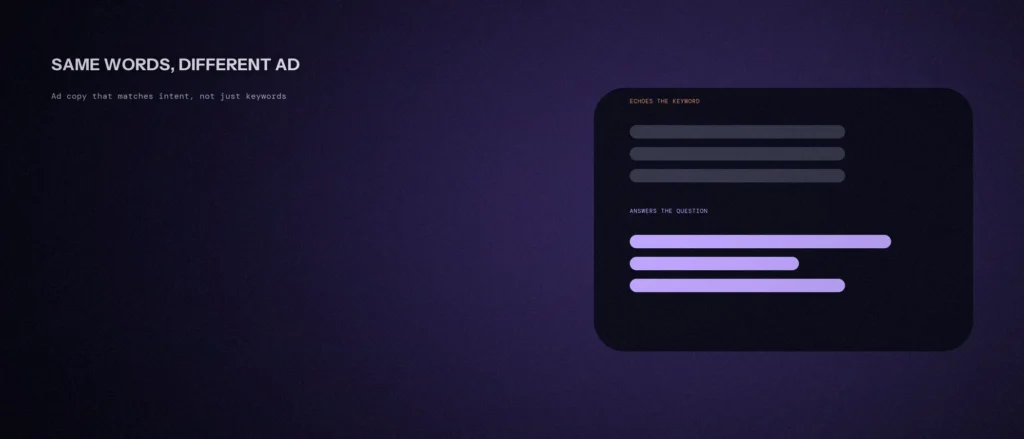
The practical difference shows up in the headline. A keyword-repeating ad says “Emergency Plumber Bangalore.” An intent-matching ad says “Plumber at Your Door Within 60 Minutes.” Both contain the searcher’s idea. Only the second one answers the question underneath it, which is exactly what makes someone click.
Why unique headlines beat repeated ones
Responsive search ads let you provide up to 15 headlines and 4 descriptions, and Google’s advice is direct: “focus on providing as many unique headlines as you can. More headlines give Google Ads more options to assemble your messages into relevant ads, which may increase performance.”
The word doing the work there is unique. Fifteen variations of the same phrase give the system nothing real to test. Fifteen headlines that each say something different, a speed claim, a price signal, a trust point, a location detail, give it real combinations to match against different searchers. Google also warns to “avoid pinning identical or very similar text to the same slot,” since it restricts the system and can lower Ad Strength.
How to actually write one
Start with the search term’s underlying question, not its wording. Ask what the person typing it is most worried about, or most in a hurry about, and write the headline that answers that worry directly. Then vary the angle across your 15 headlines, speed, price, trust, availability, location, so no two say the same thing in different words.
This also depends on grouping keywords tightly enough that one ad’s message genuinely fits every search that triggers it, which connects directly to how you set up match types. A broad match keyword triggering on loosely related searches makes writing intent-matched copy nearly impossible, since the intents keep shifting.
A prompt to write ads that match search intent
Good ad copy answers what the searcher wants right now. The prompt below asks an AI tool for options built around one search. Fill in your details, and check every line against your landing page.
Act as a Google Ads copywriter. I need ad text for one search intent.
Here is the situation:
– The search someone types: [keyword]
– What they probably want: [describe]
– What my landing page offers: [describe]
– One real reason to choose me: [for example free audit, fixed price]Please do the following:
1. Write 10 headlines, each under 30 characters.
2. Write 4 descriptions, each under 90 characters.
3. Say which headline and description best fit the intent and why.Rules:
– Do not make claims my page cannot back up.
– No fake urgency or made-up prices.
– Use plain words.
Check that each headline matches the landing page. Ads that promise something the page does not show waste your budget.
Questions worth answering directly
What is ad relevance in Google Ads?
Google defines it as how closely your ad matches the intent behind a user’s search. It’s one of the three components of Quality Score, alongside expected click-through rate and landing page experience.
Should I repeat my keyword in every ad headline?
No. Google’s guidance is to match the intent behind the search, not repeat the keyword mechanically. It advises being more specific in your ad text and providing as many unique headlines as possible, since fifteen near-identical headlines give the system nothing meaningfully different to test.
How many headlines should a responsive search ad have?
Google allows up to 15 headlines and 4 descriptions per responsive search ad and recommends providing as many unique headlines as you can. Its own data says advertisers who improve Ad Strength from Poor to Excellent see 15% more clicks and conversions on average.
Does Ad Strength matter for Google Ads copy?
Google reports that advertisers who improve Ad Strength from Poor to Excellent see 15% more clicks and conversions on average. Google also says Ad Strength isn’t used to calculate Ad Rank, so treat it as feedback on how the ad is built, not as a ranking lever.
Why is pinning the same text to one slot a problem?
Google warns against pinning identical or very similar text to the same slot, since it restricts the system and can lower Ad Strength. Leave slots free unless you have a real reason to fix a line in place.
What’s the difference between matching keywords and matching intent?
Matching a keyword repeats the searcher’s words back. Matching intent answers what they actually want, like a plumber at the door within 60 minutes for someone searching emergency plumber. The second is what gives someone a reason to click.
Where this actually matters
Copy that repeats the keyword feels safe, because it’s obviously relevant. Copy that answers the searcher’s real question is what actually earns the click, and Google’s own documentation points the same direction.
Not sure whether your own ads are matching intent or just echoing keywords? We check this as part of every Google Ads engagement we run.