
Rank tracking tools are everywhere, and most of them report the same simple thing: a keyword rank on the search engine results page, the SERP. A rank tracker says position 1. You search the same keyword yourself and your site is nowhere on the first page. Both can be true at the same time, and neither tool is broken. Google shows different results to different people, and a single “position 1” number cannot capture that.
This post explains why a rank tracker’s position can disagree with what you see or what your customers see, what Google says about why results differ, how Search Console’s position figure is calculated, and how to use a rank tracker without being misled. We re-read Google’s help page on why search results differ and its Search Console documentation on 11 October 2026. Where something is our own advice, we say so. If you want to read Search Console properly, see our post on Search Console metrics: clicks, impressions, CTR and position.
Quick summary, if you’re short on time:
- Google’s help page says that sometimes Google may give you different results based on things like time, context or personalised results.
- It names location, language, device type, related results and recent searches as context, and says signed-in personalisation can sometimes affect the order that results are ranked.
- A rank tracker measures one setup, usually a fixed place, device and logged-out state. Its “position 1” is position 1 for that setup.
- Search Console’s position is different: it is the average, across many real impressions, of the topmost position of your site.
- Judge SEO by trends, enquiries and Search Console data, and use a tracker as one input.
Jump to a section:
- Why results differ, in Google’s words
- What a rank tracker actually measures
- “Position 1” can mean different things
- How Search Console’s position differs
- How to use a rank tracker properly
- Decisions that go wrong
- A prompt to sanity-check a ranking claim
- Questions about rank tracker positions
Why results differ, in Google’s words
Google’s help page on why your search results differ from others says you may get the same or similar results as someone else, but sometimes Google may give you different results based on things like time, context or personalised results. It lists the causes:
- Time. Google says it regularly adds new content from the web soon after it is published, so people who search a few hours or even a few minutes apart may see variations. It also says that when it improves its ranking systems, the change takes time to roll out to all its data centres, which can produce differences depending on which data centre responds.
- Context. Its examples are location (searching for pizza in a city gives results relevant to that location), language, device type (mobile or desktop), related results after you return from a click, and recent searches.
- Personalisation. If personalised recommendations are on, Google says your Search experience may be tailored using things like your search history. It says personalisation does not affect all results, and that sometimes it may affect the order that individual results would be ranked, and other times the order in which content blocks appear.
So even on Google’s side, there is no single, universal list for a search. For local searches, as Google’s local ranking tips say, results depend on distance as well as relevance and prominence, so where the searcher stands changes the result.
What a rank tracker actually measures
Rank trackers, sometimes called a rank checker, track keyword positions by sending a search to a search engine and reading the SERP, often through an API or a scraper. They track keyword rankings for a domain at the schedule you set. Results also show SERP features such as the local pack, ads and AI answers, and a good tracking tool records which features appeared with each position.
A rank tracker asks Google a question from a controlled setup, usually a fixed location, a chosen device and a logged-out state, and records where your page appears. That is useful, because it holds conditions steady and lets you compare the same view over time. But it is one view.
It follows that a tracker can honestly report position 1 for a keyword in the city and on the device you set, while a real customer elsewhere, on another phone, with a different search history, sees something else. Neither is wrong. They are different measurements.
Google also says something that applies to the tools themselves. In its page on hiring an SEO, it says it does not evaluate or endorse third-party SEO tools, and that these tools do not have access to Google’s internal ranking data. A tracker can sample results. It cannot see inside Google.
“Position 1” can mean different things
| What “position 1” might refer to | Why it can mislead |
|---|---|
| First blue link in the organic results | It may sit below ads, a map pack or an AI answer, so it may not be first on the screen |
| First place in the local map pack | Depends heavily on where the searcher is standing |
| First on desktop, for a chosen city | Mobile results for the same words can be different |
| First for an exact keyword | Customers may use other words, which return different results |
| First on the day of the check | Results move from day to day, and from data centre to data centre |
The practical advice: when someone says “we are number one”, ask for which search, where, on which device, on what date, and in which part of the page.
How Search Console’s position differs
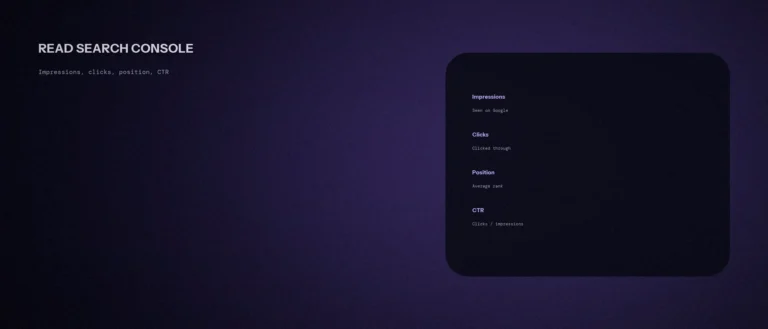
Google Search Console works differently from a tracker, and its definitions are on Google’s own help pages. The Performance report’s position is an average, taken over real impressions, of the topmost position of your site. Google says, for example, that if your site appears at positions 2, 4 and 6 for one query, it is counted as position 2 for that query. It also says a link must get an impression for its position to be recorded.
That makes the two sources complementary:
- A tracker shows one controlled view, daily, for keywords you choose, including ones where you do not yet get impressions.
- Search Console shows what real searchers actually saw, over a date range, for queries that produced impressions, including ones you never thought to track.
When the two disagree, do not decide which is right. Ask what each is measuring.
How to use a rank tracker properly
- Set the location to where your customers are. A default setting or your office location may not match.
- Track the keywords that bring business, not only the ones that flatter. Keep a short list of ten to twenty.
- Use the same settings over time. Changing location or device mid-way breaks the comparison.
- Read trends over weeks, not a single day’s number.
- Cross-check with Search Console. Look at average position, impressions and clicks for the same queries.
- Check the page, not only the number. Look at the result in a private window on a phone, and see what is actually above you.
- Tie it to outcomes. Compare ranking changes with calls, forms and enquiries. A rise that brings nothing is a signal to question the keyword.
Decisions that go wrong
- Celebrating a number while enquiries stay flat. The tracked keyword may not be the one that brings customers, or the tracker’s location may not match yours.
- Panicking over a one-day drop. Google says results change with time, and a single day’s change is not proof of a problem.
- Chasing position 1 for vanity terms. A first place for a broad phrase can bring less business than third place for a specific one.
- Treating a screenshot as proof. Anyone can show a view in which they are first. Ask for the tool, the location and the date.
- Believing a guarantee. Google says no one can guarantee a number one ranking, and that is in its guidance on hiring an SEO.
A prompt to sanity-check a ranking claim
An AI tool can ask the awkward questions about a ranking report for you. It cannot see Google, so give it the report and your own data.
Act as a careful, sceptical SEO analyst. Help me check whether a ranking report really shows what it claims.
My details:
– The claim, as I was told or as the report states: [for example “you rank number 1 for 18 keywords”]
– The tool and its settings, if shown: [location, device, language, date]
– The keywords listed, with the position each: [paste]
– My Search Console data for the same queries, if I have it: [paste clicks, impressions, average position]
– My enquiries over the same period: [numbers]Please do the following:
1. List what the report does not say, such as location, device or date, that I would need to interpret it.
2. Compare each tracked position with my Search Console position and impressions, and flag mismatches.
3. Tell me which keywords have meaningful impressions or clicks, and which are tracked but bring nothing.
4. Write five questions I should ask whoever sent the report.Rules:
– Use only my data. Do not invent search volumes, rankings or benchmarks.
– Remember that Search Console position is an average of the topmost position per query.
– Say clearly when something is your interpretation and not in the data.
– Write in plain, simple English.
Send the questions in writing, and keep the answers with the report.
Questions about rank tracker positions
Why does my rank tracker show a different position from Google?
Because they measure different setups. Google says results can differ by time, context such as location and device, and personalisation. A tracker records one controlled view.
Is rank tracker data accurate?
It is accurate for the setup it measures, which is useful for trends. It is not what every searcher sees. Google also says third-party tools do not have access to its internal ranking data.
Why can’t I find my site when I search my own keyword?
Your result is influenced by your location, device, history and the time. Google’s Search Console help page also says you might not see your site for a query that appears in your report.
Is Search Console position more reliable than a tracker?
It reflects real impressions, which a tracker does not. It is an average of the topmost position, so it can blur. Use both, and compare them over time.
Does position 1 always get the most clicks?
Not always. Click-through rate depends on the title, the snippet and what else appears on the page. Check clicks and enquiries as well as position.
How often should I check rankings?
Weekly or fortnightly is enough for most small businesses. Daily numbers move for reasons unrelated to your site, so look at the trend over weeks.
Can anyone guarantee position 1?
No. Google says no one can guarantee a number one ranking on Google. Treat any such promise as a warning sign.
Where this matters
A rank tracker is a useful, consistent measurement of one setup, and not a statement of what everyone sees. Use it for trends, cross-check it with Search Console, and judge SEO by the enquiries it brings.
If you would like help reading your own rankings and data, see our SEO services, or send us your website address and we will tell you what we see.