You open a new Google Ads account and the first screen asks you to pick a campaign type. Search? Performance Max? The names don’t tell you much, and Google’s own recommendation usually leans toward whichever one it wants more advertisers using that quarter. For a business spending a real, limited budget, picking wrong here doesn’t just waste a few days. It can waste weeks of learning-phase spend before you notice the numbers don’t add up.
Quick summary, if you’re short on time:
- Search shows text ads for what someone actually typed. Performance Max hands control to Google’s algorithm across Search, YouTube, Display, Gmail, and Maps.
- Most local service businesses should start with Search, since you can see and control exactly what you’re paying for.
- Ecommerce businesses with a solid product feed and working purchase tracking can sometimes test Performance Max earlier.
- The two aren’t rivals long-term. Mature accounts usually run both, once tracking and data are in place.
Jump to a section:
- What each one actually is
- The real trade-off: control vs. reach
- Search vs Performance Max, side by side
- Who should start where
- The mistake we see most often
- A step-by-step way to decide
- Using AI to apply this to your account
- Questions worth answering directly
What each one actually is
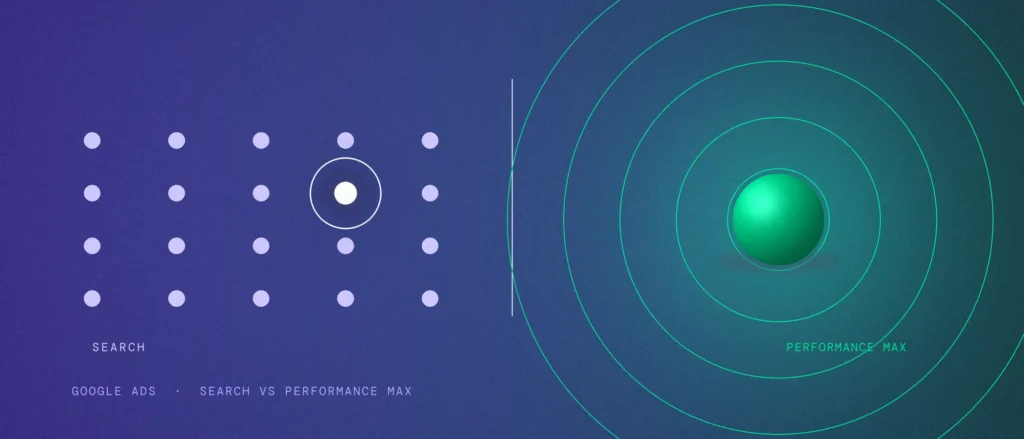
A Search campaign shows text ads on the Google search results page when someone types a query you’re bidding on. You choose the keywords, or let Google’s broad match loosely interpret them, you write the ad copy, and you can see, query by query, what people searched before your ad appeared.
Performance Max works differently, not just by a small margin. You give Google your goal, your budget, and some assets like images, headlines, descriptions, and your landing page. Google’s algorithm then decides where to show your ads, across Search, Display, YouTube, Discover, Gmail, and Maps, and who to show them to. You don’t pick keywords. You barely see which channel produced which result. You’re handing over the steering wheel and trusting the algorithm to drive toward your stated goal.
The real trade-off: control vs. reach
Search gives you visibility into intent. You can see the exact phrase someone searched, add it as a keyword if it converts, and exclude it as a negative keyword if it doesn’t. Watching a search term come in, deciding if it’s good, and acting on it, is the entire discipline of running Search well.
Performance Max gives you almost none of that. You get channel-level performance at best, rarely query-level. You’re trusting Google’s model to find converting traffic across placements you can’t individually inspect or exclude. For some businesses that trade-off is worth it. For others, it quietly burns budget on placements a person would never have chosen.
Search vs Performance Max, side by side
| Search | Performance Max | |
|---|---|---|
| What you target | Keywords, match types, audiences, locations, schedules | Conversion goals, audience signals, assets, product feed |
| Where ads show | Google Search, plus search partners if enabled | Search, Display, YouTube, Discover, Gmail, Maps |
| Query-level visibility | Good, though not every query is reported | Limited. Insights need careful reading |
| Creative needed | Mainly text ads and a landing page | Text, images, video, and/or a product feed |
| Best first use case | Capturing clear, high-intent demand | Scaling once tracking and assets are solid |
| Main risk | Broad keywords, weak negatives, weak landing pages | Automation amplifying bad tracking or low-quality leads |
Who should start where
This isn’t the same answer for every business. It depends on what you sell and how people search for it.
- Local service businesses. Plumbers, dentists, interior designers, lawyers. Start with Search in most cases, since buyers usually type a specific, location-based need and you want to catch it directly.
- Ecommerce stores. If your Merchant Center feed is clean, your product images and pricing are accurate, and purchase-value tracking is working properly, Performance Max can be worth testing earlier than for a typical service business. Just protect your branded and high-intent Search terms while you test.
- B2B or high-consideration services. Start with Search around the problems and solutions people are actively researching. Hold off on Performance Max until you have a real feedback loop telling you which leads actually turn into customers, not just which forms get filled.
A Bengaluru interior design firm is a good example of the usual local-service path. It would normally start with Search campaigns around terms like “home interior designers Bengaluru” and “modular kitchen designers near me,” sending traffic to distinct pages for each service. Once call and form tracking are accurate and there’s real project photography to use as creative, it’s in a much better position to test Performance Max for extra reach.
The mistake we see most often
A business with no prior Google Ads history launches Performance Max first, because it looked easier: fewer settings, no keyword research, Google “handles it for you.” Three weeks in, spend is real, conversions are thin, and there’s no query-level data to explain why. Nobody can tell whether the budget went to Search, a YouTube pre-roll, or a Display placement nobody would have chosen on purpose.
The better sequence for most service businesses: start with Search, where you can see and control exactly what you’re paying for. Get conversion tracking clean, understand your actual cost per lead, and build a few weeks of real data. Only then consider adding Performance Max as a second campaign, with a working conversion signal already in place for it to learn from, rather than as your only line of attack from day one.
A step-by-step way to decide
- Do you have accurate conversion tracking set up? If not, fix that first, whatever campaign type you’re leaning toward. Neither one works well while you’re optimising blind.
- Are you a local business with one or a few clear services? Start with tightly themed Search campaigns, real geographic targeting, solid negative keywords, and a landing page for each service.
- Do you run ecommerce with a healthy product feed and working purchase tracking? You can test Performance Max earlier, while still protecting your branded and highest-intent Search terms.
- Do you have enough real creative assets and a proven offer? If yes, Performance Max can complement Search well. If not, build the landing pages and assets first.
- Can you tell a genuinely qualified lead from a random form fill? If not, don’t let an automated campaign optimise purely toward raw lead volume. Feed it real qualified-lead or revenue data wherever your setup allows it.
Using AI to apply this to your account
The framework above is the right one, but answering it well means pulling together several pieces of your own business context at once. That’s exactly the kind of comparison a structured prompt handles better than a quick gut call.
“Act as a Google Ads strategist helping me decide where to start.
Business context:
– What I sell and to whom: [describe the service and ideal customer]
– Do people actively search for this, or do they need to be made aware of it first: [active search demand / mostly passive awareness / a mix]
– Monthly ad budget I’m working with: [amount]
– Do I have conversion tracking already set up and verified in Google Ads: [yes, working / yes, unverified / no]
– Do I have Google Ads history and conversion data from a past campaign: [yes, roughly how much / no, starting fresh]
– If I sell products: is my Merchant Center feed accurate and is purchase-value tracking working: [yes / no / not applicable]
– How important is it that I can see exactly which keyword or placement produced each result: [critical / somewhat important / not important]Task:
1. Recommend whether I should start with Search, start with Performance Max, or run both from day one, and explain the reasoning against my specific answers above, not in general terms.
2. Flag anything in my answers that suggests I’m not ready for Performance Max yet, specifically.
3. If you recommend Search first, tell me what signal or milestone should trigger adding Performance Max later.
4. List the two or three things I should fix or set up before spending anything, if my answers suggest I’m not ready to spend well on either.”
This is a reasoning aid, not a substitute for actually checking your Google Ads account. It can’t see your real conversion data, past campaign performance, or account history, only what you tell it. Answer the prompt’s questions honestly rather than optimistically, since the recommendation is only as good as what you put in.
They’re not actually rivals
Framing this as “Search vs. Performance Max” is useful for a first decision, but the mature version of most accounts runs both. Search handles known, high-intent demand where control matters. Performance Max layers on top once there’s a real conversion signal to feed it, reaching placements Search alone can’t touch. Treating this as a one-time either-or choice is itself a common mistake. The right mix usually shifts as an account matures and the data improves.
If you’re deciding where to spend your first rupee of ad budget, and you don’t yet have the conversion history for Google’s algorithm to learn from, start with Search for most business types. You can always add Performance Max once you understand your numbers well enough to know if it’s actually helping.
Questions worth answering directly
Can Performance Max and Search run at the same time?
Yes, and mature accounts usually do. The key is giving each campaign a clear, non-overlapping purpose and watching for one campaign quietly competing with the other for the same searches.
Will Performance Max eventually replace Search campaigns?
No. They solve overlapping but different problems. Search captures declared intent with full visibility. Performance Max trades visibility for broader automated reach. Most accounts end up needing both.
Is Performance Max good for lead generation?
It can be, but only with clean conversion tracking and a clear definition of what counts as a good lead. Weak tracking or vague lead quality lets the automation optimise toward the wrong outcome.
How much budget do I need to start?
There’s no universal number. You need enough conversion volume and time for the campaign to learn, sized to what your margins and lead economics can actually support. Start with a test budget you can commit to for a few weeks, not a one-off spend.
Should ecommerce businesses start with Performance Max instead of Search?
Sometimes, if the product feed, images, pricing, and purchase-value tracking are all reliable. Even then, it’s worth protecting branded and high-intent Search terms rather than routing everything through Performance Max alone.
Once you have decided to start with Search, the next real decision is usually which match types to run.
Working through exactly this sequencing, Search first, conversion tracking verified, Performance Max added only once there’s real data to learn from, is standard practice inside every Google Ads management engagement we run.