You’ve probably heard the “three-click rule”: the idea that no page on your website should be more than three clicks from the homepage, or visitors give up and leave. It’s one of the most repeated pieces of web design advice out there. It’s also, in the strict sense most people mean it, not really a rule at all. What actually matters isn’t a magic click count. It’s something more specific and more useful once you understand it: click depth, and how clearly your structure tells both visitors and Google what matters most.
Quick summary, if you’re short on time:
- Click depth means how many clicks it takes to reach a page from your homepage, following only links.
- There’s no official three-click rule. Google has said directly that what matters is how easy a page is to reach, not a fixed number.
- Pages buried deep tend to get crawled less and trusted less, which hurts rankings indirectly, not through a penalty.
- A hub-and-spoke structure keeps even a large site shallow without dumping everything into one giant menu.
- Aim to keep your important pages within 2 to 3 clicks of the homepage as a general target, not a strict rule.
Jump to a section:
- What click depth actually is
- Does the three-click rule actually matter?
- What actually matters: crawl depth
- Flat doesn’t mean flimsy
- A short structure checklist
- What this looks like in practice
- How to check your own site
- Breadcrumbs do double duty
- Questions worth answering directly
What click depth actually is
Click depth is simply how many clicks it takes to get from your homepage to any given page, following only the links on your site. Your homepage is depth zero. A page linked directly from your homepage is depth one. A page you can only reach by going homepage, then a category page, then a subcategory, then finally the page itself, is depth three.
This is a different idea from your site’s overall structure, which is how your pages are organised into groups, like flat versus deeply nested categories. It’s also different from crawl budget, which is how much of your site Google is willing to crawl in a given period, and mostly only becomes a real concern on very large sites. Click depth is the one of these three that affects almost every website, regardless of size, and it’s the one you have the most direct control over.
Does the three-click rule actually matter?
Research on this goes back over a decade, and it has consistently found that users tolerate more than three clicks just fine, as long as each click clearly moves them closer to what they’re looking for. What actually causes people to leave isn’t the click count. It’s uncertainty: a confusing link, a vague label, a dead end. Four confident clicks beat two confusing ones every time.
Google’s own John Mueller has said directly that what matters is how easy it is to reach a page from strong pages like your homepage, not a fixed number of clicks or how many slashes are in the URL. Search Engine Journal covered this in detail, and the short version is: there’s no hard three-click rule, from Google or from usability research. What both agree on is that a shallow, well-organised structure tends to produce the outcome the three-click rule was always trying to describe. Treat 2 to 3 clicks for important pages as a sensible target, not a strict requirement.
What actually matters: crawl depth
Google doesn’t experience your site by clicking around like a person. It follows links, and it builds an impression of a page’s importance partly from how deep that page sits in your link structure: how many clicks it takes to reach from the homepage, following only internal links. A page buried five, six, seven clicks deep sends a quiet signal that it’s not very important, even when the content on that page is excellent.
This is why site structure is an SEO question, not just a design one. Two businesses can publish the exact same piece of content, word for word, and get very different results depending on how deeply that page sits in each site’s structure and how many other pages link to it.
Flat doesn’t mean flimsy
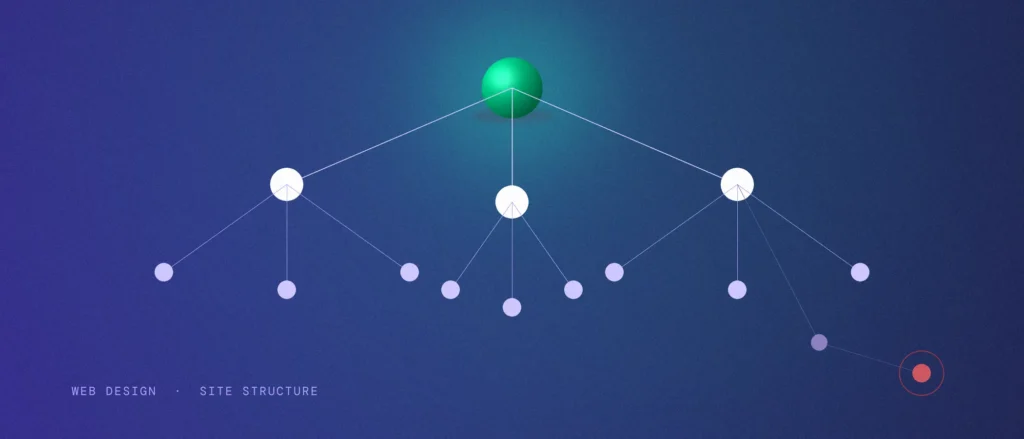
A common misunderstanding is that a “flat” structure means one giant menu with everything dumped at the top level. It doesn’t. A well-built flat structure uses hubs: a services page linking to each individual service, a blog index linking to categories, categories linking to posts, so that even a site with hundreds of pages keeps everything within two or three hops of the homepage, without the homepage itself turning into a wall of links.
This is the hub-and-spoke pattern: broad hub pages near the top, like Services, Locations, or Blog, that fan out to specific pages beneath them, each hub small enough to be genuinely useful as a menu, not just a link dump. Get the hub layer right, and depth mostly takes care of itself. You don’t have to manually count clicks to every page. You just have to make sure every page belongs to a hub, and every hub is reachable from the top.
A short structure checklist
- Keep your money pages shallow. Services, top categories, and your most important guides should sit within 2 to 3 clicks of the homepage wherever realistically possible.
- Use internal links and breadcrumbs to shorten the effective path. A deep page can still feel “close” if it’s linked directly from a relevant blog post or another high-traffic page, not just buried in a menu.
- Favour a flatter structure for anything that matters. Deep, many-layered category trees are usually harder for both people and Google than a well-organised flat one.
- Check your structure with a crawler, not just by eye. A site crawler will show you the actual click depth of every page, including ones you’ve forgotten exist.
What this looks like in practice
For a local service business, like a Bengaluru dentist or interior designer, this usually means each core service and each area you serve should be reachable in two or three clicks: homepage, then a services or locations hub, then the specific page. If “Root Canal Treatment” is only linked from inside an old blog post and nowhere in the main navigation, that’s a page quietly telling Google it doesn’t matter much, even if it’s one of the practice’s best-earning services.
For an ecommerce store, the usual path is homepage, then category, then subcategory, then product. That’s already three or four clicks before a customer even reaches the product page. The fix isn’t always to flatten the whole catalogue. It’s making sure your best-selling and highest-margin products also get direct links from the homepage, a featured section, or relevant blog content, so they don’t rely on the deepest path being the only path.
In both cases, the fix is rarely deleting layers of navigation. It’s adding a second, shorter path to the pages that matter most, on top of the structural one that already exists.
How to check your own site
You don’t need special tools for a rough first pass. Pick five pages you consider important, the ones you’d want a stranger to find easily, and physically click from your homepage to each one, counting as you go. If any of them take more than three or four clicks, or if you had to guess which menu item might lead there, that’s a real structural gap, not a nitpick.
For a fuller picture, a site crawler, even a free one, will show you the actual click depth of every page on your site, not just the five you checked by hand. Look specifically for important pages sitting deep, and for orphan pages, ones with no internal links pointing to them at all, which is the extreme end of this same problem.
Breadcrumbs do double duty
Breadcrumb navigation, the “Home > Services > SEO” trail near the top of a page, earns its keep twice over. For visitors, it shows exactly where they are and gives them an easy way to step back up a level. For search engines, it reinforces the hierarchy clearly, in a way that’s hard to misread, and can show up directly in search results as an extra trust signal. If your site doesn’t have breadcrumbs on anything beyond the homepage, that’s a cheap, high-value fix, cheaper than almost anything else on this list.
Questions worth answering directly
Is the three-click rule a real Google ranking factor?
No. Google has said directly that ease of reaching a page matters, not a fixed click count. The three-click rule is a usability heuristic, not a confirmed ranking rule.
What’s the difference between click depth and crawl budget?
Click depth is how many clicks it takes to reach a page from your homepage. Crawl budget is how much of your site Google is willing to crawl in a given period, and it mostly only matters for very large sites.
How deep is too deep for an important page?
There’s no hard cutoff, but pages sitting five or more clicks deep are a real warning sign. Aim for 2 to 3 clicks for anything you’d consider a money page.
Do I need to flatten my entire site structure?
Usually not. Adding a second, shorter path to your most important pages, through internal links or a featured section, is often enough without rebuilding your whole navigation.
How do I find pages that are buried too deep?
A site crawler will show you the actual click depth of every page. Look specifically for important pages sitting deep and for orphan pages with no internal links pointing to them at all.
This sits right next to crawl budget, since a shallow structure is one of the main things that keeps crawl budget from becoming a real problem in the first place. It also connects to our guide on SEO-ready site foundations.
Where this actually pays off
Fixing site structure isn’t a one-time project with a dramatic before and after. It’s closer to good bookkeeping: unglamorous, but it compounds. A well-structured site makes every future page you add easier to place correctly, easier for Google to find and trust, and easier for a visitor to navigate without thinking about it. A poorly structured one makes every future addition a small extra mess, until eventually nobody, including you, is entirely sure what’s actually on the site anymore.
Not sure how deep your key pages actually sit, or whether that’s quietly costing you rankings? Share your site and we’ll map the structure, flag anything buried too deep, and suggest the internal-link fixes worth doing first. Getting the structure right before content gets added is exactly why site architecture is one of the first things we plan, not something we patch in afterward, in every website development project we take on.