Ask a business owner what their homepage hero says, and most can’t repeat it word for word. That’s usually the first clue it isn’t working, because a hero that actually lands sticks in your head without trying.
The hero is the most expensive real estate on your entire website. It’s also the section most likely to be written last, rushed, or borrowed from a template. Here’s how to actually get it right.
Quick summary, if you’re short on time:
- Nielsen Norman Group’s own research found people “often leave web pages in 10-20 seconds,” and you have to communicate your value proposition within that window to hold their attention longer.
- A working hero passes the “now you can” test: read it back to yourself as “now you can ___,” if it doesn’t complete into something concrete, it’s still too abstract.
- Filler words like “streamline,” “optimize” and “innovative” are the fastest way to say nothing while sounding busy.
- Your call to action should follow the formula: action verb plus what they get plus a qualifier, not “Learn More” or “Submit.”
- The best test isn’t a design opinion, it’s asking someone unfamiliar with your business to read the hero and tell you what you do.
Jump to a section:
- Why the hero has to work in seconds
- The one-sentence test
- What actually kills hero clarity
- The call to action that gets clicked
- A simple way to test your own hero
- A prompt to draft a homepage hero
- Questions worth answering directly
Why the hero has to work in seconds
This isn’t a guess about attention spans. Nielsen Norman Group’s own research on user behaviour is specific: “users often leave web pages in 10-20 seconds, but pages with a clear value proposition can hold people’s attention for much longer.”
The same research adds a detail worth sitting with: “users have time to read only a quarter of the text on the pages they actually visit.” If your hero doesn’t communicate what you do in that first quarter of attention, the rest of the page rarely gets the chance to make the case instead.
The one-sentence test
A hero sentence that works has a simple property: read it back as “now you can ___,” and it should complete into something specific. “Now you can get your local business found on Google without guessing what’s working” passes. “Now you can experience digital excellence” doesn’t complete into anything.
A few sentence shapes tend to hold up better than a blank page and good intentions. “{Outcome} without {the usual pain point}” works because it names both the win and the thing people are tired of. “The {category} for {specific audience}” works because it tells a visitor immediately whether this is for them. A direct question that names the reader’s actual pain point works because it does the visitor’s own thinking out loud, for them.
What all three have in common: they force you to pick an actual outcome and an actual audience, instead of describing the company in the abstract.
What actually kills hero clarity
Certain words do a specific kind of damage: they sound like they’re saying something while communicating nothing a visitor could act on. “Streamline,” “optimize,” and “innovative,” used as filler rather than backed by a specific claim, are the most common offenders on small business homepages.
The fix isn’t finding fancier words. It’s replacing the vague claim with the specific one underneath it. “We streamline your workflow” says nothing. “We cut your weekly reporting from four hours to fifteen minutes” says something, but only if that number is real. A fabricated specific number is worse than an honest vague one, so only use this if the number actually holds up.
Passive voice and hedging words like “almost,” “very,” and “really” quietly weaken a hero too. “Your site could almost double its speed” reads like a company that isn’t sure of its own claim. This connects to the same clarity problem covered in our guide to above-the-fold design: a hero that hedges wastes the same limited attention a hero that’s simply too long wastes.
The call to action that gets clicked
A hero’s call to action is doing real work, not decoration. The formula worth defaulting to is action verb, plus what they get, plus a qualifier: “Get your free audit,” “See pricing for your plan,” not “Learn More” or “Submit,” which tell a visitor nothing about what happens next.
The button also shouldn’t be the only decision point on the page. Repeating the same clear action at other natural moments, after you’ve made the case, after pricing, after FAQs, matters more than making the first button bigger.
A simple way to test your own hero
Skip the internal opinions for a moment. Show your homepage hero, just the hero, to someone who has never seen your business, for five seconds. Then ask them one question: what does this company actually do?
If they can’t answer, or if their answer is vague in the same way your hero is vague, that’s a more honest signal than anything a meeting about “brand voice” will produce. Do this with three or four people who aren’t close to the business, and the pattern usually becomes obvious fast.
A prompt to draft a homepage hero
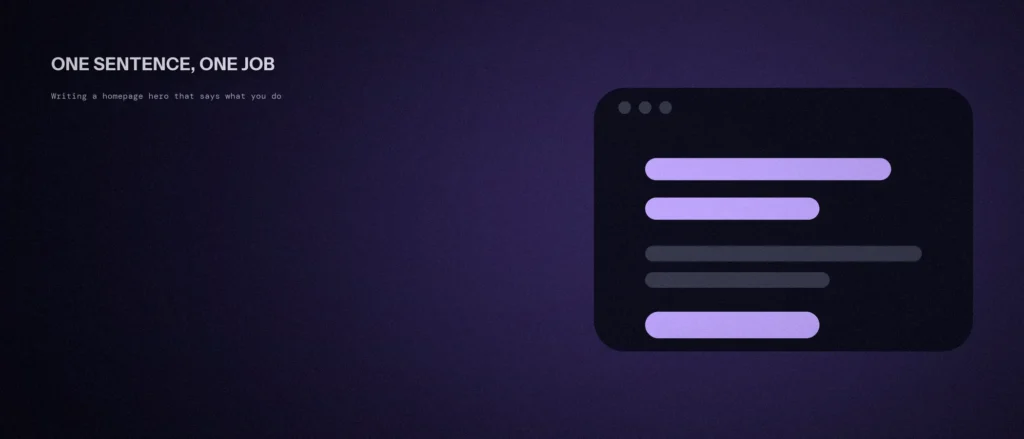
A hero should say what you do, for whom, and what to do next, in a sentence a stranger understands. The prompt below asks an AI tool for options and to explain its choices. Fill in your own details and pick the wording that sounds like you.
Act as a copywriter who writes plain, clear website headlines.
My business:
– What I do, in one sentence: [describe]
– Who it is for: [describe your customer]
– What they get: [the real outcome]
– The next step I want them to take: [call, book, request a quote]Write 5 different hero headlines with a short line under each, and tell me which one you would use and why.
Rules:
– Use plain words a child could follow. No buzzwords.
– Do not promise results I cannot prove.
– Do not use my business name in the headline.
– Each headline must say what I do, not just how great I am.
Read each option out loud. If a stranger could not say what you do after reading it, cut it. Then test the new hero on a friend who does not know your business.
Questions worth answering directly
How long should a homepage hero sentence be?
One sentence, ideally short enough to read in a few seconds. Nielsen Norman Group’s research shows visitors often decide whether to stay within 10 to 20 seconds, so the hero has to communicate the value proposition almost immediately, not build up to it.
What’s the “now you can” test for a homepage hero?
Read your hero sentence back as “now you can ___.” If it completes into something specific and concrete, it passes. If it stays abstract, like “now you can experience excellence,” it needs a real outcome swapped in.
What words should I avoid in a homepage hero?
Filler words like “streamline,” “optimize,” and “innovative” used without a specific claim behind them. They sound purposeful but tell a visitor nothing they can act on. Replace them with the concrete outcome or number the word is standing in for.
What makes a good homepage call to action?
The formula is an action verb, what the visitor gets, and a qualifier, like “Get your free audit” or “See pricing for your plan.” Avoid generic buttons like “Learn More” or “Submit,” which don’t tell a visitor what happens after they click.
How long do visitors give a page before leaving?
Nielsen Norman Group’s research says “users often leave web pages in 10-20 seconds,” and that users have time to read only a quarter of the text on the pages they actually visit. If the hero does not say what you do in that first slice of attention, the rest of the page rarely gets a chance.
What sentence shapes work for a homepage hero?
Three hold up well: “{Outcome} without {the usual pain point},” “The {category} for {specific audience},” and a direct question that names the reader’s actual pain point. All three force you to pick a real outcome and a real audience instead of describing the company in the abstract.
Where this actually matters
A homepage hero doesn’t need to be clever. It needs to survive a stranger reading it once and knowing exactly what you do and who it’s for.
Not sure if your own homepage passes that test? We check this as part of every website engagement we run.