A one-star review shows up, and the instinct is either to ignore it and hope it disappears under newer ones, or to respond defensively, explaining exactly why the customer is wrong. Both reactions are understandable.
Both are also close to the two most common ways businesses accidentally make a bad review worse, for their reputation and for how the response itself gets read by search engines.
Quick summary, if you’re short on time:
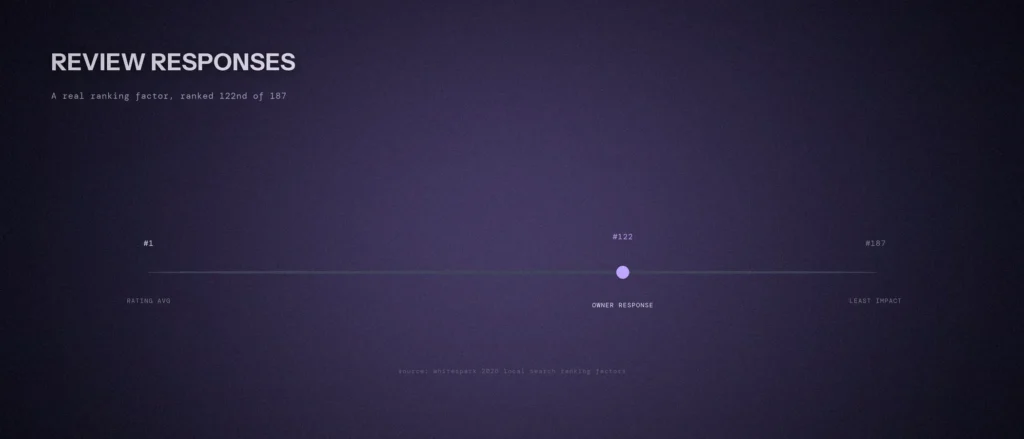
- Owner responses to reviews are a real local pack ranking factor, but a minor one. In the 2026 Whitespark Local Search Ranking Factors survey, “presence of owner responses” ranks 122nd out of 187 factors, well behind rating average, review recency and review volume.
- That means responding will not rescue a page full of one-star reviews, but the review signals around it, rating average, recency, sustained volume, matter far more than any single reply.
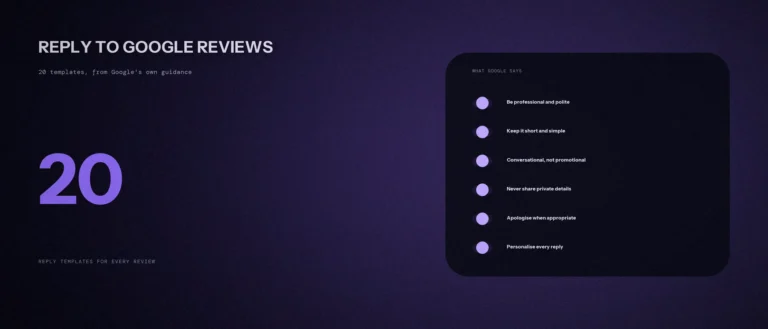
- Google’s own guidance is specific: professional, short, no promotional language, no sharing a reviewer’s private information, and no defensiveness even when the review feels unfair.
- Template responses and public arguments with reviewers are the two mistakes that do real damage, to trust and conversion, even where they don’t directly touch rankings.
- Responding well is mostly a reputation and conversion decision, not a ranking hack, and treating it as one leads to exactly the kind of generic, defensive replies that make a business look worse.
Jump to a section:
- Where owner responses actually rank as a factor
- What actually moves rankings more than a reply does
- Google’s own guidance on how to respond
- The response mistakes that do real damage
- A structure that actually works
- Using AI to draft a response, carefully
- Questions worth answering directly
Where owner responses actually rank as a factor
Responding to reviews is a real, measurable local pack ranking factor, just not a large one. The 2026 Whitespark Local Search Ranking Factors report, an annual survey where 47 local search practitioners score 187 individual ranking factors based on experience and testing, places “presence of owner responses to most reviews” at position 122 out of 187.
Real, present, and worth doing, but nowhere close to the factors that actually move a local pack position, which is why review response is just one line item in our Bangalore local SEO retainers, not the headline service.
That single number is worth sitting with before reading any further. If the goal is chasing rankings specifically, a reply to one negative review is not the lever.
If the goal is running a business that treats customers honestly and happens to also support SEO a little along the way, it is exactly the right thing to be doing.
What actually moves rankings more than a reply does
The same Whitespark report ranks several review-related factors well above owner responses: high numerical rating average sits at position 6, recency of reviews at position 11, and a sustained, steady flow of new reviews over time (rather than bursts) at position 14.
This lines up with what actually matters in practice, covered in more depth in our post on review recency vs review count: the shape of your review pattern over time carries more weight than any individual reply.
This does not mean responses are pointless. It means the response to one bad review will not offset a rating average that has been sliding, or a review profile that went quiet eight months ago.
Fix the pattern first. Respond well as part of that pattern, not as a substitute for it.
Google’s own guidance on how to respond
Google’s own help documentation is specific about tone and content, and most of it is worth following exactly, not paraphrasing into something softer.
Replies should be professional and polite, short and simple, with no promotional language: reviewers are already customers, so a reply is not the place to push a discount or offer.
For negative reviews specifically, Google’s guidance is direct: never share a reviewer’s private information or engage in personal attacks, acknowledge mistakes honestly without taking responsibility for things outside your control, and offer a genuine apology where one is warranted, since it can meaningfully rebuild trust.
For anything complex enough to need real resolution, the guidance is to ask the reviewer to make contact by phone or email rather than trying to resolve it in the public reply. Google also explicitly prohibits offering incentives, discounts or free goods in exchange for reviews or edits to existing ones, calling that fake and misleading content.
The response mistakes that do real damage
Two patterns cause more harm than the negative review itself usually does. The first is defensiveness: explaining, in public, exactly why the customer is wrong, misremembered the situation, or should have known better.
Anyone reading that response later is not evaluating who was technically right. They are evaluating how this business treats someone who was unhappy, and a defensive reply answers that question badly regardless of the facts.
The second is the identical, templated reply left across dozens of reviews with only the name swapped. It reads as exactly what it is: unread, unconsidered, and not actually about the reviewer’s specific experience.
Google’s own guidance is explicit that a reply should reference what the reviewer actually said. A template can be a starting structure, but the specific reference to their situation has to be genuine each time.
A structure that actually works
A response that holds up under both of the concerns above tends to follow a simple shape: acknowledge the reviewer by name and their specific concern, offer a genuine apology if one is warranted, briefly explain what happened only if it adds real clarity rather than sounding like an excuse.
Move anything that needs real back-and-forth into a direct contact channel rather than the public thread. Close it briefly, signed by a real name or initials, not a generic “Management.”
What this deliberately avoids: no defense of the business at the reviewer’s expense, no private details about the customer or their situation shared publicly.
Also avoided: any discount or freebie offered in the reply, both because Google prohibits incentivising reviews this way and because it can read as trying to buy the review away rather than actually addressing it.
Using AI to draft a response, carefully
Drafting a first pass at a difficult response is a reasonable use of AI, as long as the specific details come from you, not the model.
“Act as a local business owner replying to a negative Google review, following Google’s own official guidance.
The situation:
– What the reviewer specifically said: [summarise or paste the review]
– What actually happened, from my side: [describe honestly, including anything that was genuinely our mistake]
– Anything about this that needs real resolution, not just an apology: [describe, or “no, an apology and acknowledgement is enough”]Task:
1. Draft a short, professional reply that acknowledges the reviewer by name and their specific concern.
2. Include a genuine apology only where the situation actually warrants one, not a blanket sorry regardless of fault.
3. If real resolution is needed, end by asking them to contact us directly by phone or email rather than trying to resolve it in the reply.
4. Do not include any promotional language, discount offer, or private details about the reviewer.”
Read the output before posting it. A generic-sounding AI reply is exactly the template problem this whole approach is trying to avoid, so edit it until it actually sounds like a real person who read the review.
Questions worth answering directly
Does responding to a negative review actually improve my rankings?
A little, but it is a minor factor. The 2026 Whitespark Local Search Ranking Factors report ranks owner responses 122nd out of 187 factors, well behind things like rating average and review recency. Respond because it is the right thing to do for your reputation, not primarily to chase rankings.
Should I ever delete or dispute a negative review?
Only if it genuinely violates Google’s review policies, like being fake, from a non-customer, or containing personal attacks. A real, if unfair-feeling, review from an actual customer should generally be responded to, not disputed.
Is it ever okay to offer a discount to make a bad review go away?
No. Google explicitly prohibits offering incentives, discounts or free goods in exchange for reviews or edits to existing ones, and treats it as fake and misleading content.
How quickly should a negative review get a response?
Within a day or two where possible. A prompt response signals to both the reviewer and anyone reading later that feedback is actually being taken seriously.
What does Google say a review reply should look like?
Professional and polite, short and simple, with no promotional language. For negative reviews, never share a reviewer’s private information or make personal attacks, acknowledge mistakes honestly without taking responsibility for things outside your control, and offer a genuine apology where one is warranted.
What matters more for rankings than replying to reviews?
In the 2026 Whitespark survey, rating average ranks 6th, recency of reviews 11th and a steady flow of new reviews 14th, against 122nd for owner responses. A reply to one bad review will not offset a sliding rating average or a review profile that went quiet.
Owner responses are one piece of a bigger review picture, worth reading alongside our post on GBP signals that move the local pack.
Where this actually pays off
A good response to a bad review will not fix a struggling review profile on its own, and treating it as a ranking tactic leads to exactly the generic, defensive replies that damage trust more than the original review did.
Handled honestly, following the same guidance Google itself publishes, it does what it was always meant to do: show a real person is paying attention, which happens to support rankings a little as a side effect, not the other way around.
Not sure whether your current review responses are helping or quietly working against you? Share your Google Business Profile and we will check your review pattern properly, as part of every local SEO engagement we run.